


(Audio version here)
The Overflowings of a Liberal Brain has over 6000 readers! We are creating a space for liberals who care about what is true on the left, right and centre to come together and talk about how to understand and navigate our current cultural moment with effectiveness and principled consistency.
I think it is important that I keep my writing free. It is paying subscribers who allow me to spend my time writing and keep that writing available to everyone. Currently 3.8% of my readers are paying subscribers. My goal for 2026 is to increase that to 7%. This would enable me to write full-time for my own substack! If you can afford to become a paying subscriber and want to help me do that, thank you! Otherwise, please share!
I am not sure why someone’s religion matters as long as someone’s personal beliefs are not imposed on others.
This comment was made to me by one of my readers who has always expressed her commitment to liberalism very strongly. She is a staunch defender of individual liberty. She does, however, tend to disapprove of me criticising other people’s deeply held beliefs. She is not alone on this. At least once a month, I am asked why, if I am such a strong defender of freedom of belief, I cannot just leave other people’s beliefs alone. I think this misses a core feature of liberalism.
Liberalism is, at root, the commitment to letting people believe, speak and live as they see fit provided this does no material harm to anybody else nor denies them the same freedoms. It is a commitment to individual liberty which requires allowing other people to be wrong.
This can lead some people to believe that a commitment to liberalism is a commitment to moral or epistemological relativism - everybody having their own factual truths and ethical principles which must all be respected as equally valid. This is false. One can be a relativist and uphold the central liberal principle of leaving other people alone unless they are harming anyone or imposing their values on them, but relativism is not part of the liberal philosophical tradition.
Liberalism, emerging from the Enlightenment, is rooted in a tradition that values evidence, reason and robust debate. To see this clearly, it helps to separate two core commitments within liberal philosophy:
1) The right to believe, speak and live as one sees fit provided it harms nobody else nor denies them the same freedom.
2) The idea that beliefs matter, that some ideas are better than others and that we can determine which these are through a marketplace of ideas in which bad ideas can be beaten by better ones.
These are not at all incompatible. They are, in fact, mutually reinforcing. This is, arguably, set out most clearly by John Stuart Mill in Chapter Two of On Liberty. Mill first argues that any attempts to control the expression of ideas is an assault on individual liberty:
I deny the right of the people to exercise such coercion, either by themselves or by their government. The power itself is illegitimate. The best government has no more title to it than the worst. It is as noxious, or more noxious, when exerted in accordance with public opinion, than when in opposition to it. If all mankind minus one, were of one opinion, and only one person were of the contrary opinion, mankind would be no more justified in silencing that one person, than he, if he had the power, would be justified in silencing mankind.
He then explains why this matters for truth:
But the peculiar evil of silencing the expression of an opinion is, that it is robbing the human race; posterity as well as the existing generation; those who dissent from the opinion, still more than those who hold it. If the opinion is right, they are deprived of the opportunity of exchanging error for truth: if wrong, they lose, what is almost as great a benefit, the clearer perception and livelier impression of truth, produced by its collision with error.
Liberalism protects the expression of even widely rejected ideas not only as a matter of liberty, but because without this protection, truth and falsity are decided by whichever orthodoxy is dominant at the time. Individuals are denied the opportunity to evaluate ideas for themselves, tested against their strongest opposition.
If an idea is wrong, allowing it to be expressed and challenged publicly is the best way to demonstrate that it is wrong. If it is suppressed, all that is established is that those in power dislike it. This can increase its appeal, particularly when those in power are unpopular or distrusted by large swathes of the population. Driven underground, the ideas are insulated from criticism and grow more extreme in unchallenged communities. This is a breeding ground for bad ideas.
If an idea widely held to be wrong is actually correct, enabling people to argue for it publicly and address criticisms of it publicly is the best way for it to be shown to be correct. Allowing people to be wrong is a precondition for discovering what is true.
For this reason, we should be wary of any authority or movement that seeks to shield its ideas from criticism. Either it lacks confidence that its ideas can withstand scrutiny, or it lacks respect for individuals’ capacity to judge for themselves.
These are foundational principles of the liberal philosophical tradition and moral or epistemological relativism play no part in them. If beliefs did not matter and truth were relative, we would lose a primary liberal reason to defend free speech or open debate. Liberalism works because it combines individual liberty with a commitment to truth-seeking.
The claim that liberalism entails relativism is often made by authoritarians who cannot understand how one might believe some ideas are bad without seeking to ban them. If we cannot persuade them of the intrinsic value of liberty, we may at least persuade them that suppressing ideas is unlikely to eliminate them and likely to strengthen them.
More interesting, however, is the opposite mistake. Some anti-authoritarians, deeply committed to individual liberty, conclude that liberalism requires refraining from criticising others’ beliefs altogether. They believe that liberalism should embrace relativism and that not doing so is intolerant and thus illiberal. They feel that, unless somebody is imposing their views on other people, it is presumptuous, interfering or even authoritarian to tell someone we think their belief is false. This is claimed to be at odds with the ‘live and let live’ ethos of liberalism and is often criticised in a tone of “Can’t we all just get along?”
Where drives this stance? In some cases, it reflects a genuinely relativist position: the belief that objective truth either does not exist or cannot be known. This is a Counter-Enlightenment stance held by a tiny subset of liberals, interestingly most commonly found among libertarians. (Those who want to see what a libertarian postmodernist looks like might be interested in my friendly conversation with Thaddeus Russell).
More commonly, in my observation, disapproval of criticising others’ sincerely held beliefs comes from an epistemologically woolly humanitarian stance underlain by what Moral Foundations Theory identifies as the ‘care/harm’ foundation. This moral driver is more pronounced in progressives and works by considering, first and foremost, what makes people feel included, cared about and protected from hurt. While this can manifest in authoritarian ways, such as the censoriousness of the Critical Social Justice movement, it can also exist in the non-authoritarian way of simply believing that it is unkind or intrusive to criticise other people’s beliefs and kind and considerate to respect them.
Jonathan Rauch offers a useful taxonomy of principles for discerning what is true which is relevant here:
• The Fundamentalist Principle: Those who know the truth should decide who is right.
• The Simple Egalitarian Principle: All sincere persons’ beliefs have equal claims to respect.
• The Radical Egalitarian Principle: Like the simple egalitarian principle, but the beliefs of persons in historically oppressed classes or groups get special consideration.
• The Humanitarian Principle: Any of the above, but with the condition that the first priority be to cause no hurt.
• The Liberal Principle: Checking of each by each through public criticism is the only legitimate way to decide who is right.
The Simple Egalitarian Principle combined with the Humanitarian Principle is, I believe, what best explains most incidences of anti-authoritarians expressing disapproval of liberals (or anyone) criticising the sincerely held beliefs of other people. The Simple Egalitarian Principle constitutes the epistemological base but the moral driver for taking that stance is the Humanitarian Principle to cause no hurt. In Rauch’s view, the humanitarian principle can work in tandem with any of the other principles except the liberal one to establish truth via public criticism. Truth-seeking is inevitably painful. It is also, however, important.
Why is the truth important? Consider the statement which inspired me to write this piece. “I am not sure why someone’s religion matters as long as someone’s personal beliefs are not imposed on others.” I would suggest this relies upon inherently atheistic assumptions. Religions make claims not only about how we should live in this life and treat other people but also about how to achieve eternal salvation and avoid eternal torment. That does seem like a rather important thing not to be wrong about! If you understand that someone might carefully research a pension plan to ensure that their final years are comfortable, you should understand why they’d pay at least as much attention to their eternity. People who don’t think it matters whether the claims of any religion are true or not tend not to believe that any religions are true.
Religious believers frequently think other people’s religious beliefs matter. For example, a Christian might answer my reader’s question with, “Because Christ is the way to salvation.” It would not be reasonable to expect someone who believes there is one path to salvation and cares about their fellow humans to accept that it does not matter if they take it or not. We just require them not to badger them about it and to leave them alone if asked to do so. Likewise some atheists believe not only that the claims of religion are false and that this matters but that many religious beliefs are harmful and that the world would be a better place if people stopped believing they know what the divine creator of it wanted. (I am one of these.)
Both of these sets of people are likely to object to the claim that it should not matter what other people believe provided they do not impose it on anybody else and respond that caring about this is part of caring about other people. They would likely raise the issue of harm that can result from holding false beliefs. This applies much more broadly than religion and has recently most prominently been argued in relation to the concept of gender identity, antisemitic conspiracy theories and science-denialism in the realm of health.
It can be convincingly argued that people believing things that aren’t true is harmful to society which functions better and more ethically when more people’s beliefs correspond with reality. False beliefs frequently result in misguided actions that harm the actor and potentially others too. Unchallenged false beliefs can be taken at face value by others who are then wronged by having been misled. Also, people holding false beliefs in a non-authoritarian, harmless way still contribute to normalising those beliefs and making them more popular, increasing the number of people who will act on them in authoritarian and harmful ways.
Because the central tenet of liberalism is that only the prevention of harm to others justifies coercion, it has been essential to maintain a very high bar for what constitutes harm and keep it to that which is both material and direct. It cannot include the expression of subversive and/or false beliefs even when the vast majority of people would agree that their spread is being/would be detrimental to society and human wellbeing. As discussed above, this not only denies individual liberty but is unlikely to effectively reduce the popularity of the ideas. Also, occasionally, the purveyors of ideas considered subversive are right. The way to effectively demonstrate that this is not the case and defeat the bad ideas is to facilitate a culture which is positive towards robust and vigorous public criticism of all by all.
However, I would suggest that we don’t even need the justification of preventing potential harm or the pragmatic argument that knowing what is true enables effective action to defend criticising the deeply held beliefs of others. It is legitimate to care about truth for its own sake. It is legitimate to care about how we determine what is true, put energies into discovering what is true, remain committed to testing what we believe to be true and to make sound, reasoned and evidenced arguments for what we believe to be true and address criticisms and counterviews. It is legitimate to enjoy this. For many, the pursuit of truth is not merely instrumental but is a value in itself, and often a source of intellectual pleasure. Arguing, testing ideas, refining beliefs are not experienced as aggression, but as highly enjoyable and, yes, respectful engagement.
I have argued before against the belief that it is respectful and considerate to validate everybody else’s beliefs and feelings and refrain from pointing out when you think they are wrong or unwarranted. This, to me, feels very much like humouring people and to be condescending and disrespectful. I would much prefer people to assume me to be someone who cares about what is true and, if I am wrong about something, to be given the opportunity to stop being wrong.

It is, nevertheless, clearly true that many people do not enjoy engaging in arguments about their own beliefs or anybody else’s. They may be less interested in addressing questions of truth, more conflict-averse, or simply occupied with other priorities. Far from experiencing argument as enjoyable, they may experience it as intrusive or hostile. They would prefer to go through their lives not questioning anybody else’s deeply held beliefs or defending their own. This is a perfectly valid preference. It seems likely that both dispositions are part of human variation and consequently that nobody is likely to be convinced that they should enjoy engaging in vigorous debate if, in fact, they do not or that they should not enjoy this if, in fact, they do.
It is probably highly beneficial that we always have some people who want to argue stridently about matters of truth and ethics and more people who wish to do no such thing. If everybody was a dedicated arguer, daily life could become quite exhausting. If nobody was, we’d never advance any ideas or uncover any errors. How do we manage this? The simple solution would seem to be for those who want to discuss and debate ideas to do with each other and leave everybody who does not wish to do this alone. Alternatively, those of us who who wish to make arguments can do so in writing and publish essays which other people can comment on or respond to or simply ignore.
The solution is: Argumentation with consent.
A liberal society protects not only the right to express and challenge ideas, but the right to decline engagement. Written into the concept of “the marketplace of ideas” is that it is not compulsory. You may enter the market. You may leave it. You may stay at home and read a good novel or go for a walk and smell the flowers. Nobody can force you to go to the market and display your wares or buy anybody else’s. Other people, however, must remain free to do so in your absence. As I have argued before,
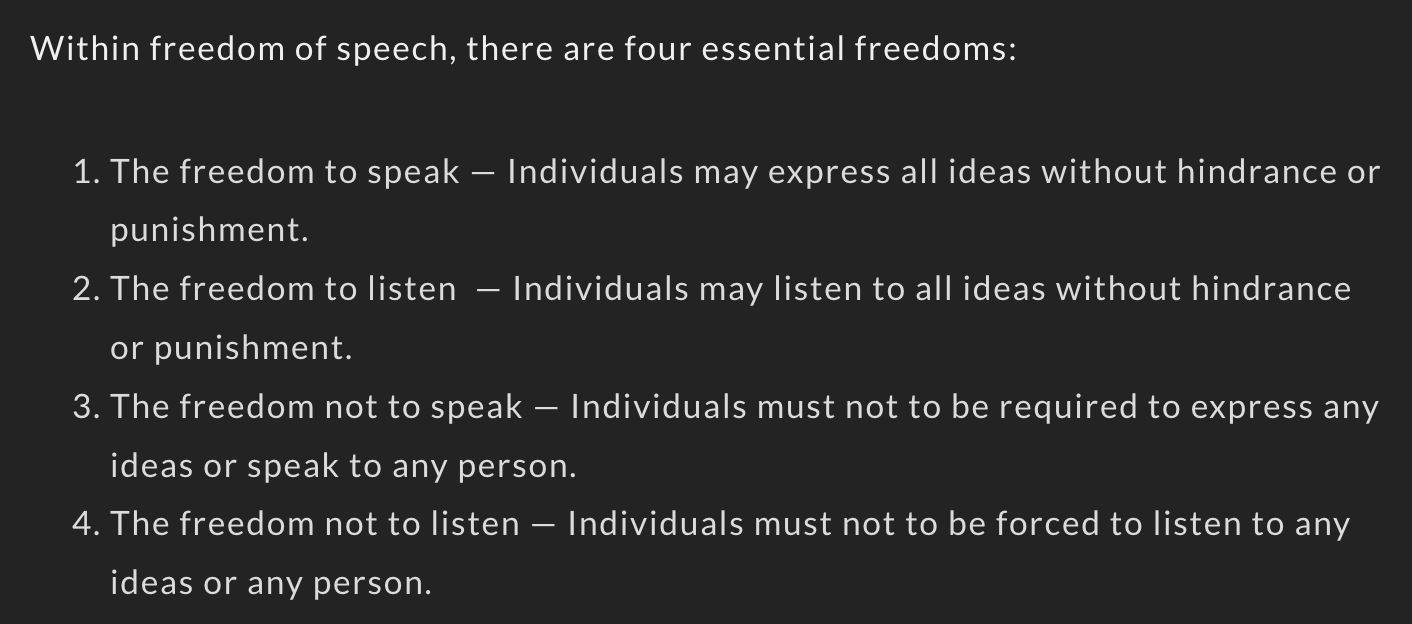
There are some who will not accept other people’s right to decline to argue with them or to disclose their stance on any issue or even consider the possibility that they may not have a stance. They will accuse others of being evasive and hiding their true position which is assumed to be problematic. They may insist that not taking a stance on their particular pet issue is a dereliction of duty or even that ‘Silence is violence.” Silence, however, is not violence and such people are illiberal ideologues who are failing to appreciate the principle of free speech which includes the freedom to remain silent and to ignore the speech of others.

There are also the ‘debate me, bro’ types who erroneously think that if anybody expresses a belief, they then have the responsibility to defend it with evidence and argument. This is not the case. The burden of proof only applies if you are trying to prove something in a debate situation. If you are not, you can just mention that you believe something and leave it there. The fact that you have mentioned being, say, a Christian or an atheist does not commit you to proving that God does or does not exist to anybody else. If anyone asks you to do so, you can say, “But I don’t care whether you believe me or not” and go away.
We must protect the right of people who do not want to argue not to have to do so and also make this a perfectly socially acceptable stance to take and not badger them into doing anything they don’t want to do. All we can ask of anti-authoritarians who do not want to engage in a debate on any issue is that they do not stand in the way of others who do. Provided those of us who do consider truth-seeking important and who do find argument intellectually stimulating are doing this with others who have consented to join in collaborative truth-seeking and productive debate, this is a perfectly liberal activity. In fact, liberalism exists precisely to make this possible.
In a recent article in The Times (23.03.2026) Trevor Phillips quoted a colleague of his who summed up The British Way as: “Live and let live - but don’t take the piss.” Some Liberals might wish to add, “And don’t expect us not to criticise you when we think you are.”
It says something that I planned to start this comment with "excellent as usual" but that's already taken (as is "brilliant as usual").
So, let me say: clear and comprehensive as usual.
I endorse your opening message and would like to encourage anyone seeing this to join me in financially supporting Helen's Substack. Not just to encourage her to keep writing—to encourage the algorithm to promote her work to a wider audience. The world would be a better place if a lot more than 6,000 people read this.