

(Audio version here)
The Overflowings of a Liberal Brain has nearly 6000 readers! We are creating a space for liberals who care about what is true on the left, right and centre to come together and talk about how to understand and navigate our current cultural moment with effectiveness and principled consistency.
I think it is important that I keep my writing free. It is paying subscribers who allow me to spend my time writing and keep that writing available to everyone. Currently 3.4% of my readers are paying subscribers. My goal for 2025 is to increase that to 7%. This will enable me to keep doing this full-time into 2026! If you can afford to become a paying subscriber and want to help me do that, thank you! Otherwise, please share!
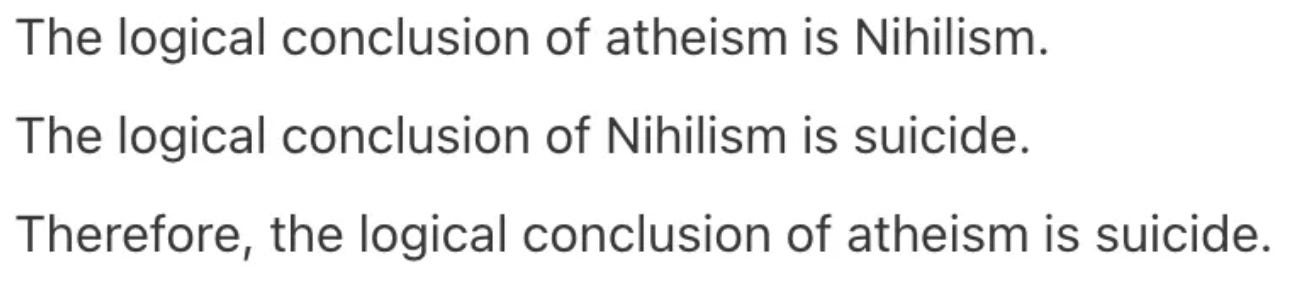
At this time of year, the internet appears to be particularly full of people of religious faith pitying or despising those with no such metaphysical beliefs for our alleged lack of purpose and meaning, and declaring that atheism is inherently nihilistic and even suicidal.
Some atheists always respond to this with a mirroring contempt for those they perceive as seeking to soothe fears of their own mortality with unsubstantiated, self-aggrandising, man-made myths.
People whining about how secularism deprives people of “meaning” are entitled. The universe does not owe you meaning. You are an animal among animals, on a rock orbiting an unremarkable dwarf star in an unremarkable spiral galaxy. One day humanity will go extinct and nothing we will have ever been or done will “mean” anything. Meaning is for the weak. You want transcendence? Here it is—contemplate the universe without you, without civilizations, without humans, without Earth. Nothing else would change. The laws of physics would stay the same, the aeons-long course of the universe’s expansion and ultimate heat death remains the same, no one and nothing notices or cares about your absence. That is transcendent. Your god is a tiny, petty god, a front for your miserable vanity.
The trouble is that even this supposedly hard-edged view accepts the same small and rather depressing assumption: that unless our existence is significant to some higher power, or inscribed on the universe for eternity, it is not significant at all. If nothing larger than humans notes our existence for all eternity, the narrative goes, then our lives must be meaningless, purposeless, futile. The only reasonable response to this reality must be to descend into nihilism and despair or, if we are strong and brave, a kind of grim stoicism to endure and make the best of our brief, small, shallow and meaningless existence.
This is nonsense.
Humans are animals, yes, but is there anything better to be? Your other options are ‘vegetable’ or ‘mineral.’ We’re the kind of animals who have big brains and complex social and emotional needs that seek and create meaning. The source of and fuel for human meaning has always been other humans. Other humans are right here wanting to connect, to love, to be inspired and to offer inspiration in return.
Is there anything more powerfully meaningful and precious than falling in love, growing that love, building a life in that love? Or knowing oneself to be loved and to always be wanted and treasured within a family or chosen family or community? What is more meaningful than that spark of recognition and kinship when you meet and connect with one of those few special people who are weird in the same way you are (or in a totally different way that complements you) and they get you and you get them and you know that this is a bond of friendship forming that will be a delight to explore and bring joy to your life for decades to come? Likewise, what compares to the joy of encountering a mind that inspires you, that nourishes you, provides you with new ideas or ways of thinking about things or gives shape to ideas and intuitions you hold semi-formed and makes them fall into place?
Not only do you have the capacity to experience love and connection in many forms with other humans. You probably also have the capacity to make humans and that is a love and connection that bursts powerfully into existence and creates meaning and purpose like no other. Yes, you are an animal, but you are an animal that thinks and feels and connects deeply and in complex and multifaceted ways. You are a human. Whatever metaphysical beliefs you might have about your own existence, your sources of joy, love, fulfilment, meaning, purpose, intellectual expansion and artistic appreciation are almost certainly found in other humans.
Your meaning and your purpose are centred in your humanity. Other animals could be argued to have meaning and purpose on various metrics, but it does not look like ours. Your specific meaning and purpose might look like professional ambition and success, but this would be meaningless without other people. You could be the fastest runner in the world or the greatest mathematician or you might have designed the most fantastic product ever conceived of, but if you are alone on a desert island, what does this signify? Perhaps your meaning is to be found in the creation of art, but if you never showed it to anyone, would its meaning not seem at least considerably diminished? You might find your meaning and purpose in raising children or caring for your family, but this does inherently involve other people. Maybe your purpose in life is to care for dogs or cats or other animals? This is still, at root, the instinct to love and connect, and if you don’t interact with other humans ever, you will quickly become mentally unwell. For some people, their stated meaning and purpose is the worship of God, of course, but such individuals are typically more family and community orientated than average, not less. Very few people choose to become hermits and when they have, historically, this has typically been presented as the ultimate form of self-denial because it withholds from the individual the thing that people need most - human connection.
Human meaning is deeply orientated towards other humans. Does this strike you as inadequate? Does conceptualising yourself as a member of a species of big-brained ape fleetingly existing on a wet rock circling a big ball of gas within a vast universe feel small and depressing and desolate to you? If so, I wonder why. To me, it feels awe-inspiring. This watery ball upon which I am circling a sun is able to sustain life and my kind of life established itself and persisted despite great obstacles. I am the product of millions of years of evolution. Every one of my ancestors was strong enough, healthy enough, attractive enough and fortunate enough to survive and procreate and had they not done so at the time they did with the organisms they did, I would not exist. The probability of my existence is infinitesimally tiny and yet, here I am.
I am made of the stuff of exploded stars and most of me is water which has been part of oceans and rivers all over the world. All of me has been part of other objects, plants, animals and humans. My complex and marvellous body has been shaped by millions of years of evolution and its functioning has culminated (at this point) in the production of a brain which can comprehend all this about itself. This does not fill me with a sense of futility. It fills me with a sense of awe, wonder, continuity and connectedness.
The simple myths and stories about gods and creation seem small and shallow and uninspiring, in comparison, and very much the product of humans trying to make sense of their existence and find comfort and security during times in which the information we have today was simply not available to them. Perhaps a god exists and this is all part of its plan. If so, that would be very exciting, but currently dominant concepts of God make it something very much like a human, and I see little reason to assume this would be the case.
Why would a divine superbeing manifest as a father, a monarch, a judge? Those are simple human archetypes. Why would it manifest love, sociality, compassion, a sense of justice and a desire to create and build things? Those are the traits of our species of social mammal that evolved to help us thrive and survive. Why would it wish to be worshipped, demand loyalty and experience anger and jealousy and a desire to punish dissent? Those are the products of human defensiveness, insecurity and a drive to maintain control amid constant threats from other humans. This is particularly nonsensical in the case of beliefs in a monotheistic god.
No, this concept of God looks, like everything else we do, like a manifestation of a very narrow conception of what it means to be human. I do not wish to be so constrained. I want to embrace and explore what it means to be human and how to live as a human among humans in ways that maximise the joys and pleasure and wellbeing of humans and minimise the suffering and despair that we can also experience so intensely. I am, in short, a humanist and there is nothing small or nihilistic or suicidal about that.
It must, nevertheless, be conceded that to be human is to die and in the atheistic conception, to cease to exist. To be human is also to know this and to have to try to make peace with it. The anguish inherent here is less to do with one’s own death. If we are correct that ‘self’ is brain and can be assumed to die with the brain, we cannot experience our own deaths in any way. The pain comes overwhelmingly from our capacity to love and connect so deeply and then to experience agonising grief at the loss of another human. It comes again from our humanity and our human connections. I struggle still to accept that my parents are gone and, for most of history, being human has involved having to psychologically survive the deaths of one’s children. It is unsurprising that human myth-making has repeatedly included conceptions of an afterlife in which our departed loved ones are waiting for us.
The preciousness of life, however, is surely related to the fact that it ends? We have limited time in which to love, connect, build lives, learn, explore and experience joy and fulfilment. We do not typically regard things as worthless if they end. Would a good meal, a good book or good sex not start to pall and lose their meaning and pleasure if they went on forever? Their finitude is what produces the incentive to make them good. This surely applies to human lives as well. Our knowledge that our lives are short is a powerful driver of the will to extend them, make them more comfortable, more rewarding, more fulfilling and create a world in which children are not expected to die and which protects each individual’s right to stay alive and pursue happiness and fulfilment. “She’s gone to a better place,” a believer in an afterlife might say to comfort the bereaved but they still typically seek to make this world a better place for their fellow humans and help them to live long, fulfilling lives of peace and joy within it.
This is something we can all focus on during this festive season, whether we are celebrating Christmas, Hanukkah, Yule, or simply enjoying that very human pleasure of gathering with the people we love to eat, drink and be merry. We don’t need to sneer at others for not rooting their meaning in eternity or the divine and accuse them of emptiness, meaninglessness or nihilism. Nor do we need to embrace this in a display of materialist bravado. Instead, we can value our humanity, honour the unique qualities of our shared human nature, and celebrate the extraordinary good fortune we each have to exist at all and do so right now, with one another. Our empathy, compassion, love and capacity for connection with other humans is ultimately what drives us all and gives our lives meaning. It is what makes us human. Human is a good thing to be. It is enough.
Peace and goodwill to all humans!
For me, this is nothing short of profound. Your recent illness did not impair your visionary mind. Thank you, Helen. I am sharing this with the people I love.
Thank you Helen. I want to read and re read. You’ve articulated so much of what I grapple with. Many blessings to you and yours x