


(Audio version here)
Today, I came upon a six-part series by Paul Spooner in which he argues that liberalism and evolutionary forces are in conflict. He says,
Modern liberal and feminist societies generate:
• very low marriage rates
• delayed motherhood
• widespread voluntary childlessness
• fragmented kin networks
• weak boundary maintenance
• identity structures built around autonomy rather than family
• economic incentives that compete with reproduction
• urban living conditions that suppress fertility
These are not moral failings. They are structural features of the system. But evolution does not evaluate intentions, it evaluates outcomes. When these outcomes persist, the demographic trajectory is simple:
Liberal societies shrink. And shrinking societies are replaced.Replacement is a polite term for extinction.
In another installment, Spooner writes,
Moral progress and evolutionary progress are two entirely different things.
They do not track each other. In fact, they often move in opposite directions.
A culture can become kinder and still collapse.
A society can become freer and still disappear.
A civilization can become more humane while dismantling the machinery that allowed it to survive in the first place.
Evolution is not a moral project.It does not reward virtue.
It does not honor fairness.
It does not care if people are happy, equal, fulfilled, or expressive.
To evolution, the only metric is persistence.
And this is where the modern West walks blindfolded toward a cliff.
And,
David Hume gave the world a principle that prevents catastrophic confusion.
“You cannot derive an ought from an is.”
Evolution defines what is selected, not what ought to be selected. Nature tells us what survives, not what should survive.
This distinction is the firewall between science and ideology.
I feel a need to challenge some of this!
Science tells us what ‘is’ certainly but there are very many things that ‘are’ and what we decide to do in relation to them will depend on our principles, values, goals and the kind of society we want to live in. It will depend on our ideology. It is no less ideological, for example, to decide to limit freedom and enforce conservative values in an attempt to boost the birthrate and reduce the need for immigration from more fecund cultures than to decide not to do that and prioritise individual liberty for the humans already living in the society and seek other means of increasing the birthrate or accept that immigration (or robots?) will be necessary.
Spooner himself comes dangerously close to confusing his ‘is’ with his ‘ought’ when he seems to assume that liberals not seriously considering the ‘ought’ of abandoning liberal principles and taking people’s (women’s) reproductive freedom away have simply not appreciated the ‘is’ of a declining birthrate and potential consequences thereof. It is quite possible that they have but that they do not see entirely abandoning the liberal foundations of Western Civilisation as a workable solution to this. They may even see this as giving up on our culture without a fight and be inclined to suggest that those who regard living in a society which denies such freedoms and enforces such values with equanimity might want to go and live in one rather than destroying the culture of Western liberal democracies.
There is much to be said on this subject but, today, I will just address the rather strong, emotive claims made in the post I encountered today:
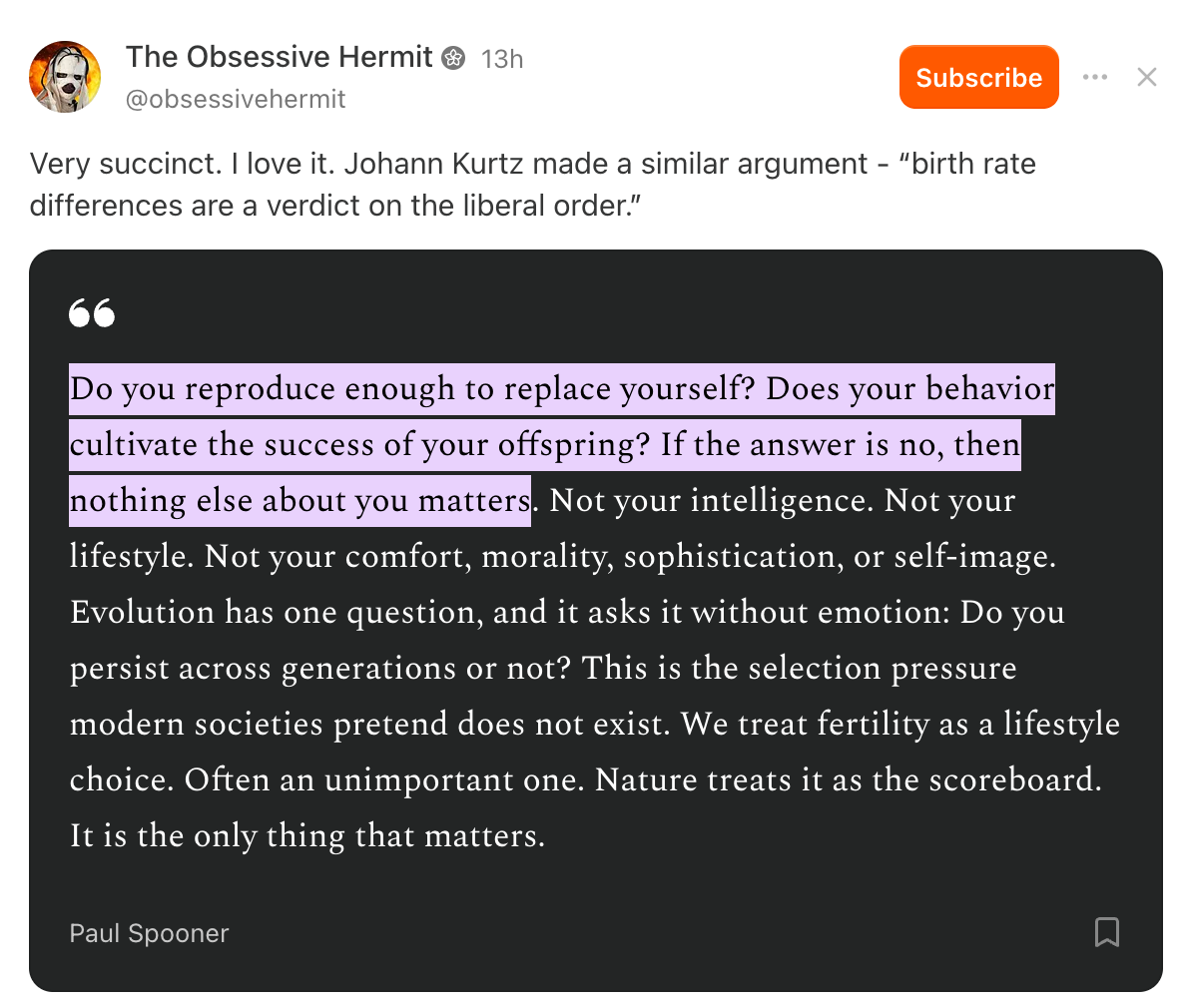
It is true that nothing but reproductive success matters to biological fitness. Evolutionary forces do not care if any individual is happy, good, free, loved, intellectually fulfilled or productive of anything else. An individual who lived 25 years experiencing nothing but misery and suffering and causing nothing but misery and suffering to others but produced 10 children would be a resounding success in evolutionary terms. One who lived 100 happy, joyful years bringing love and joy to others while discovering the cure to multiple fatal diseases, writing great literature and composing great music but had no children would be an utter evolutionary failure.
If we evaluate what really matters by whether it serves the purposes of evolution, we must support endeavours that produce more of the former kind of people and penalise the latter.
This is a good reason not to evaluate what really matters by whether it serves the purposes of evolution.
The fact that we are biological organisms who replicate by sexual reproduction does not mean that we should structure our lives, meaning and purpose around this fact.
The kind of biological organism we are is a big-brained ape who can understand its own nature and much of the world it lives in. It can think abstractly and theorise and is capable of complex and powerful attachments and emotions and moral reasoning. It can discover and invent groundbreaking things and create great art and form complex societies and devise ways to enhance the thriving and minimise the suffering of the apes who live in them.
These are biological facts about us just as much as our nature as a sexually reproducing species is.
One can deny either aspect of human nature, I suppose, but both remain true. We know both that we are sexually-reproducing mammals and that the kind of sexually-reproducing mammal we are is a complex human capable of multiple forms of greatness, discovery, purpose, connection, fulfilment, compassion and love.
We could prioritise our nature as sexually-reproducing biological organisms and make that everything that matters in theory. In practice, we cannot because of the kind of organism we are. We are humans. Much more than this matters to us. All of us. Not just liberals. There has not been a society of humans yet that did not think love, connection, happiness, morality, discovery, art, purpose, reputation and so much more matter. Liberalism is just the system which enables us to think freely about these and value life, liberty and the pursuit of happiness. Denying this aspect of our humanity is to be just as fundamentally wrong about the biological reality of humans as denying that we perpetuate our species via sexual reproduction.
Is it possible that the sheer complexity of our brains and the purposes, meanings and life goals we set for ourselves as individuals makes enough of us deprioritise reproduction that our species goes extinct? Possible? Yes. The birth rate is dropping worldwide and not most dramatically in liberal societies. Likely? No. In theory, though, this could happen because we are not mindlessly driven by the biological imperative in the same way other animals are. We could go extinct. This feels very sad to us because we are not yet extinct and so we still exist and have brains that can theorise about this hypothetical scenario and have feelings about it. If we actually became extinct, nobody would exist to recognise it or feel anything about it so it wouldn’t matter very much.
We could consider the large and complex brains of humans a design flaw on the part of evolution that works against its primary aim of getting us to procreate. To remedy this, evolution would need to favour the genes of the stupid, incurious, uncreative and amoral and those inclined to value safety over freedom and collectivism over individualism. Selecting for these could, over a long enough period of time, devolve our species into some form of ape which lacked our higher cognition, curiosity and capability for complex attachments and was driven much more by a simple drive to survive and procreate. That could also happen. Either way, humans would have ceased to exist.
Spooner’s argument, of course, is not that evolution should solve this problem for us but that Western societies should consider changing their culture to make humans less free to embrace so many aspects of their humanity. In this way, we could prevent liberal societies from being replaced by other cultures and consequently going extinct. The same reasoning applies, however. If, in order to save liberal Western democracies from being taken over by other cultures, we have to change them from being liberal democracies and make them more closely resemble the cultures we are supposedly saving them from, how can we be said to have saved them? Can we prevent ourselves from obliviously “walking off a cliff” by instead hurling ourselves voluntarily over it?
This argument commits an abuse of evolutionary principles in the service of a culturally and socially conservative (ideological) stance. Few people genuinely take the position that we must be driven by the biological imperative and especially not social conservatives who would frown upon the ‘harem’ set up that would maximise male biological fitness and the serial monogamy that would maximise female biological fitness. Those few who genuinely think we do and that to do otherwise is a denial of science and betrayal of our nature are themselves in denial of the complexities of human nature. They are just as wrong-headed as queer theorists who claim that our belief that we are a dimorphic sexually-reproducing species is a social construct that we can overcome by theorising otherwise.
There is no need for any of this if one really just wants to make a case that it would be good if we increased the birth rate to replacement levels. This can be done while remaining firmly rooted in material reality. The pronatalist position does not actually require quasi-mystical submission to “the biological imperative.” Instead, we can think about ways to make parenthood easier, more affordable and more attractive to more people living within our cultural reality. No denial of human nature or concealment of ideological commitments under the guise of ‘science’ is needed.
The Overflowings of a Liberal Brain has over 6000 readers! We are creating a space for liberals who care about what is true on the left, right and centre to come together and talk about how to understand and navigate our current cultural moment with effectiveness and principled consistency.
I think it is important that I keep my writing free. It is paying subscribers who allow me to spend my time writing and keep that writing available to everyone. Currently 3.8% of my readers are paying subscribers. My goal for 2026 is to increase that to 7%. This would enable me to write full-time for my own substack! If you can afford to become a paying subscriber and want to help me do that, thank you! Otherwise, please share!
I am honored that you took the time to read it and I value and appreciate your feedback.
I am loving the respectful dialogue as opposed to some of the responses Helen’s writing receives.