


(Audio version here)
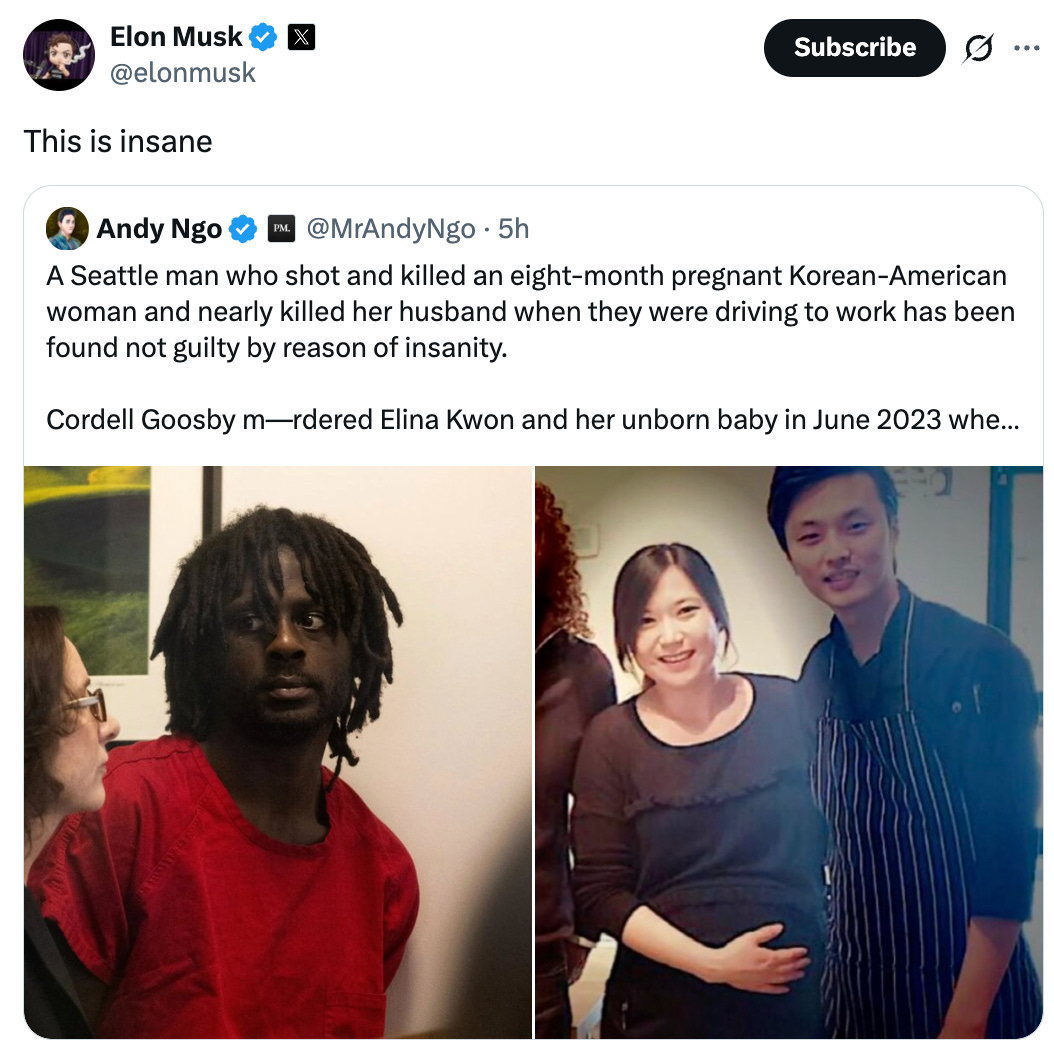
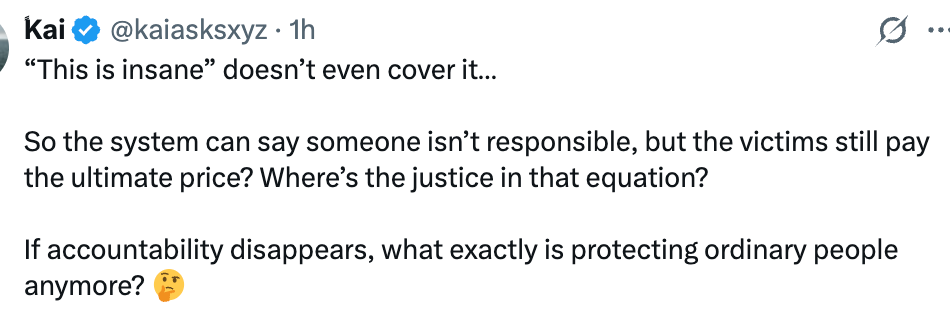
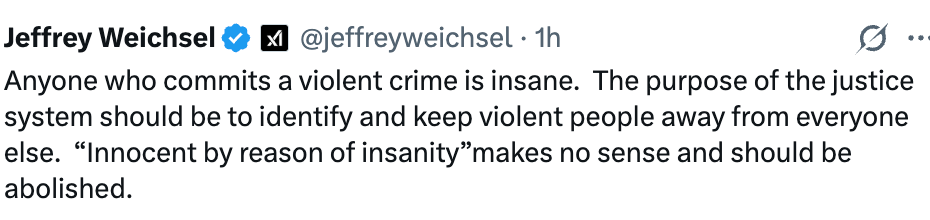
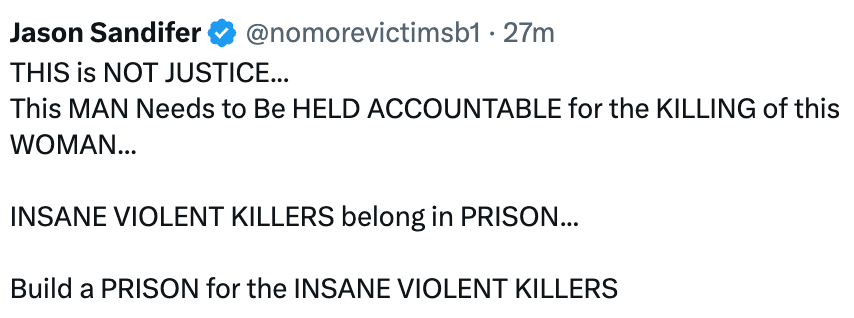
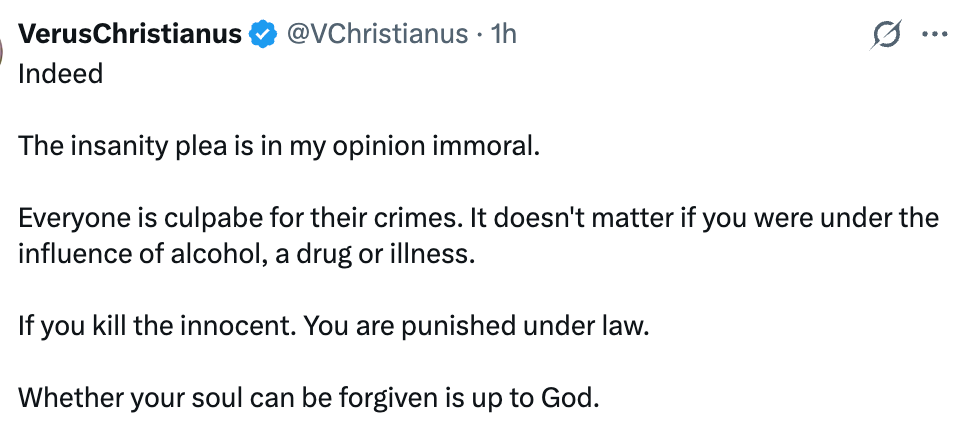
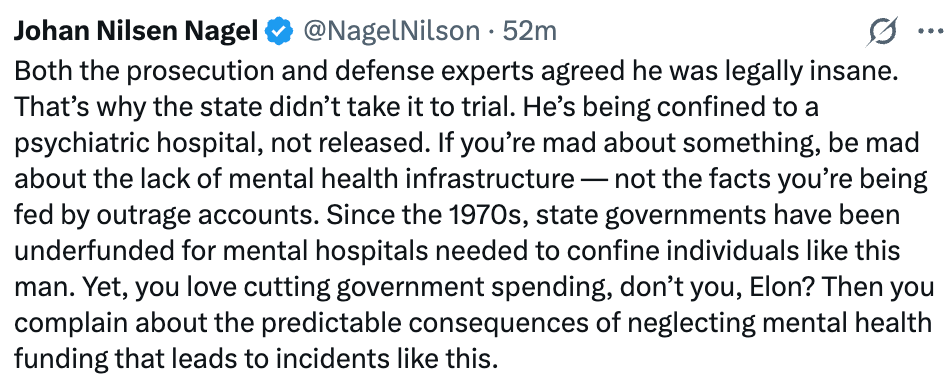
These kinds of outraged responses demanding that the criminally insane be punished for their acts frequently appear when somebody who does something truly awful is found not found not guilty by reason of insanity and confined to a psychiatric institution. People frequently feel that justice has been denied, but this, I would argue, relies on a concept of justice that is not justice at all. Underlying this appears to be intuitive reasoning that goes something like this:
If a crime is really, really heinous, then it cannot justifiably be explained on the grounds that the perpetrator was insane and justice cannot be served by treating them as such.
But how does that follow?
These are two completely separate questions:
What act was committed?
Was the person who committed it mentally capable of understanding what they were doing?
The severity of the act tells us nothing about the mental state of the person committing it. The horror of the crime tells us how bad the act was, not how sane the perpetrator was. It cannot be that the more horrendous an act is, the more mentally competent the perpetrator becomes. There is simply no logical connection between the two.
This seems to come from a very primitive intuition about justice that is based on a sense of balance rather than a consideration of ethics and effectiveness. It is the same kind of intuition, I think, that once made things like child sacrifice make sense to our ancestors. If you sacrificed something extremely valuable, the cosmic scales were tilted in your favour. Your community had already suffered enough. The gods, fate, or the universe now owed you prosperity in return.
But justice in the more developed sense that requires our higher cognitive faculties does not work like this. It requires that we first discover what is true about the situation and then apply moral reasoning and strategic thinking about responsibility, deterrence, and the protection of society. If someone truly did not understand what they were doing, that remains true whether the act was minor or monstrous. The horror of the act does not magically restore the perpetrator’s sanity.
Try a thought experiment. Do you believe that you would be justified in killing someone who was trying to kill you or someone you love? If so, imagine that you experienced a psychotic episode in which your brain fed you information that someone was trying to kill you or someone you loved and this information was utterly indistinguishable from reality.
In that situation, you might commit an act of violence to save your own life, or that of your spouse, child, or parent. An act based on this ethical reasoning would normally be considered morally justified by the vast majority of people. However, because your brain is feeding you false information, you have actually killed an innocent person who intended you no harm. The problem is therefore not with your ethics but with your perception of reality. This is why evaluations for an insanity defence are frequently referred to as determining whether the individual was ‘mad or bad.’
A radical misperception of reality is what is required for an insanity defence. It cannot be that you were having very strong emotions due to a mood or personality disorder and, in a fit of rage, you knowingly killed an innocent person. It must be that you did not know what you were doing. For example, you believed the person was a murderer posing an immediate threat to your life. Alternatively, you did not know that what you were doing would result in death or injury. This has been the case when somebody’s delusion caused them to believe themselves to be saving a family member from a demon which was possessing them.
In such a situation, you would absolutely need to be removed from society until we could be sure that you were no longer in danger of having such a delusion again. We might never be able to be sure of that so this could be a life sentence. But the only way you could be morally responsible for the killing would be if it were morally wrong to kill someone who is trying to kill you. That is what you believed yourself to be doing. And because of what was happening in your brain, you had no way of believing anything else or distinguishing your delusion from reality.
That is the ethical reality of the situation.
Other ethical questions can exist around this. Are evaluations of mental state rigorous enough? Can they be fooled? Are they biased? If people who knowingly committed crimes are escaping punishment through fraudulent insanity defences, that is a different problem entirely. So too is a concern that evaluations for releasing people who have committed violent crimes during a psychotic episode are not stringent enough or that they are not properly monitored on their release, posing a risk to the public.
And there are more complicated cases in which someone who was utterly delusional may still bear some level of responsibility. Was this the first onset of schizophrenia, which often appears suddenly in the early twenties in someone who has no prior reason to doubt their own perception of reality? Or was it somebody who already knew they had a psychotic illness which made them wrongly perceive others as a threat and has medication and caseworkers to report emerging symptoms to? If they deliberately neglect their medication or conceal worsening symptoms and then commit a violent act, they may well bear responsibility in the same way that someone who knows their eyesight has deteriorated badly but chooses to drive anyway would be responsible if they killed a pedestrian.
But those are separate questions.
The idea that “the act committed was so horrendous that the perpetrator cannot possibly be insane” is simply vengeance intuition.
It is emotionally-driven vengeance, not sober ethical reasoning grounded in reality.
The Overflowings of a Liberal Brain has over 6000 readers! We are creating a space for liberals who care about what is true on the left, right and centre to come together and talk about how to understand and navigate our current cultural moment with effectiveness and principled consistency.
I think it is important that I keep my writing free. It is paying subscribers who allow me to spend my time writing and keep that writing available to everyone. Currently 3.8% of my readers are paying subscribers. My goal for 2026 is to increase that to 7%. This would enable me to write full-time for my own substack! If you can afford to become a paying subscriber and want to help me do that, thank you! Otherwise, please share!
How depressing that this kind of argument still has to be made, or rather, that it has to be remade because so many people seem to never have had this explained to them before.
I feel similarly about when juveniles are "tried as an adult" due to the severity of the crime. Separate standards for minors and adults arise from their differing levels of capacity and should be completely unaffected by the nature of the crime.