


(Audio version here)
A strange kind of black-and-white thinking seems to have arisen around conspiracy theories. A surprising number of people appear to think we face a stark choice:
Believe that people never conspire together for harmful, criminal or antisocial ends.
Accept all conspiracy theories as inherently plausible.
This, of course, is a false choice. The same principles for evaluation apply to claims about conspiracies as to claims about anything else. Is there evidence for it? Does it make sense? How probable is it? What would falsify it?
I recently saw Coleman Hughes give an excellent talk on conspiracy theories at the LevelUp 2026 conference. He rooted human susceptibility to them in our evolved psychology. We make sense of things by arranging them into stories, and stories involving agents with motives are easier for us to understand than complex interactions between impersonal processes, mistakes, incompetence and poorly functioning systems. Consequently, when faced with frightening or bewildering problems, we are prone to attributing them to motivated agents who can be identified and fought.
Interestingly, Hughes provided evidence that we are no more inclined to such thinking now than we ever have been. It can feel as though we have become more prone to conspiratorial thinking, but this appearance is likely due to social media which enables proponents of them to be more visible and find each other.
Hughes’ most important observation, from my standpoint, was the way in which conspiratorial thinking prevents liberalism from working as it should. He pointed out that, for a marketplace of ideas to work and systems like due process and knowledge production and democracy to function, we need a working assumption that people we disagree with are wrong rather than evil, duplicitous and intending harm. The first assumption enables productive arguments while the second justifies force, censorship and dismantling of systems of dialogue, justice and democracy.
Following this talk, people queued up to ask questions, and several of them were variations on: “Conspiracies really happen. Consequently, some conspiracy theories are correct, and to dismiss them categorically is to shut down arguments without addressing them.” Some people felt that ‘shutting down’ was the intention of deriding conspiracy theories: a way of delegitimising critiques that challenged the establishment narrative.
This is a reasonable concern. A marketplace of ideas cannot function if we decide that any particular type of claim or critique is automatically invalid. Nevertheless, we cannot solve this problem by treating all such claims as inherently plausible either. Too often, people approach the issue as though faced with a black-and-white choice between gullibility and cynicism. Gullibility means accepting ‘establishment’ narratives uncritically and dismissing allegations of corruption out of hand. Cynicism means finding claims of corruption, deception and powerful hidden agendas inherently plausible. Framed this way, most people would rather be cynical than gullible.
Better than trying to lean towards a pseudo-sophisticated, cynical scepticism of mainstream assumptions that leads to an (ironically, gullible) uncritical acceptance of conspiracy theories, however, is exercising an evidence-based epistemology and sound reasoning. The false choice being offered in these discussions is precisely that - false. It is not that in order not to be a conspiracy theorist you have to deny that conspiracies ever happen. Or if you accept that they do, you have to lend credence to all theories that they have.
In most situations, we accept that some claims of wrongdoing are true and some are false and that this is best determined via evidence. We do not typically think we must commit to either accepting or rejecting all accusations categorically on the grounds that a cynical false positive error (believing wrongdoing has happened when it has not) is better than a gullible false negative error (believing wrongdoing has not happened when it has). We might think of reasonable objections to the ‘believe all women’ stance proposed by some feminists on the grounds that the consequences of not believing victims of rape were far worse than the consequences of a few false accusations being believed. Critics of this stance argued rightly for the importance of applying due process to individual cases.
We know that conspiracies happen. When somebody is convicted of conspiracy to commit a crime, this is because the body of evidence has been deemed to have established beyond reasonable doubt that they did this. Likewise, the reason people can point to large-scale conspiracies such as Watergate, COINTELPRO, MKUltra or tobacco companies covering up the harms caused by their products as examples of conspiracy theories turning out to be true is precisely because evidence established that they were.
This does not mean that everybody who believed such a claim before the decisive evidence emerged was epistemically justified in doing so. Whenever somebody who arrived at a claim through an ideological or tribal narrative later says, “Look! This shows that I was right!”, they are confusing being right with having had good reason to believe they were right. Subsequent evidence can establish the truth of a claim, but it cannot retrospectively make an unreliable method of arriving at that claim reliable.
If their original belief was rooted not in the available evidence but in a tribal narrative, they cannot reasonably claim the later confirmation as evidence that their reasoning was sound. They are also liable to forget all the occasions on which the same method led them to confidently assert claims that turned out to be false. This is the distinction between truth and epistemic competence. Somebody who arrives at the correct answer by an unreliable method has not demonstrated that the method for getting there was sound.

The distinction between truth claims and methods for establishing what is true, and why it matters so much that the latter are reliable, seems counterintuitive to many people. So, let’s try a deliberately extreme thought experiment.
Imagine two warring tribes with different gods and different creation myths.
In Tribe A’s myth, God is the sun. It became lonely, so it created the Earth and put people on it. But it could never get too close without burning them, so the sun flung a rope around the Earth and began swinging it around itself, allowing it to see all the people living there. The purpose of life is to worship and entertain the sun. If humanity fails to do so, the sun will cut the rope and fling the Earth out into the cold and dark.
In Tribe B’s creation myth, the Earth was alone and the people living on it were cold and blind, so they prayed to largely indifferent gods for a lantern to warm them and enable them to see. The gods took pity on them, created one and sent it orbiting around the Earth so that everybody could share its warmth and light. The lantern will eventually go out and the gods have lost interest again, so the purpose of life is to make hay while the sun shines!
Suppose science later establishes, through observations such as stellar parallax together with gravitational theory, that the Earth orbits the sun. This would not confirm Tribe A’s creation myth. Its members could not now take credit for having been right, demand that everybody worship the sun as a god and insist that any other truth claims contained in their myth had thereby been vindicated. One element of their story happened to be correct by accident. Believing creation myths would remain a vastly poorer epistemology than relying provisionally on multiple forms of corroborating scientific evidence.
Consequently, when somebody proposes that a large-scale conspiracy is being perpetrated by the government or by powerful factions within society, the response should be neither, “No, because that doesn’t happen/those people would never do that,” nor, “Yes, because this is the kind of thing that happens/those people are the kind of people who do that.” It should be: “How do you know that?”
We know that human beings are prone to constructing complex, seemingly coherent narratives that make events feel comprehensible and manageable, fit our pre-existing beliefs and map readily onto concepts of in-groups and out-groups. We then reinforce those narratives through confirmation bias and motivated reasoning. Our most successful systems of knowledge production are designed precisely to mitigate these tendencies: by demanding evidence, exposing claims to criticism and treating willingness to discover that one is wrong as an intellectual virtue. This applies far more broadly than to conspiracy theories.
One questioner at the conference asked Coleman whether it would help if we stopped using the term ‘conspiracy theory’. He replied that changing the language used to describe a phenomenon does not generally solve the problem, because people will retain the same positive or negative attitudes towards it whatever we call it. I typically agree with this stance. Cultural problems and conflicts are rarely resolved by renaming them.
Nevertheless, I do think ‘conspiracy theory’ is an inaccurate way to describe the problem, and that this inaccuracy lends itself to much of the confusion (and deliberate obfuscation) surrounding the subject. The core problem is not that people develop theories about conspiracies. It is how they arrive at them, why they find them persuasive, and whether they are willing to revise or abandon them when confronted with disconfirming evidence.
The problem, in other words, is with a particular kind of epistemology. I tend to avoid the term ‘conspiracy theory’ because it so readily invites the response that some theories about conspiracies have been verified by evidence. Instead, I prefer to identify the problem as a conspiratorial mindset: a mode of reasoning in which an individual interprets events through a suspicious, low-evidence ideological narrative rather than evaluating claims proportionately to the available evidence.
Somebody with a conspiratorial mindset typically sorts the relevant actors into morally opposed camps: one demographic, tribe or faction is good, another is bad, and society, or some sphere of society, is structured in ways that enable the bad group to oppress the good one. Current events are then interpreted through this theoretical framework. Evidence that could support the narrative is seized upon, even tenuous connections are invested with great significance, and disconfirming evidence is disregarded or explained away. The theory typically becomes increasingly elaborate as more and more inconvenient evidence has to be accommodated without allowing the central narrative to fail.
Below is a diagram of an antisemitic conspiracy theory in which I feature. I have encountered it a number of times while being accused of complicity in a Jewish-led plot to eradicate the white race, undermine Christianity and trans everybody’s children. In this case, the ‘good’ people are white conservative Christians and the ‘bad’ people are Jews. The underlying claim is that Jews control much of intellectual life and the media and use this power to harm the good people. There is seemingly nothing that can disconfirm this hypothesis.
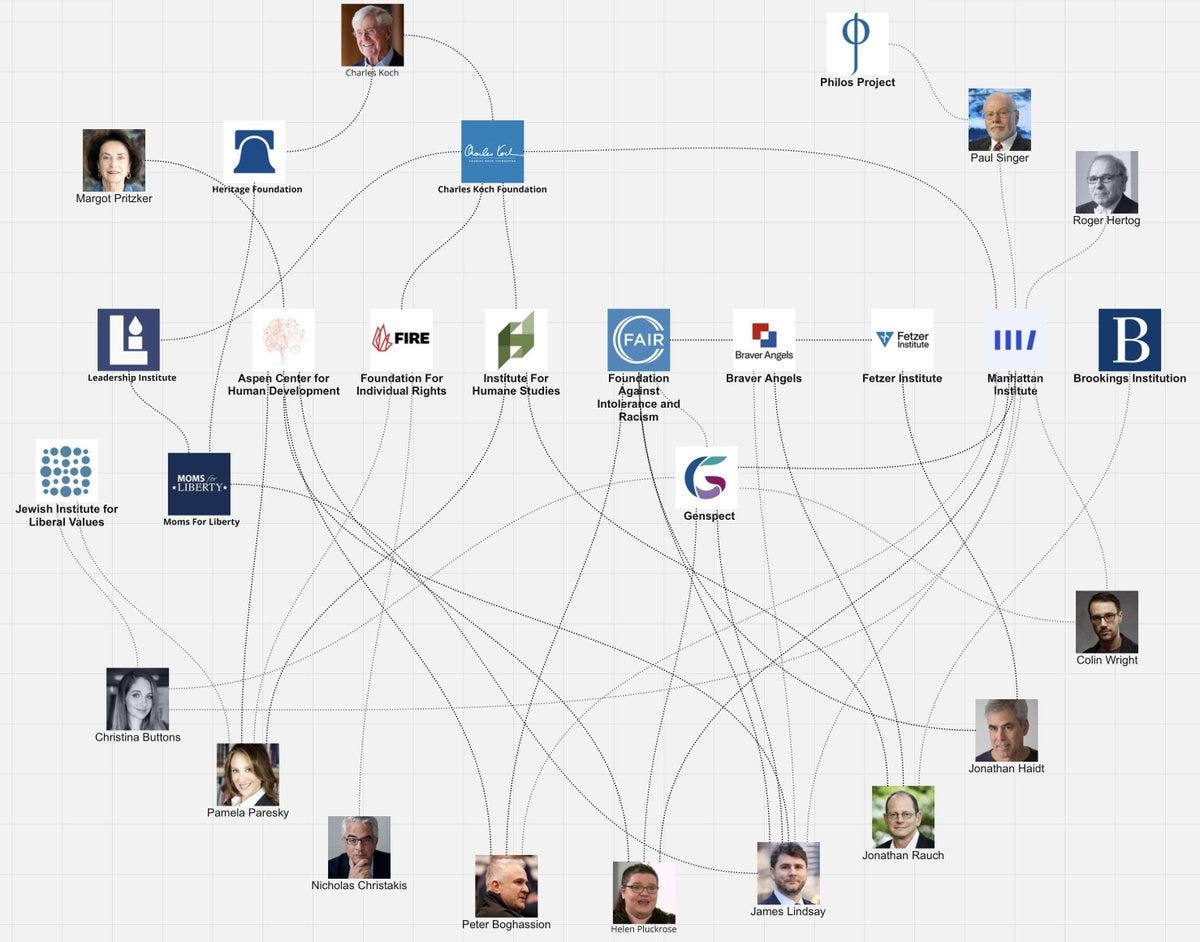
The current conspiracy theory dominating online attention is the one around Lindsay Clancy’s trial for the murder of her three children. She has admitted that she killed them but her defence team is seeking to have her acquitted on the grounds of insanity - specifically, postnatal psychosis. Nevertheless, there is so large an online movement blaming her husband, Patrick, for the killings, that his attorneys have issued a statement, putting accusers with both large and small followings on notice that they are defaming him and causing great psychological harm. The implication is that they are liable to be sued. While most feminists sympathetic to Ms. Clancy have argued that a poor standard of postnatal care and/or reckless overprescribing of psychiatric medication was responsible for her becoming so mentally unwell she committed this terrible act, a subset of her defenders will not be satisfied unless she, a member of the good people (women) is entirely innocent and an agent of the bad people (men) supported by systems of power (patriarchy) is guilty.
In this conspiracy theory, Patrick must therefore have killed his children and thrown his wife out of a window and then convinced her, in her mentally vulnerable state, that she did it. He has been enabled to get away with this, according to the theorists, due to either knowing complicity in a cover-up by multiple parties or patriarchal assumptions that regard men as inherently credible and trustworthy while systematically doubting women and being quick to assume them blameworthy. Michael Wagner, a leading scholar in communication who focuses on how the online environment affects people’s beliefs, described the process by which this kind of thinking develops to CNN
Those conspiracy theories, Wagner said, are often ways of looking at the world that provide answers to questions when an outcome is too uncomfortable for people.
“So, if they’re following the trial and have learned a lot of detail about the trial, but don’t trust the legal system, and don’t trust police, and don’t trust the news media, they may be more likely to adopt conspiracy theories as a way to explain why the outcome they think should happen isn’t happening,” Wagner elaborated, calling the phenomenon a “toxic soup for the development of conspiratorial thinking.”
It is, of course, possible that a conspiracy has taken place and Patrick Clancy actually killed his children. But for this to be true, the conspiracy has to be extremely elaborate. He would have had to somehow fake or manipulate the CCTV footage in both the pharmacy and restaurant, requiring the cooperation of people at two separate businesses. The police officers who examined it would have had to either miss this or been complicit in concealing it. Mr. Clancy would also have had to either convince his wife into lying for him or delude her into believing that she herself killed the children, having already, presumably, planted incriminating searches on her own devices. He would then have had to put on a performance of shock and horror at discovering his children’s bodies that convinced experienced emergency services personnel (unless they were also in on it). This is all incredibly complicated, elaborate and implausible.
It is, however, possible. There would need to be convincing evidence of this, but what has been offered takes the forms of ambiguous forensic details, the absence of Lindsay’s fingerprints on the exercise bands and presence of Patrick’s which can be explained by him removing them and technical problems in retrieving blurred prints, along with Lindsay’s low heart rate and body temperature which do not really indicate anything specific about Patrick and Patrick’s shoes appearing differently in different light and at different angles. Elaborate stories have been constructed around all of these
It is possible to imagine ways in which evidence could emerge that proved an elaborate plot facilitated or enabled by external parties which explained these details. It would make a good psychological thriller. However, none has, and in the absence of it, people dismissing the allegation as a conspiratorial speculation right now would have no reason to be embarrassed if evidence of a plot were later discovered. They are making the right judgement based on what can be known at this time and the reasoning of those making the claim. They should change their minds if the evidence later warranted it and in doing so, they would not become ‘conspiracy theorists’ in the sense that this is meant, because they would not have developed a conspiratorial mindset. They would have accepted that a conspiracy occurred because there was evidence that one had.
Ultimately, we do not have to choose between regarding any theories of a conspiracy having occurred as ideological nonsense or accepting all of them as inherently credible. We can instead choose between having a cynical and politically biased conspiratorial mindset or one which attempts to mitigate the tendency to confirmation bias and motivated reasoning, exercises epistemic humility and critical thinking and regards evidence as essential to determining what is true.
I would argue that we should choose the latter and encourage others to do so too. One particularly good study into “epistemic beliefs’ role in promoting misperceptions and conspiracist ideation” is by Garrett and Weeks, communication scholars. They find (perhaps rather unsurprisingly) that individuals’ beliefs about the nature of knowledge and how one establishes it have important implications for how accurate their perceptions are, with reliance on intuition over evidence and a belief that truth is political being predictive of misperception. They write,
Individuals who view reality as a political construct are significantly more likely to embrace falsehoods, whereas those who believe that their conclusions must hew to available evidence tend to hold more accurate beliefs. Confidence in the ability to intuitively recognize truth is a uniquely important predictor of conspiracist ideation.
Garret and Weeks recommend promoting epistemic beliefs that stress the importance of evidence and the need to be cautious about trusting to feelings.
This certainly seems like a good idea! The issue is how to do so most persuasively. There has not been any notable absence of people informing their political opponents that they are indulging in conspiracy theories and should consider caring about evidence instead. This tends to result in defensiveness and, to a particularly conspiratorial mindset, even accusations that the critic is complicit in the conspiracy in some way. Attempts to address mis/disinformation using legal or institutional power are likely to be received particularly badly. This can be seen as more evidence of oppressive, powerful forces censoring the truth, entrench people further into a conspiratorial mindset and force them to gather outside of mainstream spaces where their claims are much less likely to be challenged at all.
When addressing this point in his talk, Coleman Hughes said, “Institutions are downstream of culture and culture is downstream of the stories we tell.” Yes! Rather than trying to force top-down control of information, we would do better to work on reforming our epistemic environments from the bottom up. By far the best way to address the problem of conspiratorial thinking, preference for intuition over evidence and beliefs that truth is fundamentally political is to do so among our own tribes: the people with whom we share goals and values and by whom we wish to be respected. This is where we have the most influence on the stories that get told, the culture that develops from them and ultimately the institutions we rely upon to produce knowledge and use it ethically and effectively.
I would argue that we should all think of culture on a local level and consider ourselves to have some ability to influence it. Because we do. We choose whose thinking we respect and, consequently, whom we read and listen to and which voices we amplify. We choose which circles we move in and how we engage within them. We can all exert some influence over the stories our tribes tell and the cultures our groups develop.
What would improve in your political circles if their members held in highest esteem those who were rigorous, careful, charitable and consistently principled in their thinking; those who cared about what was true and were willing to change their minds when this was warranted? How would things change if members routinely asked one another, “How do you know that is true?” and people spoke in anticipation of being asked this question, knowing that an unsatisfactory answer would reduce their credibility and status among their peers?
We may not have increased our tendency towards conspiratorial thinking as a species, but the supersession of gatekept legacy media by social media, podcasts, YouTube and individual writing platforms certainly creates the potential for perverse incentives in attracting audiences. It has become commonplace to bemoan the influence of audience capture in degrading political and cultural commentary but, too often, people seem to forget that they are that audience. The rapid expansion of available media gives consumers power too.
What if we all tried to boost the most evidence-based and consistently principled voices and criticised conspiratorial thinking, bullshit and illiberalism within our own tribes? If audiences can incentivise commentators to become more sensationalist, tribal and conspiratorial, can they not also discourage those tendencies? If peer pressure and the drive to be accepted within our own social circles can push people towards reckless and unethical behaviour, could they not also incentivise thoughtful and principled conduct?
I think those of us who are concerned about what feels like a growing culture of epistemic chaos should try to avoid simply feeling powerless and besieged by it as an external force. Instead, we should recognise that we are participants in and creators of culture and do whatever is within our reach to change it.
The Overflowings of a Liberal Brain has over 7000 subscribers! We are creating a space for liberals who care about what is true on the left, right and centre to come together and talk about how to understand and navigate our current cultural moment with effectiveness and principled consistency.
I think it is important that I keep my writing free. It is paying subscribers who allow me to spend my time writing and keep that writing available to everyone. Currently 3.8% of my readers are paying subscribers. My goal for 2026 is to increase that to 7%. This would enable me to write full-time for my own substack! If you can afford to become a paying subscriber and want to help me do that, thank you! Otherwise, please share!
This domain is a personal obsession of mine, and I have found Keith Stanovich's work extremely useful in unpacking the different kinds of cognitive errors driving what he calls dysrationality, which includes improper weighing of evidence. He distinguishes cognitive "miserliness" (a tendency to rely on familiar heuristics, intuition, etc. and generally avoid serious cognition), from "contaminated mindware" (e.g. ideologies and biases that skew or subvert cognition), from "mindware gaps" (e.g. lack of competencies required to evaluate the question at hand). These are not mutually exclusive of course, and a given person might 'present' errors in one domain but not others. That is Stanovich's main focus - understanding why a generally smart/clever/rational person can nonetheless hold a particular false belief (e.g. conspiracy theory) or take some exceptionally irrational action.
Great article. Couple of thoughts on this: "Individuals who view reality as a political construct are significantly more likely to embrace falsehoods, whereas those who believe that their conclusions must hew to available evidence tend to hold more accurate beliefs."
I think that there is a genuine ambiguity about causation in political discussions, and we generally need to use "causal models" as an intermediary between evidence and belief. The causal models used though - within indirect relationships between observations and outcomes in the presence of many other seen and unseen dynamics - are often the contested bit, and nearly always impossible to "prove". (Many authors have addressed complexity and the limits of understanding and prediction, such as Paul Oremord, in his book "Why Most Things Fail")
If I hold to a conspiracy theory that "our government are trying to kill the old people", then how strong a case is there if the government, say, remove winter fuel payments, tax pensions, reduce healthcare and social care, and introduce a euthanasia bill: I could point to studies to say that in 70%-90% of the times that these policies were implemented, they led to higher death rates amongst the old at a disproportionate rate compared to the rest of the population.
The government could claim, in response, it is trying to reduce public costs, stimulate enterprise and increase tax revenues, which will make everyone live longer - and label their critics as conspiracy theorists. They point to studies that GDP/capital (say) correlated with age, and they are trying to lift GDP/capita.
I am pretty sure that my wife and dog engage in illicit biscuit eating sessions. They leave the kitchen and the number of biscuits are less than when they entered. However, in more complex situations than this, then "evidence" is not so much an object (weapon/photo/document/event), but of a more ethereal causality i.e. the forces between objects, usually in the presence of other concurrent forces. It can make it tricky NOT to be a conspiracy theorist. We sometimes have to proceed with the "best imperfect evidence", hold our views lightly, and wait until we are proven wrong. Otherwise, we can come to believe nothing at all when things get complicated.
This is actually the way that the best forecasters* on the planet proceed. They still get it wrong. They piece together disparate evidence, assign probabilities, and update judgements.
(* To be a strong forecaster, you need to understand why things happen i.e. minimise bias in interpreting events and relationships).