


(Audio version here)
In a recent excellent essay, Joseph Heath argues that, in order to defend the liberalism that underlies our modern democracies, we need to ensure that people generally, but especially emerging adults, understand why it was historically necessary. In this, he was influenced by his father, a medievalist. I endorse this proposition wholeheartedly! My own academic background in late medieval history in England strongly informs my own arguments for the importance of liberalism. History reveals very clearly that real authoritarianism has not only been tried, but has been the norm and, in fact, appears to be the natural state of being for our species. The premodern history of civilisational rule can, in one sense, be understood as one faction of humans gaining sufficient power and influence to impose their own concept (often self-serving) of the Common Good on everybody until another becomes powerful enough to knock it aside, usually bloodily.
Heath sees three impediments to the defence of liberalism. The first is the idealists, on both left and right, who, failing either to have appreciated this aspect of history or believing that theirs is the one Common Good that can stick and bring peace and harmony, wish to impose it on everybody. The second is ‘the normies’ who defend liberalism because they believe it is self-evidently a fully sufficient and optimal system and don’t understand why anybody would want anything else. They consequently fail to make a persuasive case for it. The third is young people who, having just started to think about the ordering of society and experiencing the confidence of youth and associated scorn of existing ideas on the subject, are primed for disrespecting liberal societies.
Heath addressed the most common criticism of liberalism, which is that it fails to provide a “Common Good” in the sense in which that term is generally used to refer to a single cohesive belief system. (It can, of course, be argued that it is in the interests of everyone to uphold liberal freedoms). I responded in an irritable way to this.
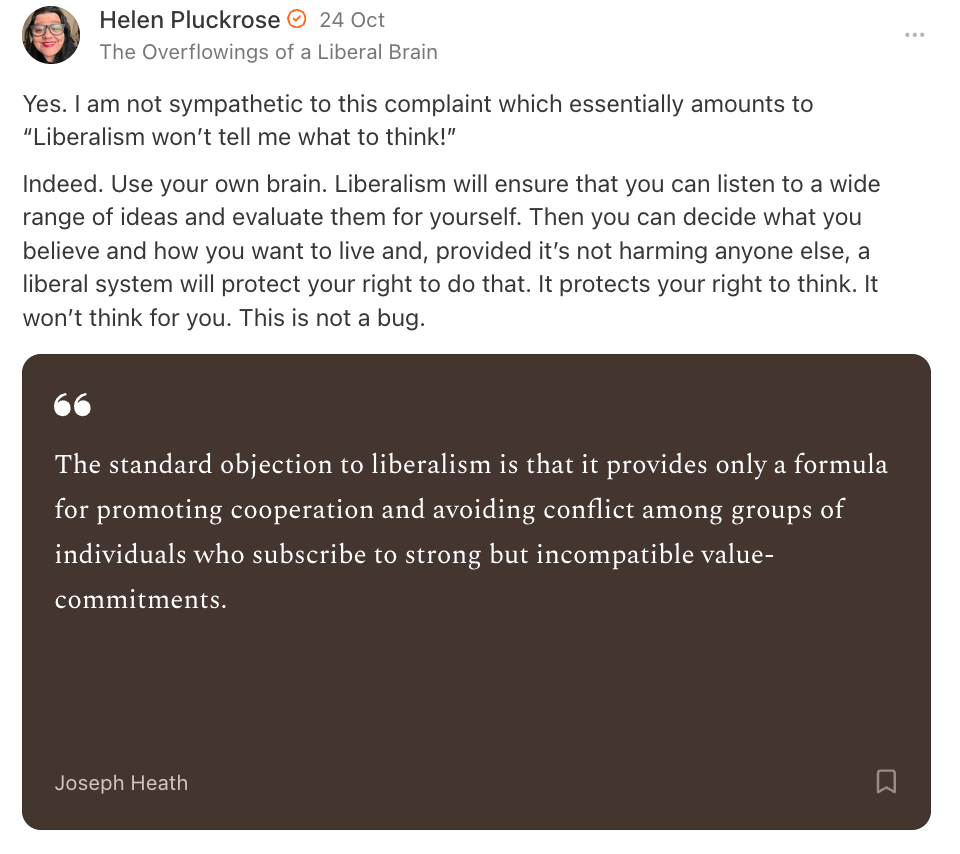
However, Heath is right to say that defenders of liberalism need to do a better job than simply dismissing the moral intuitions of the “Common Good”idealists, whatever their concept of the common good is - woke, religious, reactionary, Marxist etc. We do need to convince them that their interests too are best served by protecting liberalism.
Where I disagree with Heath is on his assumption that liberalism can generally only be valued pragmatically as a ‘second-best arrangement’ or a compromise rather than as a set of principles and values that can be held as a primary goal for their own sake. For Heath, it seems, individual liberty is not something that typically form the basis of deepest ideals and is underlain by moral intuitions. We must find meaning and purpose elsewhere but defend liberalism as a practical framework for managing disagreement using reasoned arguments and the evidence of history.
[T]he two sets of governing principles in our society – liberalism for the state and capitalism for the economy – are second-best arrangements. In other words, they do not coincide with most people’s sense of what an ideal world would look like. (Just to be clear, they are not second-best in the real-world sense. In the real world, they are the best that we can hope to attain, at least for the foreseeable future. The problem is that they are second-best with respect to most people’s personal values and moral ideals.
“Most people” is doing a lot of work here. Is it really uncommon to hold individual liberty in the realm of both one’s personal life and free enterprise as a central concept for an ideal world? This would seem to be contradicted by Heath’s own identification of those who believe this does satisfy our highest aspirations as ‘the normies.’
The second major group that must be defended against are those who can be thought of, for want of a better term, as the normies. These are the people who simply like the Bill of Rights and Best Buy, and don’t really understand what could motivate anyone to want more. From their perspective, liberalism and/or capitalism are the ideal arrangements – they directly satisfy our highest aspirations. There’s no need to invoke the crooked timber of humanity in defence of these systems, one can just point to the values that they realize. The problem with this group is that, even though they are nominally on the correct side of the argument, the way they set things up creates easy pickings for the idealists. Indeed, it encourages the idealists, by reinforcing their view that those who oppose them must suffer from either stunted imagination or moral depravity. With friends like this, who needs enemies?
This would seem to acknowledge that one can hold liberal principles as an ideal and also that this is quite normal. I would certainly hope this to be the case and generally argue on the assumption that it is. Does having liberalism as one’s North Star really support accusations of a stunted imagination or moral depravity?
When I responded to the original quote accurately stating common critiques of liberalism, what I was feeling was moral indignation! I feel this way whenever somebody complains that liberalism cannot provide them with meaning, purpose, a shared narrative or an ethical framework. I experience such criticisms as demeaning of human dignity, intelligence and autonomy. Liberalism is not simply a system for managing conflict and, in economic form, inspiring innovation and creation. It speaks to the moral worth of individuals, the human capacity for self-determination, the essential value of being able to think freely and the virtue of respecting our fellow humans’ right to do the same. I think it would be true to say I am a liberal idealist.
Is this so very uncommon? I don’t think so. My belief that the human drive for autonomy and self-determination is largely innate and deeply entwined with moral intuitions draws on my study of history and of contemporary political movements. In my academic writing, I took issue with the Burckhardtian claim that individual autonomy and self-determination were a socially constructed product of the modern period. In defence of my argument, I looked at the medieval system of confessionalism and its central and explicit aim to squash this very drive and conform individuals to orthodox Catholic beliefs in every area of their lives. Would it really have been necessary to compel every individual to attend confession and check the compliance of their thinking if such a drive were not fairly ubiquitous among medieval humans? Or to have produced so many sermons stressing the evils of independent thought and self-will? I think not.
We certainly saw a dramatic rise in arguing for this explicitly during the modern period, however, and this wa framed as an ideal and a moral imperative. The American War of Independence is the clearest example of a mass uprising for autonomy, self-determination and free trade. Were people willing to fight and die because they had made a rational and evidence-based decision that this was the best system of government even though it did not really appeal to their personal values and moral ideals? It seems unlikely and is not indicated in the writing at the time. Likewise, are those currently fighting the Iranian Islamic Regime inspired by a pragmatic evaluation of optimal systems of governance for conflict resolution and economic growth even though it does not fire their ideals and call upon their moral intuitions? Perhaps some of them are but what are the women who stand on raised platforms, holding their hijabs aloft symbolising? I believe it is the drive for individual autonomy and self-determination.
An interesting study by Dobbin and Kalev into why diversity programmes fail produced considerable evidence of a consistent human opposition to being told what to think, and concluded that any successful attempt at workplace training must work with the human drive for autonomy and self-determination rather than against it. It seems that when we are told we must think a certain way or believe a certain thing, our intuitive response is to find reasons not to think that way and disbelieve what we are told. But if we are invited to consider ideas and decide for ourselves whether they have worth, we are more likely to find that they do.
Is this really the same thing, though? Are human ‘individual liberty’ moral intuitions so conflatable with liberal democratic systems of governance and capitalism? Moral drives and social systems are, of course, different things, but when people are inspired to fight for a certain system, it is those moral intuitions and ideals which drive them to do so. I would argue that the drives which inspire people to defend liberalism and free trade are those of individual autonomy and self-determination. I cannot concede them to be ignoble or lacking in imagination. On the contrary, I think the simplistic aims of those Heath calls ‘the idealists’ whether this is Wokeness, Marxism, Christian Nationalism or reactionary social conservatism can be more plausibly argued to be limited and unimaginative, seeking to find comfort in a narrow and closed view of the world.
Yet, Heath correctly points out that, for very many people, liberalism is not a primary ideal. It does not speak to a lack they feel in meaning, purpose and community. When surveyed, people reveal low levels of liberal and democratic values. He writes,
In the domain of politics, the ideal is normally some form of communitarianism. People want to live in culturally rich communities with shared values and a dense network of high-trust social relations. In the economic realm, the ideal that corresponds to our everyday moral intuitions is socialism. Since the division of labour that characterizes our economic life is, fundamentally, a system of cooperation, it seems only natural that it should be governed by norms that directly enjoin cooperative behaviour.
What explains this? I think there are two factors at play.
Firstly, I think we must consider that the drive for individual autonomy and self-determination and the drive for community and shared values are human constants. They can conflict but also complement. This can look like the desire to compete but also to cooperate or the drive to individuate but also to commune or to think independently but also find comfort in shared values and common narratives. It can also look like the drive for freedom vs the drive for safety which underlie so many discussions and debates about policy and ethics and which do both merit consideration. Consequently, it is not clear that one is inferior to the other or should be subordinated to it. Heath rightly points out that liberal democratic systems and capitalism are the systems that work to make this productive, reconcile conflicts, advance knowledge and inspire growth and innovation. Even when it feels counterintuitive, liberalism really is the system that works best with the messiness of human nature.
Secondly, while the drive for individual autonomy and the drive for communitarianism are in all of us in different quantities, one or the other can come to the forefront depending on the situation. Some people do indeed seem to be strongly individualist and others equally strongly communitarian, but most people probably are not. Consequently, they can find the stance of liberal individualists or the position of communitarians more convincing at different times. There is good reason to believe that feelings of insecurity can influence people towards what feels like the safety of communitarian stances with shared narratives while greater stability provides breathing space to think more expansively about individual rights and freedoms.
However, existing in tension with that, is the fact that we can also become complacent about what we already have and yearn for what is absent, threatened or denied. In his book, On Identity, Amin Maalouf argues that aspects of identity become most important to us when they are threatened. For example, a gay man could regard his sexuality as primary when he is being persecuted on those grounds, but if that threat recedes and a threat to his nation arises, his sexual identity may become less important and his national identity come to the forefront. I think a similar phenomenon can apply to the drives for individual liberty and for community.
Liberal impulses can be triggered strongly in a society when freedom is being subjected to collectivist demands for conformity. Some of the strongest defences of liberalism for its own sake have come from those who have escaped communist states. Similarly, many of the most fundamental liberal principles are to be heard from people living under Islamic regimes. Likewise, a desire for a communitarian concept of a “Common Good” can emerge within societies where people feel that liberal individualism has resulted in a pluralism and atomisation that makes them feel untethered. This is, perhaps most strongly expressed by the postliberal populists (as also noted by Heath). If this is correct, it may not be that most people living in liberal democracies do not naturally find liberal principles to satisfy their deepest ideals and moral intuitions, but that they take them somewhat for granted, in a way that their ancestors of a century ago, living through communism and fascism could not.
Most satisfyingly, Heath’s educational solution addresses both of these problems! If we can ensure that nobody reaches adulthood without an understanding of what differentiates the modern period from the medieval one and the nature of the threat to liberal and democratic values that dominated the first half of the 20th century, this can best instill in emerging adults an intuitive sense of why defending liberalism is so important and also make them feel a connection to that history.
We would also need to present this in a way that can inspire a certain amount of idealism, however! What Heath describes as a ‘normie’ liberal attitude is probably what I have been describing as ‘liberally-minded’ to indicate those who take liberal principles as a given without having thought through an articulated defence of them. It will indeed be unpersuasive to those who feel dissatisfied with liberalism to encounter a complacent and dismissive attitude of “What are you talking about? This is great. What more do you want?” Instead, liberals need to inspire the unconvinced and particularly the young to recognise what an astounding development liberal modernity really was in human history and feel themselves to be the heirs to it!
We might also need to accept that some people genuinely do have very low drives for individual autonomy and self-determination and a much stronger need for a feeling of safety embedded in a community with a shared narrative and shared sense of the Common Good. We likely cannot convince people who do not feel strong ideals or moral intuitions towards individual liberty (and free trade that they should develop those feelings. We can and should speak to their expressed concerns, rather than dismissing them out of hand as ill-motivated authoritarians, however. We can try to persuade the progressive idealists that liberalism has been the mechanism which has produced so much progress for the most vulnerable people and the conservative idealists that conserving western civilisation requires conserving liberalism.
This is where I agree with Heath wholeheartedly. We do need to make pragmatic arguments that speak to historical reality. If we cannot persuade people to value liberalism for its own sake, then we can make strong arguments to convince them to recognise the importance of liberalism as a second-best arrangement that will, in the long term, protect them and the values that matter to them. It protects their right to hold their own beliefs and live according to them within a voluntary community of like-minded people. This does require them to uphold other people’s right to do the same.
The Overflowings of a Liberal Brain has over 7000 subscribers! We are creating a space for liberals who care about what is true on the left, right and centre to come together and talk about how to understand and navigate our current cultural moment with effectiveness and principled consistency.
I think it is important that I keep my writing free. It is paying subscribers who allow me to spend my time writing and keep that writing available to everyone. Currently 3.8% of my readers are paying subscribers. My goal for 2026 is to increase that to 7%. This would enable me to write full-time for my own substack! If you can afford to become a paying subscriber and want to help me do that, thank you! Otherwise, please share!
Classical liberalism where it exists has always existed alongside community: neighborhoods, voluntary associations, and civil society - the sort of groups Tocqueville lauded. They are compatible with liberalism in the sense they are often chosen freely, and themselves honored liberal principles.
Loved this. Yes, I value liberalism so much precisely because I’ve experienced its opposite, and everyone I know who has escaped an authoritarian regime or culture similarly finds it miraculous and precious.
But when I speak to friends who grew up always having taken living in a liberal society for granted, I can see many have experienced it as excessive, or cutting them off from a source of community or goodness, or a source of value, or a sense of cultural cohesion or continuity, etc etc. I do intuitively grasp what they feel they’ve lost or missed out on - but I am not convinced that an illiberal society would necessarily deliver it any better (or at least, that even it it did, it’d come with a side of tradeoffs that they can’t envision and can be somewhat naive about).
I very much agree humans have both communitarian and individualistic / liberal instincts and that their importance can flex over time and in different contexts - but the loss of one is felt most sharply when it is being lost, denied or torn down. For me personally, having experienced both modes, I have found that living in a liberal culture still affords me the option to self organise into mutual communities and therefore, to find an optimal balance of individualism and community and to bind myself to strong values too - whereas living in an illiberal culture has been worse for not allowing that degree of flexibility.
I also notice that many people’s critiques of liberalism - say for example, the failures of policies relating to multiculturalism - are, in fact, down to allowing some *illiberal* and /or totalitarian expressions of culture / religion to take hold - but this is often in direct opposition to liberal principles enshrined in law so an alternative solution would be to consistently apply the rule of law, rather than either selectively allowing for authoritarian instincts to permeate if they’re done so by so-called oppressed classes or giving up on liberalism altogether. In a similar vein, I wonder if many people’s critiques of liberalism include things that have happened for all of human history, including in the most illiberal, authoritarian societies but are turbo charged more by technology and other factors - for example, if one believes abortion is a great evil of a liberal society, an authoritarian or illiberal or even religious society doesn’t necessarily preclude it given many have allowed for (sometimes forced) abortions / infanticides, and rates have been fairly stable across many different types of societies. Likewise, if someone is bothered about some of the sexual norms in liberal cultures, I wonder what they’d think of pornography use in some of the most religiously oppressive countries, or the ways elites have just tried to get around strict laws - like mistress / short term marital arrangements or laws for taking women as booty for spoils of war, or a class of prostitution that gentleman could make use of, etc. Nor do today’s illiberal/authoritarian countries escape other trends like falling birth rates. So I am not even convinced that a lot of the aims people want to pursue by turning post liberal will indeed be met in a post liberal world, if one were persuaded that the goals were good. And on the flipside, we’d be losing a lot that is taken for granted too.