

(Audio version here)
The Overflowings of a Liberal Brain has over 6500 subscribers! We are creating a space for liberals who care about what is true on the left, right and centre to come together and talk about how to understand and navigate our current cultural moment with effectiveness and principled consistency.
I think it is important that I keep my writing free. It is paying subscribers who allow me to spend my time writing and keep that writing available to everyone. Currently 3.8% of my readers are paying subscribers. My goal for 2026 is to increase that to 7%. This would enable me to write full-time for my own substack! If you can afford to become a paying subscriber and want to help me do that, thank you! Otherwise, please share!
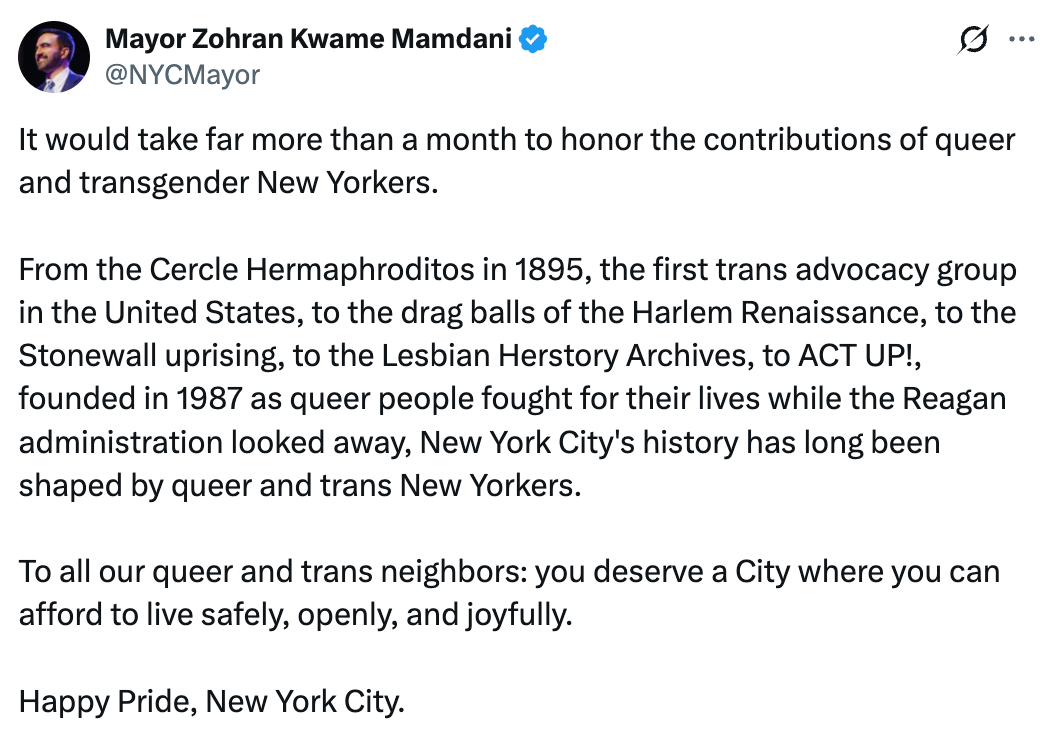
On the first of June, the mayor of New York City, Zohran Mamdani, posted on X,
Andrew Sullivan objected,
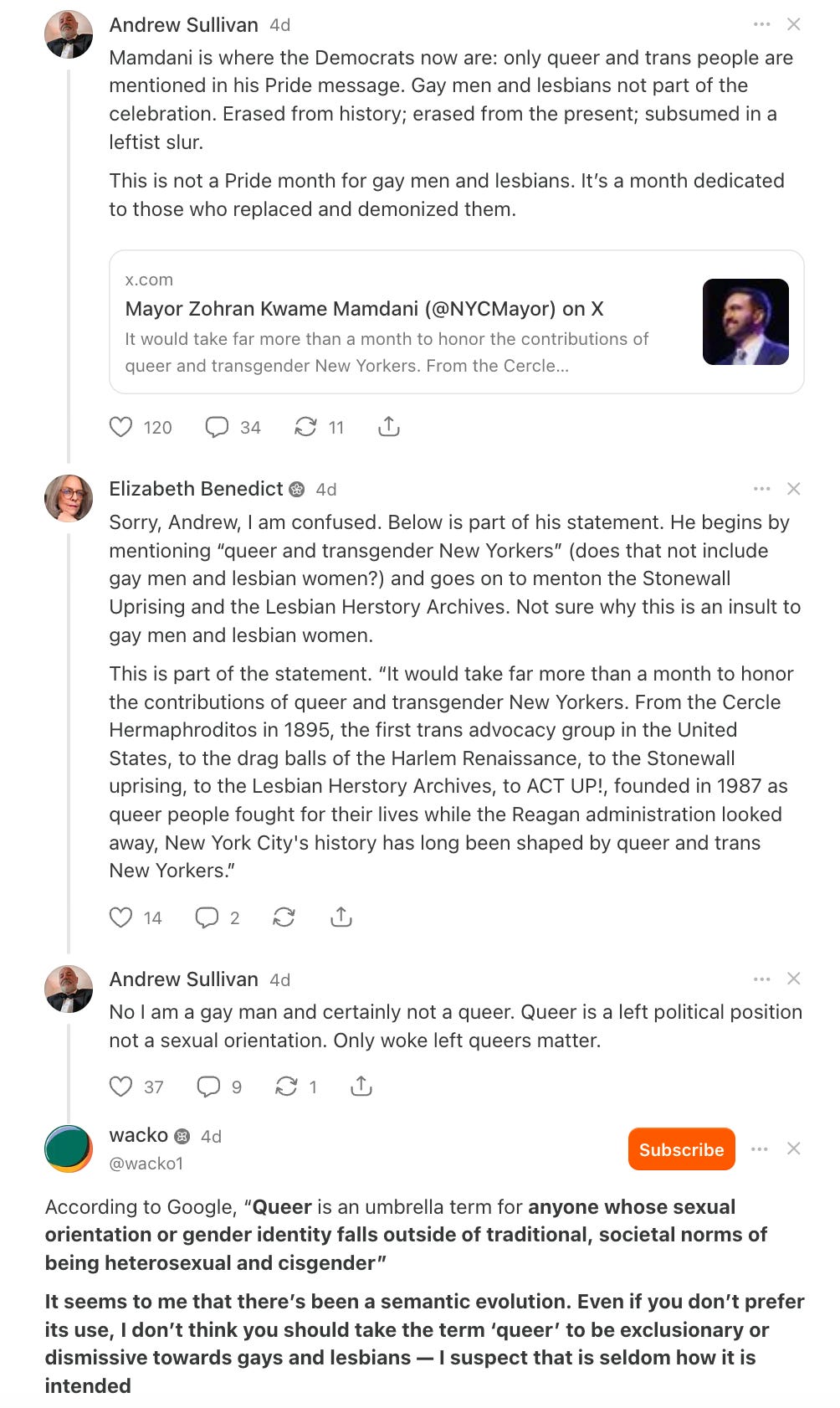
The confusion here appears to be happening in good faith and this particular disconnect occurs quite frequently. Many people who understand that the term ‘queer’ is defined as being inclusive of everybody who does not fit the definition of ‘masculine man attracted to women’ or ‘feminine woman attracted to men’ perceive that this quite obviously includes gay men and lesbians. They are consequently genuinely confused when some gay men and lesbians say it does not include them and consider their perceived omission to be significant and worrying.
This confusion arises when people do not really understand the significance of the concept of ‘queer’ in its current political context. This have failed to appreciate, as Andrew puts it, that “Queer is a left political position, not a sexual orientation.” That is, they have failed to recognise that ‘queer’ refers to a set of political and philosophical beliefs about sex, gender and sexuality which holds that having categories for these is an oppressive social construct which should be disrupted as a form of progressive political activism. This is the central tenet of "Queer Theory” which explicitly understands itself as a subversive, transgressive political theory. Therefore, to refer to somebody as ‘queer’ is to attribute to them a political identity rather than to make a neutral statement of fact about their sexuality.
The majority of people who are same sex attracted do not adhere to the tenets of Queer Theory and have a variety of political and philosophical views. Some strongly object to the concept of ‘queer’ and oppose same-sex attraction being regarded as a transgressive, subversive political identity. They may instead want to live in a society where homosexual is recognised as something that some people are and for this to be largely unremarkable and not assumed to include any particular social status or kind of belief system.
This has been the liberal stance with regard to gay rights as well as women’s rights and the rights of racial minorities. Liberalism, which foregrounds the right of all individuals to life, liberty and the pursuit of happiness has focused on removing barriers that prevent some demographics from achieving this and then leaving them alone to decide what they want to believe and do. This was the leading approach to securing rights for women, racial minorities, religious minorities and sexual minorities from the end of the 19th century upto the 1980s. In relation to gay rights, it is best summed up by the slogan, “Some people are gay. Get over it.”
This was very successful because the individual and universal elements of liberalism appealed to intuitions of fairness commonly held by people on both the left and the right. However, beginning in the 60s, a movement of radically deconstructive postmodern thought on the left arose to disrupt it. The central belief of this was that what we consider to be knowledge is, in fact, a construct of oppressive power, perpetuated in discourses (ways of talking about things).Objective truth is unobtainable and the best we can do is theorise about what political forces caused knowledge to be constructed in this way in the first place and try to deconstruct it. This remained almost entirely within the bounds of academia where it troubled the general public very little due to being largely incomprehensible until the end of the 1980s. (I have written about this here). At this time, it was mutated into an accessible and actionable form by scholars developing a cluster of ‘applied postmodern’ theories that were known as postcolonial theory, queer theory, critical race theory and intersectional feminism along with the lesser known dis/ability studies and fat studies. Central to this wave of theories was identity politics.
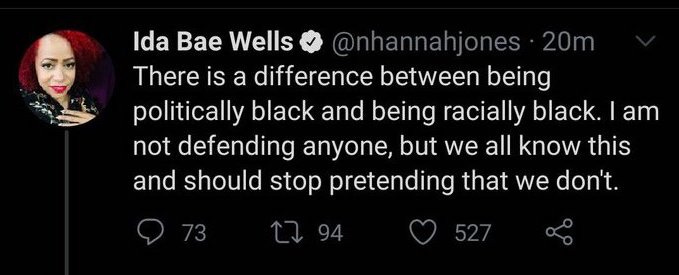
Identity politics works very differently to liberalism in that, instead of focusing on the rights of the individual to universally granted rights and freedoms and objecting when any group is denied this, it focuses on the group specifically, rejecting both individualism and universalism. The group then becomes a collective defined by specific theorised interests which are political. People from within those groups who hold those political beliefs are presented as the authentic ‘voice of colour’ or ‘queer voice’ while those who hold different views are regarded as inauthentic and not truly a member of the group whose opinions should be considered. In relation to race, it looks like this:
In relation to sexuality, it looks like the exclusion of lesbians, gay men and bisexuals (LGB) who do not ascribe to the tenets of queer theory that sex, gender and sexuality are social constructs whose categories should be disrupted and whose boundaries must be blurred. Many gay men, lebians and bisexuals did dissent from this, because being attracted to people who have the same genitalia as you does not automatically predispose one to have radically deconstructive left-wing political views.
Many of the LGB believed that there is significant evidence that we are, in fact, a dimorphic sexually-reproducing species and/or that ‘gender’ is a nebulous ill-defined concept at best and that being gender nonconforming is fine and does not change ones sex and that homosexuality refers to being attracted to people of the same sex, not the same gender identity. Many did not think that being same-sex attracted was the same kind of thing as having a sense of gender identity different to one’s sex or being asexual, demisexual, polyamorous or inclined to dress up as a squirrel. In short, many objected to being bundled together with anybody who could be considered, under some definition or other, not to fit perfectly within vanilla concepts of heterosexual monogamy. They felt that being same-sex attracted was a clearly defined and easily understood category of its own and deserved to be recognised as such and not forced into political solidarity with anybody else and that they should not be expected to affirm political and philosophical allegiance to any theoretical framework at all.
Ultimately, many of the LGB objected to being defined not by something they are (same-sex attracted), but by something they are not (conventionally masculine or feminine, heterosexual, monogamous, devoid of sexual eccentricities) while having their existence explained by an ideology they did not believe in. They objected to being called ‘queer’ because they recognised this, correctly, as a political identity and not a neutral description of their innate sexual orientation. Adherents to queer theory are also fully aware that it is a set of political and philosophical beliefs, so when they call lesbians, gay men and bisexuals ‘queer’ they are imposing those beliefs upon them. Equally, when they refer to “queer” people, they are quite explicitly excluding lesbians, gay men and bisexuals who do not consider themselves to be queer.
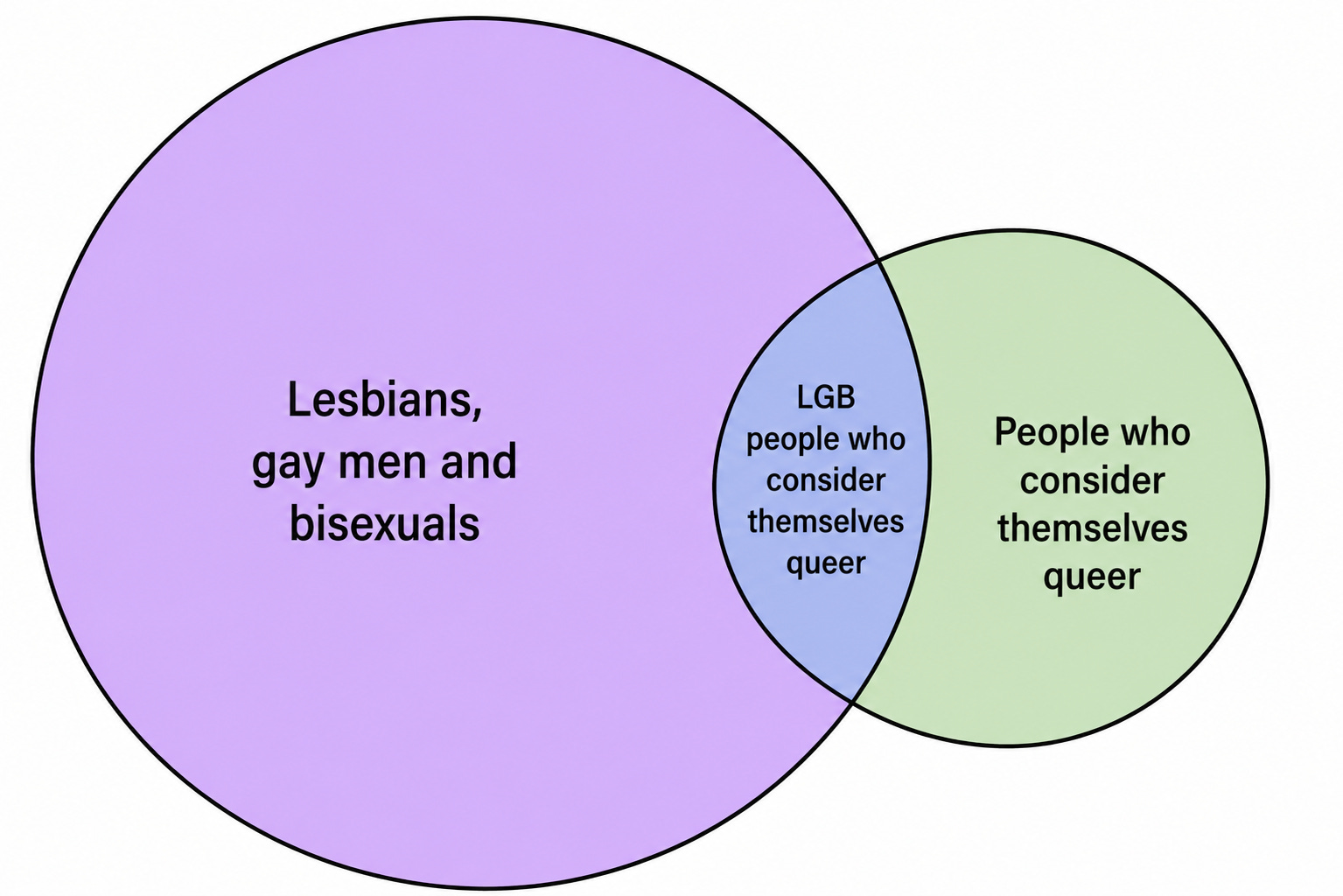
A venn diagram may help to illustrate this because it shows who is included in which definitions and who is excluded. “Lesbians, gay men and bisexuals” refers to anybody who is attracted to others of the same sex including those who consider themselves queer and consequently hold the beliefs of queer theory. It does not include those who consider themselves queer but are not attracted to others of the same sex. “Queer” refers to anybody who considers themselves queer including those who are attracted to others of the same sex. It does not include lesbians, gay men and bisexuals who do not hold the beliefs of queer theory.
When Andrew Sullivan said that by specifying ‘queer and trans’ people, Mr. Mamdani was erasing gay men and lesbians (who do not also consider themselves queer), he is simply correct. Within the current discourse, ‘queer’ does refer to people who hold the beliefs of queer theory and ‘trans’ refers to people who perceive themselves to have a gender identity which does not match their biological sex. Gay men and lesbians who do not believe either of these things are not included here. While Mamdani does refer to Stonewall, Lesbian Herstory and ACT UP!, only those who also consider themselves queer are celebrated. While trans people are also celebrated, the majority of those who also consider themselves to be gay men or lesbians would, by the standard definition of homosexuality, be heterosexual.
It is, of course, possible that Mr. Mamdani misspoke and does not fully appreciate what queer means in the current discourse of political activism. People can use the term as a slur or misunderstand it as a broadly inclusive term as indicated by the people responding to Andrew. It seems unlikely that Mamdani would not understand the political implications, however, because he is a politician who has been active on many related issues. It seems much more likely that he was using the term in its political sense and celebrating those who hold those political views specifically despite this excluding gay men and lesbians who don’t.
When people advocate for LGB rights specifically, it is generally understood that they are exclusively advocating for people who are same-sex attracted and not for anybody else who considers themselves queer. Those who do this will explain why they have this particular focus quite explicitly in an open and principled way. It would be helpful if those who advocate for queer rights were either similarly explicit that this does not include gay men and lesbians who don’t hold the beliefs of queer theory and justify this with an ethical rationale. In this way, people who don’t keep up with political terminology will understand to whom the term does and does not refer. Alternatively, they could use language which does include gay men and lesbians in their advocacy regardless of their political and philosophical beliefs and accept that same-sex attracted people can and do authentically hold a variety of them. That would be ideal.
Oooooh, this is an interesting one about his intentions.
I do think online, it is easy to stay in a bubble convinced that everyone's intentions are bad.
For a couple of years I had a podcast called Queerious. I interviewed 'Queer' Artists about their work and what it was like growing up gay etc. It was quite enjoyable and affirming to hear embarrassing stories about falling in love with the straight girl in school (classic). But what I wasn't aware of at all, was that Queer Theory existed or was even a belief system.
I had heard that Queer was a slur that people used to use against gay blokes but it had been 'reclaimed'. At that time, I thought it was a powerful thing to encourage and would go to Queer groups for film nights and events. Purely to have a laugh and meet new people. Never with ill-intentions. Again, I named my podcast this because I thought it was a cool name.
Since having a massive mental health breakdown (or hitting woke breaking point as Lindsay once put it), I started to reassess things and realised that one of my core values had been ignored since being embedded in this way of thinking. My dad taught me that being gay is not a big deal. It's about wanting to have sex with the same sex and that's the only difference between me and someone else. He was right and I knew that in my heart, but for years would get more involved with being Queer, lots of naval gazing with anger and saying Capitalism a lot and spending hours and hours online and berating and shouting at people for believing differently.
I still feel ashamed about that.
A lot of people don't really have a clue about all of these theories and it would be incredibly helpful if they were rightly framed as theories and not facts. Especially when looked at in universities or social groups.
Mamdani seems to be a critical theory advocate in lots of his personal politics, so no doubt he knows what Queer means in that context, but I think the word Queer to most people now means gay or including all letters of the gay alphabet. Whether people like that or not.
And when people belong to LGB groups, it's going to be hard to have dialogue about it, because from the Queer side you are made aware that anyone questioning your views is a bigot or deliberately wants to bully people or exclude them. And I'm sure as you know being a Bisexual woman, part of the experience of being gay is not wanting other people to be picked on or left out.
Anyway, I wish I could afford to subscribe, but sadly I am a penniless pauper. But still your biggest fan and one day will curtsey you for helping me come out of this way of thinking. Seems good story telling, cognitive dissonance and rational kindness are ways of helping people come out of such ideologies.
Have a great week! :)
Good article, thankyou. In Australia it is now illegal for lesbians to organise public events for same-sex attracted women. This is because queer theory dogma has been enacted into laws and policies. Lesbians are now meant to be attracted to males who claim to be lesbians, who describe their penises as ‘female penises’. Genderists deny or downplay biological sex and say the subjective ‘gender identity’ should override all other considerations. We are now subject to authoritarian laws informed by queer theory. The legacy LGB organisations have been colonised by queer theory and gender ideology. These LGBTQWERTY organisations now produce glossaries that redefine us to fit the dogma. Whereas a few years ago we fought for ‘same sex’ marriage, the phrase ‘same sex’ has been sent to the scrap heap. We are now described as ‘same gender attracted’. I want nothing to do with ‘queer’. I want nothing to do with the ever expanding acronym. I ask that if people would like to refer to a lesbian they use the word ‘lesbian’. If referring to same-sex attracted people, say ‘LGB’. But please don’t force-team us in the LGBTQ+ acronym, and please don’t call us ‘queer’.