

(Audio version here)
The Overflowings of a Liberal Brain has over 7000 subscribers! We are creating a space for liberals who care about what is true on the left, right and centre to come together and talk about how to understand and navigate our current cultural moment with effectiveness and principled consistency.
I think it is important that I keep my writing free. It is paying subscribers who allow me to spend my time writing and keep that writing available to everyone. Currently 3.8% of my readers are paying subscribers. My goal for 2026 is to increase that to 7%. This would enable me to write full-time for my own substack! If you can afford to become a paying subscriber and want to help me do that, thank you! Otherwise, please share!
I am currently very heavily overweight, having gained 30kg (66lbs) following a major bleed and severe anaemia and having been far from slim in the first place. I have spent the last seven weeks rebuilding my mobility and losing weight very successfully (12kgs or 25lbs now) by burning more calories than I consume, using a food plan and forms of exercise I find enjoyable. I feel great about it and have been speaking positively and optimistically about this online. In retrospect, this was a mistake. It has brought three different kinds of sanctimonious arseholes out of the woodwork to rain on my parade. These are:
1. The Moralistic Puritans: those who treat slimness as evidence of virtue and obesity as evidence of moral failure and are self-righteously dismissive of factors of physiology, psychology and circumstance which can make recovery from obesity difficult.
2. The Dietary Evangelists: those who believe their preferred nutritional theory or programme is perfectly suited to everyone and the only way to manage weight, want to tell you all about it and become particularly enraged by anyone successfully doing so with any other approach
3. The Fat Activists: those who treat the desire to lose weight as a political statement revealing a morally abhorrent fatphobia that amounts to hatred of fat people and even genocidal intent towards them.
My Personal Account (which you can skip if you want to get to the scolding)
I became suddenly overweight in my early twenties as a result of being required to take anti-epileptic medication to undertake nurse training and this made me both sluggish and ravenously hungry even when I had just eaten. Doctors told me that I could manage this by simply eating healthily and planning my meals carefully, but I found this not to be the case. The medication also slowed my thinking to such an extent that the necessary study became extremely difficult.
On stopping the antiepileptics, I was able to implement a calorie controlled diet and walking programme and lose 60kg (132lbs) in 18 months and then adapt this to an ongoing plan that balanced calories in and calories out without having to think much about it. I maintained a slim weight until about a decade ago when another neurological blip caused damage to the nerves to my ear and eye and I had to take medication for the pain. Again, I doubled my weight due to being ravenously hungry all the time. I will always be deeply sympathetic to those whose struggle with their weight is due to excessive hunger. This is a miserable state of affairs.
I was able to stop all centrally-acting medication a few years ago but it was not so easy to lose weight this time. I was already so large that exercise was difficult. I was no longer working an active and rewarding job in social care but writing about sensitive issues that made people yell at me. “Peak Woke” happened and I was working long days trying to support people hit by it in their place of work. I was overworked, highly stressed and chronically sleep-deprived. Exercise and meal-planning were not on the agenda but high energy junk was. I had ongoing neurological problems that would intermittently render me horizontal, in pain and fed up. At the same time I nursed my father through the end of his life and then became the carer for my mother whose memory was failing her. I suffered a major depressive episode following her death and was ultimately admitted to a psychiatric hospital weighing 162kg and barely able to walk. I had developed a problem of compulsive overeating to manage stress and distress and was disabled by sheer fatness. Getting on top of all this felt overwhelming due to the sheer scale of the problem and length of time it would take me to return to a healthy weight.
My elder daughter indirectly helped me to make a start on this. She experienced a very difficult time and I went to New Zealand to help her through it. I found that in caring for her, I was also caring for myself and I gradually emerged from the dark, cold, slimy pit that is depression. I knew how to lose weight because I had done it before. I also believed that, once I was on the right track for this, I would not find it difficult to maintain because, unlike so many who struggle to keep weight off, my default appetite is not large and my natural disposition is energetic.
This did prove to be the case and I lost 40kg with very little difficulty and thoroughly enjoyed the process. I was then hit with a number of minor health problems and then a major gastric bleed which caused me to lose a third of my blood and spend 6 months largely in bed with severe anaemia becoming breathless when walking at all, having a very foggy brain and being thoroughly fed up. I reverted to comfort eating and ultimately regained 30kg.
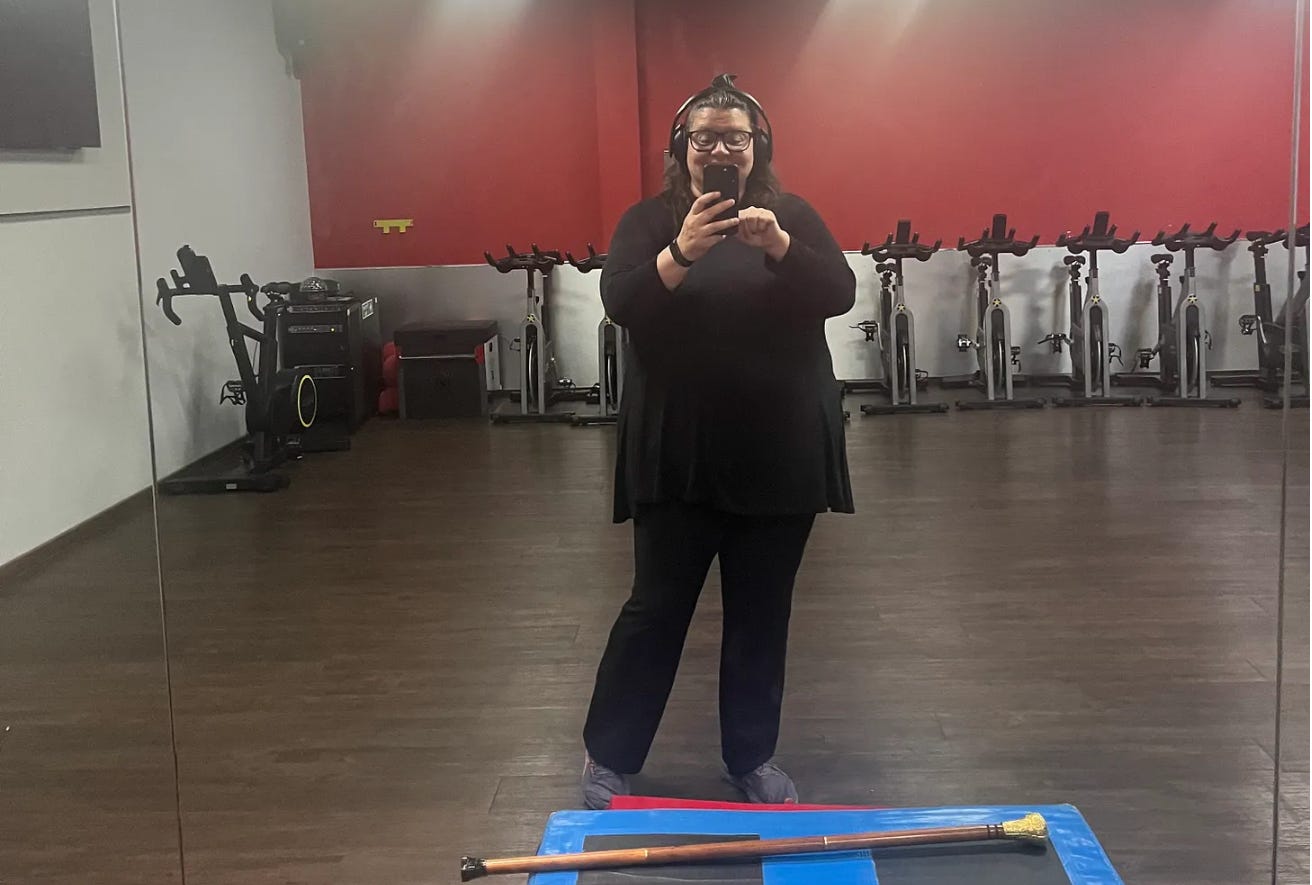
I struggled to regain my mobility and each attempt resulted in a crash which again rendered me bedbound and not making progress. I was afraid that I was on a trajectory to becoming housebound at the age of 52. Seven weeks ago, I booked myself into a four week programme of physical rehabilitation and made recovery my full-time job. From a starting point of being able to walk for about 15 minutes every other day and weighing 152kg, I have built myself up to being able to alternate walking for an hour one day with going to the gym and performing strength and flexibility exercises the next. I am now 139.6kg.
I am feeling very positive about the future now. My plan is very simple.
I will eat the number of calories necessary to sustain an active woman of 5ft9 at 70kg (approximately 2000).
I will be active.
I will inevitably gradually return to being an active woman of 70kg.
I do not find keeping to this plan difficult or onerous. I am able to make four enjoyable and satisfying meals a day and I am not hungry. Now that I have a baseline of mobility back as well as a basic degree of flexibility, I am thoroughly enjoying my walks and looking forward to being light enough to get back on my bike and ultimately to run. I am looking forward to feeling like me again and living an active, healthy life unburdened by excessive amounts of fat. I know how to do this and there is no reason why I cannot continue doing this for the rest of my life, just as I already have for most of it.
Enter the sanctimonious arseholes to tell me how wrong I am about this.
The moralistic puritans
This category of commenter regards slimness as a virtue and fatness as a vice and enjoys insulting or hectoring others on the grounds of this belief. Some of them are people who have few personal merits but happen to stay slim quite easily or at least, don’t find it overwhelmingly difficult. They then make a virtue of that much like people who, for the same reason, make a virtue of their skin colour. Those who have individual good qualities they can legitimately be proud of seldom choose to behave this way.
Others seem genuinely to have a puritanical attitude in which suffering is virtue and do not think weight loss is meant to be enjoyable or easy. Those undertaking it must find it painful and horrible in order to atone for the sin of getting fat in the first place, and be shamed in the process. They are the most likely to object on moral grounds to the use of GLP-1 medication to inhibit an excessive appetite or forms of exercise which are also fun. I once engaged with one who was outraged by my meal plan because it included steak and pasta and insisted I had no right to enjoyable food or to work out a way not to be hungry until I stopped being so fat. This is an unhealthy form of thinking similar to those found in eating disorders or in punitive ascetic mentalities more broadly.
Either way, the moralistic puritans overlook differences in physiology, psychology and circumstances that can make weight-management genuinely very difficult for some people, and mistake their own ability to manage their weight for evidence of their generally superior character.
Although everybody has some aspects of their life they find easy to manage and others they find more difficult - whether this occurs in the realm of the intellectual, psychological, relational, professional, logistical or physical - there can be a particular kind of cruelty and contempt reserved for those who struggle in the highly visible area of their weight. Fatphobia is definitely a real phenomenon although to be meaningful, the term does need to be reserved (as the suffix suggests) for those who express a genuine hostility and aversion to human beings who are fat rather than a recognition of this as a potentially disabling health condition. People who enjoy exhibiting this aversion are deeply and unpleasantly moralistic and also display an unwarranted confidence in libertarian free will.
People who struggle to manage their weight because they naturally have a larger appetite than will sustain them at a healthy weight, or who find exercise thoroughly unpleasant or difficult due to physical limitations did not choose these physiological realities. Nor do those who overeat for psychological or emotional reasons choose to experience the unhappiness they are trying to soothe. Those who consume more calories than they burn because they have a poor grasp of nutrition and do not understand that this is what they are doing did not intentionally set out to undermine their own desire to be a healthy weight. Nor do those who end up overeating because their lives are too busy or chaotic for them to give their attention to their own diet typically wish to have lives where self-care is at the bottom of their list of priorities.
People who judge the obese particularly harshly and attribute all manner of moral and intellectual failings to them and seemingly take pleasure in being gratuitously cruel to them quite possibly did not choose this mentality either. Nevertheless, I think we can more reasonably identify it as a moral failing and character defect than being overweight, and socially disapprove those exhibiting it in public.
Those who are genuinely concerned about the rise of obesity and the effects of this on health would do better to think holistically and practically than moralistically. If the problem is an excessive appetite, this can best be assisted with information on protein-rich diets which can be more satiating or, if this is not sufficient, medication to reduce hunger. Exercise need not be a penance and the more forms of enjoyable and sociable exercise that are available, the better. Where emotional pain has led to comfort eating, psychological support to address the cause of that pain and advice on non-calorific forms of self-soothing are more likely to be helpful than public shaming. Likewise, education is the best response to those who have not understood how to manage their weight and practical support for those who are too overwhelmed by life’s responsibilit to prioritise their own health.
Being compassionate and practical is just generally better than being a moralistic puritan.
The dietary evangelists
This category of responder is the one I have found most personally infuriating. They tend to be zealously committed to their pet theory of optimal nutrition and much less so the wellbeing of actual human beings who need to find a way of eating that will maintain a healthy weight sustainably. They will appear in the notifications of anybody joyfully sharing an account of successfully losing weight and inform them that they need to stop doing what is working so well for them immediately and instead do something else that may or may not work and has a high probability of making them miserable.
At their best, the dietary evangelists are people who have found a way to manage their own weight that they can sustain long term after having tried and failed with other methods and now want to share the Good News of this with others from genuinely good intentions. At their worst, they are zealous obsessives committed to a particular theory of nutrition who believe weight loss can only legitimately be achieved this way and are consequently highly motivated to tell those losing it some other way that they will fail and are either mistaken or lying about succeeding in the first place. The usual ideological-narrative-protection protocol applies here and they will find a way to invalidate and explain away anybody successfully managing their weight another way.
In my experience, advocates of the ketogenic diet have been the worst for this. I tried this for three months mostly to see what effect it had on my neurological condition (it was originally called ‘the epileptic diet’). It was actually rather good for inflammation, but I found it made me utterly miserable and nauseated and hate my life. Also weight loss only resulted when I became so sick of meat that I would rather fast than try to swallow another mouthful of it. I am glad so many other people have found it effective and something they could enjoy and stick with but it was certainly not sustainable longterm for me. I ultimately had to block dozens of them in the end, so persistent were they and so angry that their food plan might not be effective or tolerable to somebody else.
The dietary evangelists are also highly prone to appearing on the notifications of people like me successfully losing weight by eating fewer calories than I burn in order simply to insist I cannot possibly succeed at this. The reasons given are most commonly,
“It’s too difficult and burdensome to calculate calories every day. You won’t be able to stick to it.” It’s not, though. I soon learnt what calories were in any food and developed a rotating menu of options that add up to 1800-2000 calories a day without having to think much about it.
“You’ll be hungry maintaining a calorie deficit every day and won’t be able to stick to it.” I’m not, though. Today, I had scrambled eggs on toast for breakfast, a tuna sandwich for lunch, beans on toast for tea, braised beef and mashed potato with veg followed by jelly and yogurt for dinner and for snacks, three rich tea biscuits, an apple and a packet of crisps for 2000 calories. Honestly, this is plenty.
“You can’t actually calculate calorie intake or expenditure accurately so you can’t reliably maintain a deficit anyway.” OK, well, maybe I can’t calculate it precisely, but if I go with what My Fitness Pal and FitBit says with an aim for a 1250 deficit a day to lose 5kgs a month, I do actually lose 5kg a month reliably, so I’m good.
“You’re not really losing weight. That’s just water.” What? For this long? All 60kgs of it on one occasion? What am I? A hot water bottle with a very slow puncture? Was I never actually obese at all, just suffering from gross oedema?
This is all deeply infuriating and there often seems to be a element of projection in it. When I asked recently why so many people feel the need to indignantly discourage a fat woman joyfully reporting losing weight by eating fewer calories than she burns, several people replied that they perceived me to be telling them that they can all easily do this and also should do this, when they find it difficult. I think this is probably correct. It is not, however, what I am doing! I think a calorie-controlled diet works for me because I have very plain, simple and repetitive tastes. I will happily eat the same 2 breakfasts, 8 lunches and 8 dinners repeatedly with only occasional variation by preference and they will also be heavily focused on seafood, fish, beans, eggs, chicken, beef, potato, bread and pasta with absolutely nothing in the way of sauces or seasoning. This is perfect for me but when I have shown my meal plans to other people wanting to lose weight, they have told me that such a diet would make them lose the will to live. I absolutely do not claim that the meal plans that work so well for me must be enjoyable for other people!
This is, in fact, my point! I think the key for any individual prone to being overweight is finding a way of managing food and exercise that works with their own personality and tastes in the long term and then entrenching this as a habit. For some people, it might be weight-lifting and keto that allows them to be a healthy weight and enjoy their lives. For others, intermittent fasting and swimming might be something they can stick to quite happily. Yet others might find having low calorie weekdays not to be burdensome and allow for a more indulgent weekend accompanied by dance classes which they find fun. For me, it is a system of calorie-controlled meals that I enjoy and walking, cycling and, when I am light enough, running which I find exhilarating and long to be able to do again. As long as the end result is fewer calories being eaten than burnt, it will work and there is no need to make this any harder than it need be.
If dietary evangelists really are motivated by their own frustrations at having found a calorie controlled approach unsustainable for them, they should try to imagine how frustrating it must be for others to be continually told their favoured food theory must work for them when they know it will not.
If someone says, “I find this diet really hard to stick to,” or “It’s not making me lose weight,” that is the time to step in and offer an alternative that has worked for you and that you think has scientific backing you can show.
If someone says, “I’m losing 5kg a month by eating and exercising in a way that gives me plenty of energy, is enjoyable, doesn’t leave me hungry, and I could do this forever,” that is the time to say, “That’s great! Good for you.”
The Fat Activists
This category of responder is the one that has targeted me for their anger most intensively since I included criticism of the theories underlying their activism in my book Cynical Theories. For Fat Activists, the desire to lose weight or even just saying publicly that being overweight is uncomfortable, constraining and increases the risk of serious health problems is to become complicit in an oppressive system of fatphobia that harms fat people. In order to do this, they move the issue of being heavily overweight from a personal problem to a societal one. If somebody does not want to be fat, this must be a reflection of the way in which society regards and treats fat people rather than any consequences inherent in obesity itself.
At its best, Fat Activism accurately addresses unwarranted negative attitudes towards fat people (see the moralistic puritans section) and seeks to overcome them. At its worst, it penalises anybody trying to address the problem of obesity as a hateful bigot and, when they themselves are suffering from the problem dismisses them as having internalised fatphobia. They deny people the autonomy to decide what they want for their own bodies.
In order to sustain the belief that obesity is only a problem because of the way society views fat people, it becomes essential to deter fat people from openly saying that they are uncomfortable, in pain, physically limited, unhappy with their appearance or struggling with compulsive overeating due to psychological distress. In reality, it is unlikely that there are very many people who voluntarily choose to be heavily overweight and are happy this way for the same reason that we do not see many people voluntarily don a backpack full of bricks every morning and happily move about their day wearing it. It is objectively unpleasant to try to live one’s life while carrying much more weight than one’s frame can comfortably manage. Many people, however, resign themselves to this because they have found it so difficult to do anything about it. For some, who have been overweight all their lives, they may not even know what it feels like to move about unencumbered by excessive weight.
Fat Activists therefore target overweight people like me expressing pleasure about becoming less fat and enjoying the process and accuse us of supporting fatphobic assumptions that feed into toxic diet culture and make fat people hate themselves. Note that this is the opposite of how things work in other forms of identity activism. We do not see black people told not to say that their experience of being black is horrible for the sake of black people who experience no problems at all, but we do see fat people told not to reveal the struggles obesity causes them for the sake of those not experiencing any. This is, of course, because the cause of disadvantage due to being black is unequivocally societal prejudice while the cause of disadvantage due to obesity is frequently physical and caused by the weight itself. Nevertheless, I have been very frustrated to be scolded by a young, moderately plump individual telling me that I only believe I am uncomfortable and in pain and worry I might die soon because of my internalised fatphobia and that this creates a toxic environment for people like her.
One tactic that such activists typically use to discourage the heavily overweight from trying to lose weight is to quote statistics on the longterm outcome of dieting. This reveals that most people who lose substantial amounts of weight regain it and more and is used to argue for the futility of trying to lose weight. The reasoning here is flawed, however. It relies upon a definition of ‘diet’ as ‘a short term weight loss plan’ rather than ‘the regular combination of food and drink consumed every day.” A short-term weight loss plan cannot result in longterm weight loss, by definition. If we look at people who maintain a healthy weight for their entire lives, we find that the explanation for them doing so is indeed ‘the regular combination of food and drink consumed every day.”
People who say “Dieting doesn’t work!” are using reasoning that would be recognised as nonsensical in any other comparable situation. We do not say that cleaning one’s house doesn’t work because as soon as you stop, it gets dirty again and may end up even dirtier than it was before you started that particular cleaning routine. We certainly don’t say the solution to this problem is to get society to accept filthy houses as a perfectly valid life choice even though it makes people miserable and uncomfortable and is a health hazard. We accept that it is perfectly normal and reasonable to wish to live in a clean house and that achieving this requires ongoing, sustained effort. If somebody has difficulty managing this, it is appropriate to offer support depending on what the problem is - physical, psychological, educational or practical.
A genuinely useful form of activism on behalf of fat people would likewise seek to address the full range of problems they may face. This absolutely includes addressing genuinely prejudiced attitudes that regard the obese as morally or intellectually deficient and discriminates against them and doubts their competence in areas entirely unrelated to their weight. However, it should also include support for the very real problems caused by carrying much more weight than one’s frame was built to handle and the causes of that problem. It could support people who want to lose weight with tailored advice on nutrition and exercise to help them find an approach that is sustainable for them, provide access to fat friendly gyms and exercise classes and, where appropriate, provide information on medical interventions. Some Fat Activists have stood against GLP-1 receptor agonists for managing appetite on the grounds that this promotes fatphobia. This is the opposite of helpful.
GLP-1s are not a suitable treatment for me as my problem is not with excessive appetite. I do not need personalised support with finding an approach to weight-management because I already have one. Nor can Fat Activists succeed in discouraging or shaming me out of losing weight because I do not respect them or want their approval. It would, however, be good if they would stop actively working against the interests of the majority of fat people and actually do something useful.
Conclusion
Someone successfully achieving a health goal through an individualised and sustainable method and celebrating this openly is not a problem that needs correcting by the assortment of judgemental loons who are offended because they got fat in the first place, don’t like being fat or because the method of losing weight goes against their dietary ideology. Yet, they manifest themselves in spades.
It should not be beyond us, as a society, to accept that obesity is a serious health problem and refrain from being unpleasant to fat people at the same time. To be fair, most people do manage to achieve this balance just fine. For every one person who has sought to discourage me when I celebrate my successes online, there have been at least 5 telling me that they find my progress inspiring and that they are having another try at addressing their own weight problem and 20 simply being happy for me and encouraging.
Let’s have more of this, please. If you are somebody who feels inclined to be moralistically judgemental about another person’s weight problem, consider not doing that and instead offering encouragement or, if solicited, practical advice. If you are somebody who has found a way of managing your own weight and you see somebody else talking about weight loss online, check first to see if they are asking for advice on how to do this. If they are, by all means, offer it. If they actually doing well another way, resist the temptation to divert them and just say “Well done.” If you are a Fat Activist feeling annoyed about somebody being negative about obesity online, consider whether they are actually expressing a bigoted prejudice against fat people or are fat themselves and trying to overcome very real physical problems resulting from this, and don’t confuse the two.
If you are a perfectly normal person who feels no need to derail people successfully addressing a health problem and are happy for them, good! Carry on doing that. Let’s get more positive conversations going on around this and offer respectful encouragement to each other. We are all apes whose fat storage systems were built for times in which food was scarce and it was good to overeat when we had the opportunity and store the surplus as fat for later. We do not live in such an environment now and consequently many of us are too fat. In order to address this problem, we need more people finding a wide variety of solutions that can work for very different problems and personalities and more people being rational and evidenced and compassionate. We need fewer people being sanctimonious arseholes. We always need that.
I just love to hear you mapping a rational path through all the quagmires.
p.s. that's great. good for you.
Excellent