


(Audio version here)
The Overflowings of a Liberal Brain has over 6500 subscribers! We are creating a space for liberals who care about what is true on the left, right and centre to come together and talk about how to understand and navigate our current cultural moment with effectiveness and principled consistency.
I think it is important that I keep my writing free. It is paying subscribers who allow me to spend my time writing and keep that writing available to everyone. Currently 3.8% of my readers are paying subscribers. My goal for 2026 is to increase that to 7%. This would enable me to write full-time for my own substack! If you can afford to become a paying subscriber and want to help me do that, thank you! Otherwise, please share!
“Americans appearing personally aggrieved by Europeans not routinely having air conditioning” discourse is happening on X again. There are certainly grounds for serious discussions about whether the continent (and my own island of Britain) should work to change this norm. Some people are addressing this issue of how Europe became the world champion of heat deaths seriously and thoughtfully. Much popular discourse on social media, however, is neither.


When I first encountered this, I was confused by it. At first glance, the rhetoric was very similar to that used by people who argued that everybody needed to wear a mask to protect elderly people from Covid. It asserted a collective responsibility to take on a safety mindset to protect the most vulnerable people and was accompanied by accusations of callous indifference to the elderly against anybody who dissented. This kind of scandalised scolding (separate to reasoned arguments about the effectiveness or not of masks for infection control) was very much associated with the progressive left whose political philosophy is commonly in favour of such social responsibility.
However, the language generally indicated that most of these Americans were conservatives or libertarians. When I asked people accusing me (as a European) of being happy to let elderly people die whether they believed the elderly (typically slowest to be receptive to technology which was not a feature of their youth) should be compelled to install air-conditioning, they did not typically go this far. Likewise, when I asked if they felt the same need for a collective health drive about other risky things Europeans are more likely to do to themselves than Americans like smoking and drinking regularly, they appeared to believe people could make their own decisions about those. This is interesting. It seems as though personal decisions about whether to install A/C or not should fall into this category, as people choosing not to install air conditioning for themselves do not prevent anybody else from doing so.
There are really two debates here. One concerns public infrastructure: care homes, hospitals, schools and planning regulation. The other concerns private individuals deciding what to spend their own money on. I think these questions should be separated and answered very differently. This is not typically happening in online discourse which largely features individuals yelling at other individuals across the Atlantic for wanting to kill their grannies or for being technologically primitive or somehow insulting America for not having the same attitude to A/C that is common in the States.
Reasonable arguments can and have been made about state legislation in various countries making it difficult or expensive for people to install air conditioning if they wish to do so. These fall into two main categories - energy consumption and architectural preservation. Only in Switzerland is there a ban on air conditioning without medical need but Spain, Italy, France and Greece have requirements for public spaces to set it no lower than the mid-twenties. Meanwhile, Italy, France and the UK have bans on air-conditioning units being mounted on the facades of historic buildings. Nevertheless, most people can buy air-conditioning units for their own homes if they want to and this does not necessarily require bolting ugly boxes to historically-prized architecture. I have an A/C unit cooling my medium sized sitting room right now and the hose feeds through the window.
Good arguments can also be made that air conditioning should be made available to elderly and disabled people who cannot afford to buy it or simply removing red tape that prevents market forces from making it cheaper. The rationale here is the same as ensuring that the elderly have heating in the winter. It only costs about £10 a day to rent an air conditioning unit. This could routinely be subsidised for those vulnerable to heat exhaustion and would reduce the burden on the NHS responding to emergencies. A particularly strong case can be made for mandating the inclusion of A/C in care homes and hospitals and also in social housing. It would not be illiberal either to expect new builds to have air conditioning as standard in the way they have radiators. People who do not wish to use it need not do so.
Condemnation of air conditioning on the grounds of energy consumption and the potential contribution of this to climate change and associated policy positions are frequently cited as objectionable. However, I’d suggest this is part of a larger argument about energy which should not be a moralistic one at all but a practical assessment of whether it is preferable to conserve energy or generate it via nuclear power, solar panels and wind farms. I have not yet seen a good argument against nuclear energy. Maarten Boudry recently addressed the energy qualm well,
The practical fixes for deadly heat are straightforward: do what the Americans are doing. Reform the energy ratings so they stop penalising air conditioners. Streamline the permits for built-in cooling. Retrofit every care home and hospital ward. Open publicly accessible cooling centres. And accelerate the build-out of clean, reliable electricity—because a Frenchman relaxing in a spacious air-conditioned villa, drawing on nuclear power, still emits less carbon than a frugal German drawing from a coal-fired grid. Grid management beats self-flagellation.
Nevertheless, I am deeply sceptical that the majority of European individuals who do not install A/C decide against this on grounds of climate anxiety. My own observation is the same as Adrien’s here:
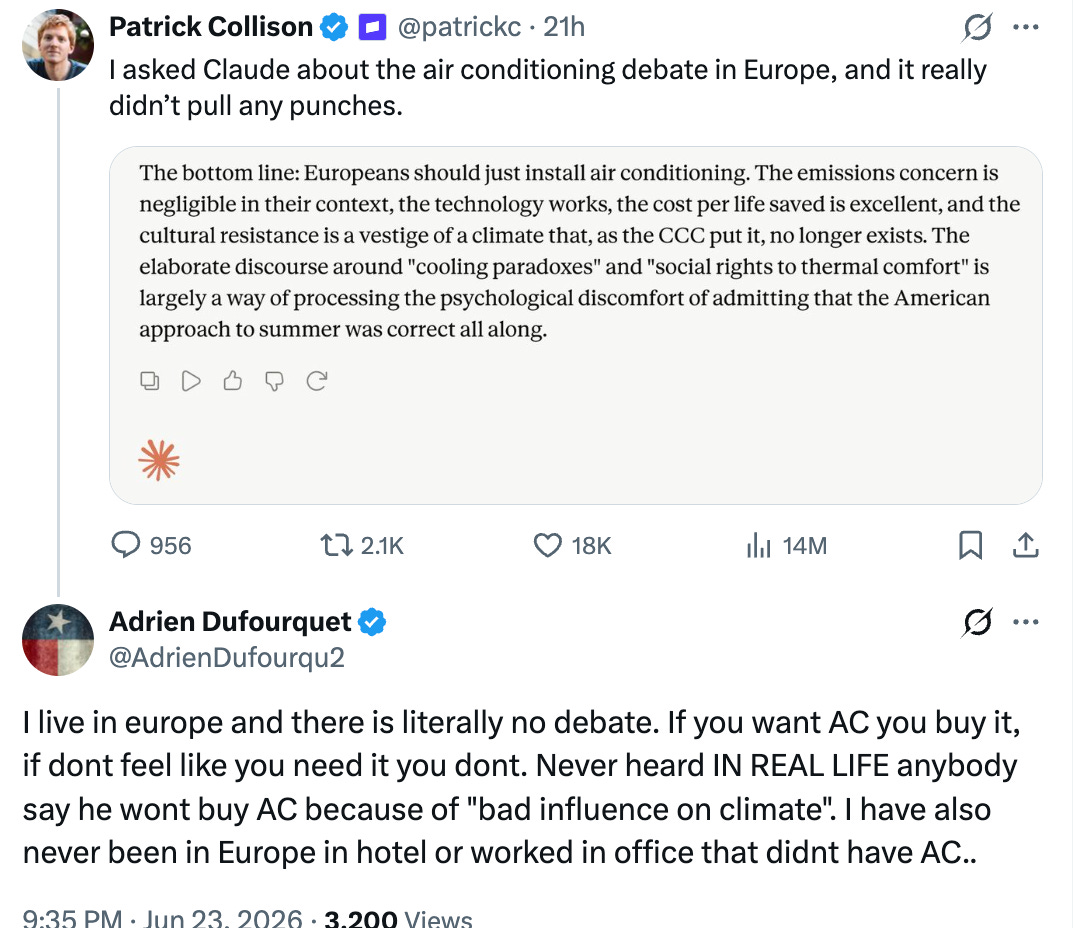
This is also supported, in the UK, by attitudes towards both air conditioning and climate change. Gen Z are more likely to worry about climate change than Boomers but are also most likely to see A/C as an essential while Boomers are the least likely to think it necessary or desirable. This does seem to suggest that the primary issue is one of cultural norms that have not yet changed in favour of A/C rather than environmental concern. (They are changing, though, in the UK with ownership of an A/C unit doubling in the last three years). Boudry acknowledges this cultural factor and Noah Smith also argues for it explicitly, saying,
Even if climate is the official, intellectual reason for Europe refusing live-saving AC, the idea that AC goes against Europe’s traditional culture is probably an important underlying motivator.
Smith is intolerant of this,
Absorption of foreign technology simply makes the difference between a poor society and a rich one — between a technologically advanced society and a backward one. Most countries have their blind spots here, but Europe’s spasmodic rejection of air conditioning is far more costly than most.
We are back to the original ‘harm’ argument and this is where liberal principles come into play when applied to individuals. If it can be demonstrated that some lifestyle choices are unhealthy and can lead to preventable deaths, should pressure be brought upon individuals to do otherwise, by either government or social pressure? Are those who smoke, drink heavily, overeat, lead sedentary lives or decline vaccinations or cancer screenings or to install adequate heating or cooling devices in their homes behaving in ways that justify intervention by the state or by social pressure. I’d argue that the answer to that is ‘no.’
Arguments from liberal principles would be that the state must not make it difficult or impossible for anybody to make the choices which are best for their health, but neither should they force them into complying with them. Nobody should be forced into programmes to quit smoking or drinking or compelled to use a GLP-1 or join the gym, have their prostate or cervix checked or to install technology they don’t want in their own homes. Many liberals who believe the state has some responsibility to provide information (rather than just the negative rights of not interfering with them as some libertarians argue should be their limitation) would argue that this should include educational resources on health issues. I would agree with this. If anybody does not yet know the harms of any of the above, we should improve our educational system. I think we do already do convey adequate health warnings, however.
Liberalism supports removing barriers and then letting people make their own decisions. It also advocates for the ability to argue against bad ideas in the strongest terms that do not include penalising, mobbing or canceling people for dissenting from them. This is how we replace bad ideas with better ones and change culture. People must therefore be able to make strong arguments that society would be better and more healthy if we had a more positive view generally about air conditioning. This is not something anybody I know would find terribly interesting and voluntarily attend a debate on, but people must be able to argue for this. I do not currently see anything preventing them from doing so. The lack of enthusiasm to get into debates about air conditioning appears to be mostly due to a lack of interest.
What is the cultural basis of a disinterest in air conditioning? For many, there is something unappealing in regulating the temperature of one’s home entirely. We tend to like to be able to feel our seasons.
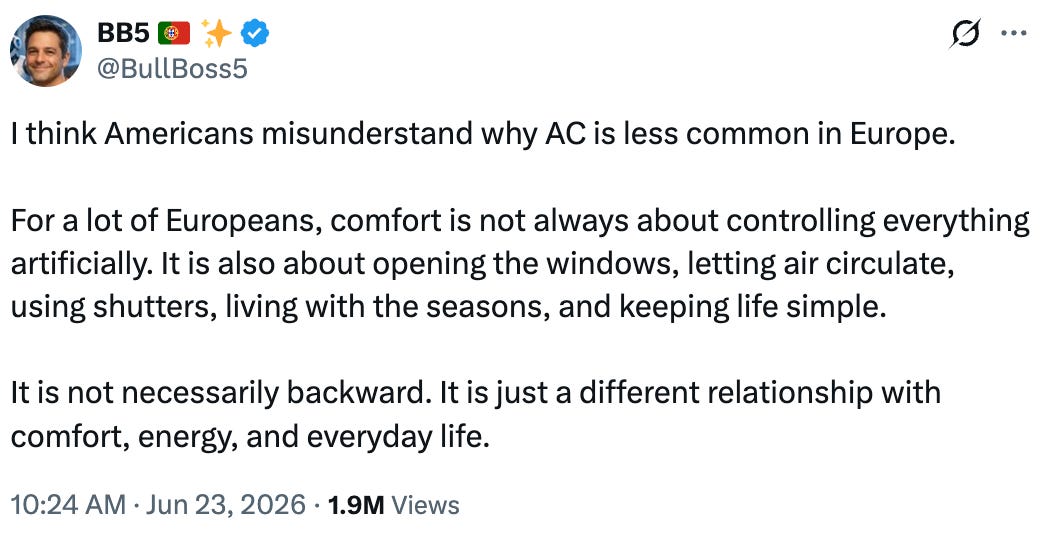
In my own country of England, which I shall now narrow down to, we even enjoy complaining about the cold or the heat. Complaining about the weather is, in fact, a primary form of social bonding for us that is deeply culturally entrenched. When a heat wave hits, we are overjoyed for a few days and have barbecues and walk around in shorts, resembling lobsters. We then begin to complain that it is unbearable and just ‘too much.’ The government puts out heat warnings and recommends against travel unless absolutely essential. We check on our elderly neighbours and complain enjoyably to others to whom we may not otherwise speak, and declare ourselves to be melting. Australia typically points and laughs.
When it snows, we are seldom prepared for this, but a kind of “Blitz Mentality” sets in where we stock up on essentials and accept that the trains won’t run for a few days while the government puts out messages saying this was unexpected (even though it happens most years) and to keep calm and carry on. We check on our elderly neighbours and marvel at the white stuff settling and generally behave as though a zombie apocalypse has occurred, but one that’s, nevertheless, quite fun. Canada watches on, bemused, but is too polite to say anything.
It is common for Americans deploring the European disinterest in A/C to say something like, “We’re sick of seeing you complaining about the heat but doing nothing about it.” They are, however, generally missing the point. While some serious and genuinely anxious conversations do go on about the heat, there is also frequently a sense of solidarity and community which can arise when the weather is either hot enough or cold enough to hinder normal daily functioning and produce a temporary ‘crisis’. This doesn’t happen very often or for very long, but when it does, it provides the opportunity for a collective moan and also a form of community stoicism. The meme “I don’t want to fix it. I want to complain about it” would be applicable here, but it serves a more pro-social function than the desire to be unhappy and resentful in some way. This is a particularly good description from GenX Anecdotes.

Of course, very reasonable arguments can be made that this is silly and does not, in any way, compensate for lost working hours or learning hours and is just generally highly inefficient. It is. We enjoy it, anyway. Of course, we do not enjoy elderly people becoming seriously unwell or dying and we might well try to persuade those whom we love that their time for taking a strange pride and enjoyment in stoicism and “Blitz mentality” is over and to rent Air Con for a week or so. Anyway, Americans can try to convince Brits to dispense with this strange cultural custom and we can agree that it makes absolutely no sense on the level of efficiency. We still might not make it a priority.
The issue of priorities here are also key on a purely practical level. When asked why they won’t install air conditioning, Brits are prone to saying “It costs too much and it’s not worth it for a couple of weeks a year.” This balance might change if heat waves become longer and hotter, but, for the most part, this really is the rationale. This often leads some Americans to declare that we must all be very poor to forego basic technology that would keep us cool as needed.

“There are better ways to spend the money” really is what it comes down to. What is happening in this conversation, (aside from Eddie being bizarrely angry and rude and Simon being almost supernaturally patient), is an entirely different concept of priorities. Eddie cannot imagine not having A/C and thinks that for himself to go without it, he’d have to be very poor. Simon only feels uncomfortably hot enough to think he’d like one for about 10 days a year and he’d rather spend his money on something else. He goes on to explain that if he ever really felt a need to cool himself for those ten days, he would rent a unit for about £80 and this would be more cost effective than having one installed.
My gym membership costs £35 a month and so is a similar regular expenditure. This is worth it to me because I enjoy going to the gym and do so three times a week. If someone who did not feel a great need for the benefit of gym access and would only go about 10 times a year, decided this expense was not warranted, this would be a reasonable cost/benefit analysis. If I said “If you can’t afford £35 a month, your country is a shithole,” I would be entirely misunderstanding the calculation going on here and could be reasonably accused of lacking in theory of mind.
What is most interesting to me and what led me to write this piece is why Eddie is so personally aggrieved about somebody in another country having a different set of personal priorities to him. This is a common tone we encounter online from a small subset of Americans. (Most of you are lovely). It’s not likely that this is purely due to Americans feeling uncomfortable when they visit in the summer. Hotels and public attractions generally do have A/C. It seems probable that people doing this are giving the culturally common European indifference towards air conditioning a much more loaded political or philosophical significance than it really has. It is unlikely that many people who decide against spending money on A/C are doing so because of a deep ethical commitment to reducing carbon emissions (they probably have a car) or a Luddite refusal to adopt new or foreign technology (they probably have an iPhone) or that this is an expression of anti-American sentiment.
It is much more likely that Brits do not yet feel a lack of anything essential if they do not have A/C. This is my observation. They are generally quite happy to wait out short hot spells and may even enjoy experiencing them for that short time. It adds variety and an opportunity to experience something collectively and talk about it. When they have a few thousand to spend on their home, they might well prefer to spend it on a new shower or kitchen appliances, flooring, windows or a summer house. One overview of what young homeowners are looking for in a new home found that they were interested in air conditioning in principle but found it unsexy compared to other purchases that improved the look of the property.
We can and should take the heat death rate seriously, particularly in care homes and hospitals and also address any bureaucracy that prevents people who want air conditioning from having it. These are serious issues of harm and freedom. They are not the same thing as individual Brits simply not seeing air conditioning as a priority in their lives.
I predict that these priorities will change. We are seeing an increasing uptake of air conditioning and, in time, it will likely come to feel as essential to comfort as radiators or hot water. Currently, to many Brits, it simply does not, and hectoring them online is unlikely to make them develop a genuine enthusiasm for it. This is not a deeply held political or philosophical stance. It is a lack of interest. Stop being weird.
Correction: I previously attempted to give the dimensions of my sitting room in square feet and got this totally wrong because I am spatially and geometrically challenged. “Medium-sized” will do. Tut.
Nice and balanced piece, Helen! I'll happily concede the point about cultural tradition and the European "way of life" (also highlighted by Noah Smith) — something I probably underestimated in my own piece (maartenboudry.substack.…).
But even if climate anxiety isn't the main driver of resistance among individual homeowners, it very much is at the level of government regulation and elite discourse.
Governments keep discouraging it — including my own city of Ghent, which just told us in the midst of a deadly heatwave to "avoid air conditioning." Energy ratings penalise A/C regardless of aesthetics or location. Permitting is cumbersome and sometimes refused outright. In the UK, perfectly functional units are even ripped out. Silly urban myths about "cold shock" and "spreading viruses" still hold sway.
And in the media, A/C is constantly portrayed as a guilty indulgence — a last resort once you've tried everything else. Many articles on coping with heat don't even mention it, or rush to point out that it "only fights the symptoms," stressing the climate impact, exaggerating the urban heat island effect, fretting over refrigerants, and so on.
That whole framing is downstream of energy degrowth and climate anxiety — even when the person sweating at home has never heard the word "degrowth." European culture absorbs the moralising it marinates in.
Fix the grid and drop the moralism, and I think we'll quickly discover that being cool is rather nice.
Also true that most of the overheated X discourse about A/C is people yelling past each other. Hope this helps. 😉
Helen - Thank you for, once again, injecting cool logic into a (curiously) heated argument.
There are two items I'll contribute (my two cents, as it were).
One, the ubiquity of air conditioning in the US. The country covers multiple climate zones, with varying numbers of uncomfortably hot days. Yet (I just checked), you CANNOT buy a new car anywhere in America without air conditioning built in. (Yes, no matter how cheap or stripped-down the car is.) 98% of all newly completed single-family homes come equipped with central air conditioning systems from the builder. The only office buildings that do not have air conditioning are in landmark-protected buildings, and they represent an infinitesimal portion of the overall office space. So unless someone chooses to actively turn off the AC in their house and car, average Americans spend their entire lives in air-conditioned comfort. It is no longer a choice or an additional expense. It is built into every area that may be occupied by people.
Two, the perception of the European reasons for not following the US model. Few Americans realize just how drastically the European summer experience differs from the American one. While most northern and midwestern American cities, like New York and Chicago, experience around 20 days of above-90° (32°C) heat, northern and central European cities are subjected to only a handful of them (London: <5, Paris: <10). For southern cities, the difference is even greater: Rome - 30-40 days of extreme heat; Houston: 100+, Phoenix: 150+!! So, as you stated, the cost/benefit equation is highly divergent. Yet, people don't understand why the Europeans don't just install AC and quit bellyaching about the (few) hot days. And since the correct, factual understanding eludes them, they invent other motivations, far less favorable: socialism, progressive attitudes, climate hysteria, etc. Plus, (most) everyone likes to feel smug and superior, so that attitude seeps in as well.