

(Audio version here)
The Overflowings of a Liberal Brain has over 6500 subscribers! We are creating a space for liberals who care about what is true on the left, right and centre to come together and talk about how to understand and navigate our current cultural moment with effectiveness and principled consistency.
I think it is important that I keep my writing free. It is paying subscribers who allow me to spend my time writing and keep that writing available to everyone. Currently 3.8% of my readers are paying subscribers. My goal for 2026 is to increase that to 7%. This would enable me to write full-time for my own substack! If you can afford to become a paying subscriber and want to help me do that, thank you! Otherwise, please share!
(Note: This piece was written before Heather Herbert was arrested and charged. I have left the argument substantially unchanged because its primary focus is the distinction between the legal framework governing free speech and the ethical principle of free speech).
Heather Herbert, a trans-identified MtF web developer and activist at the University of Aberdeen, posted on Bluesky in response to the news of Ann Widdecombe’s murder saying, “Some good news for once. I hope it was an extremely painful death. I hope she was handcuffed to the bed as she screamed in agony.” This disgusting comment, so revealing of the callous and sadistic mentality of a trans activist who clearly believed this would not undermine his status in his peer group, led to anger, revulsion and outrage. It also led to large numbers of individuals demanding that Herbert be fired including Reform MSP, Mark Simpson, who described it as “hate speech” requiring disciplinary action from the university.
Herbert has now been arrested and charged for his speech. Prior to this, I objected to attempts to have him fired via political mob-pressure on principle.
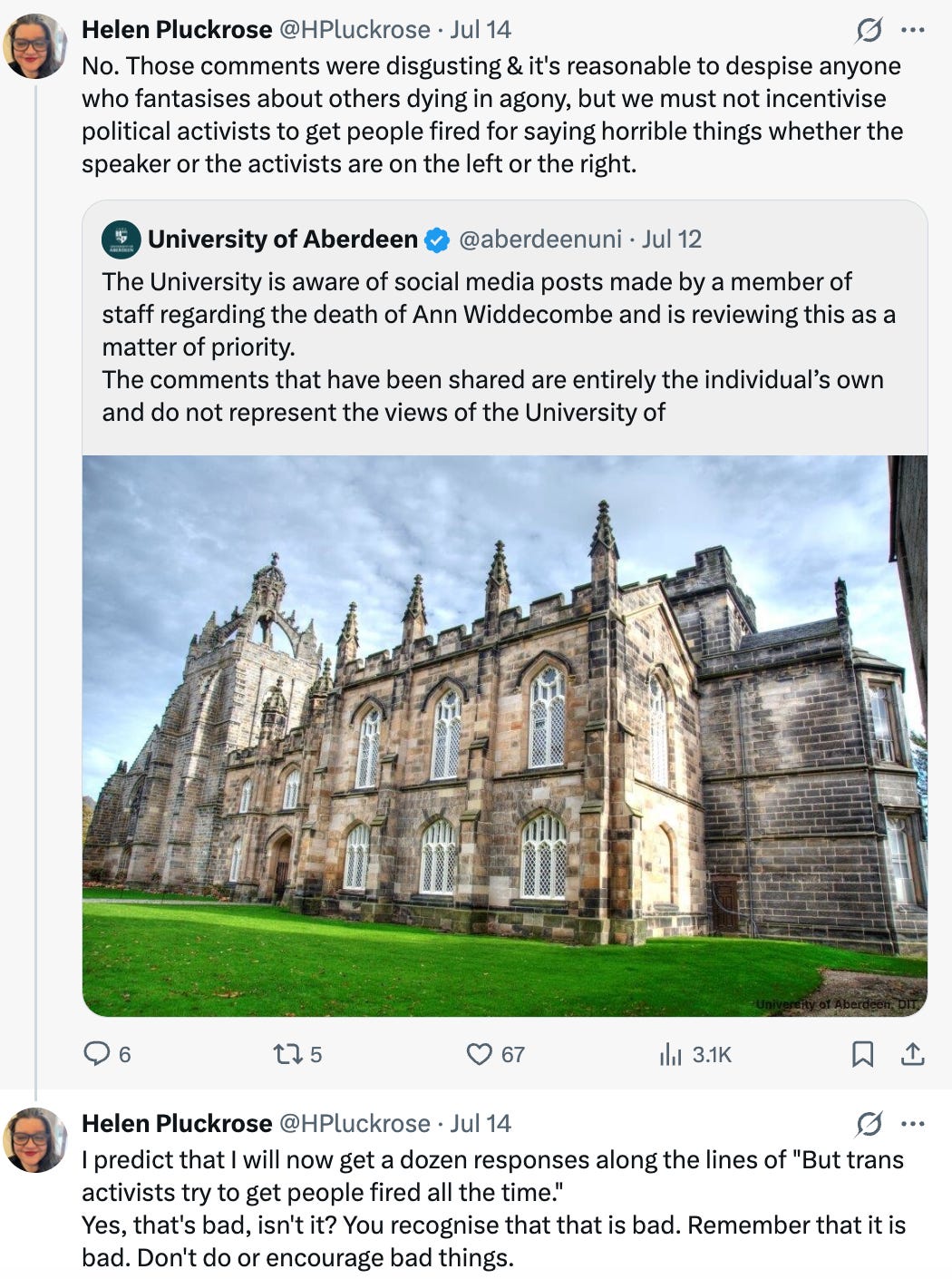
Writing before Herbert's arrest, Kevin Lister, a maths teacher who lost his job for refusing to honour a trans-identified student's pronouns, responded in the way a liberal should. He defended the free speech of a trans activist whose movement had championed the very principles that contributed to his dismissal and had done so in a highly authoritarian way. I greatly admire Mr. Lister for that consistency. It would have been easy for someone with his experiences to become authoritarian in turn—or simply remain silent and enjoy the schadenfreude—but he did neither. Lister wrote:
This has got nothing to do with Aberdeen University, I don't even know why they are investigating it.
He should not be sacked for his vile and ignorant posts because to do so continues the terrible attacks on free speech that are happening in the UK.
Instead he should be free to demonstrate his ignorant and self centred behaviours. The only things Aberdeen University should be interested in is that he is not allowed into women's spaces and he is not allowed to compel anyone's speech such that they must use his language.
Equally, staff and students at Aberdeen University should be entitled to express their views on what they want to see happen to him without fear of reprisal.
This is at the core of my coming case at the Upper Tribunal against the DBS.
I have been kept on the Children's Barred List for posting concerns on social media about the sexualisation of the class room, buying babies on line, and the social transitioning of children.
If Aberdeen University fire him for expressing his views, however distasteful they are, then we are even more firmly on the path to increasing restrictions of free speech and governance by the mob.
A terrible emerging reaction to the Ann Widdecombe murder is to use it to impose more restrictions on free speech and to accept the police and the government manipulating the agenda to control our thoughts.
That is what we should be most fearful about.
Bravo, sir! This is the way.
A reply to Mr. Lister from a large account named UKVillaFan with the biography “Sex is binary; gender identity is not real but an unfalsifiable construct of queer theory” made a common and repeated category error.
This is a fundamental misunderstanding of how ‘free speech’ functions. The idea that we all have the right to say anything we like, to express any opinion in any way we choose, is a complete fiction.
Freedom of expression is not an absolute right but a qualified one. That means it has limits. This is explicit in the wording of Article 10 of the European Convention on Human Rights. I encourage you to read both the Convention and the Human Rights Act 1998 for the details.
The framework of ‘human rights’ is the curtailing of state power against individual citizens. It is not generally a mechanism for controlling interpersonal relationships or those between employee and employer or individual and organisation.
Whilst states can, and the UK does, legislate in the ‘rights’ field to prevent unlawful discrimination, such rules are limited in nature. Contract law and defamation issues will override ‘freedom of expression’ most of the time.
The University will have a policy about employee social media usage and perceived impacts on its reputation as an organisation. Breach of any such policy could lead to disciplinary action and this would not be a breach of the employees right to freedom of expression unless the speech used is specifically protected (for example, expressing a protected belief under the Equality Act). Even if the underlying political disagreement were a protected belief, employers can still limit manifestations that are violent, harassing, or reputationally damaging.
It should go without saying that wishing someone’s death to have been the result of violent torture is not a protected belief.
Whether Aberdeen disciplines him or not has zero to do with a supposed expansion of state control over speech and it is ridiculous to make such a conflation. The state isn’t even an actor in this scenario at this stage. This is about his employment contract.
…
UKVillaFan conflated laws around freedom of speech with the ethical principle of freedom of speech. This happens so frequently that it seems worth using this particularly good example to break this down. Laws, regulations and policies tell us what is while ethical principles provide justifications for what should be.
Laws controlling or protecting speech have varied considerably over time and space but have historically mostly mandated affirmation of monarchical, dynastic, theocratic or regime authority. More recently, in the West, they have protected individuals from such state control. Knowing what they are is important if one wishes to avoid being arrested or to pursue a denial of freedom in a court of law but they tell us nothing about whether or not the law is ethical or reasonable. Everybody can think of some law, regulation or policy that has existed in some time or place that they believe should not have and needed to be resisted.
The principle of free speech is a central tenet of philosophical liberalism. It takes a stance that individuals should have the freedom to hold and express their own views both as an individual liberty and because this enables challenging authority, correcting error, advancing knowledge and resolving conflicts. It makes no truth claims about what is but argues for what should be. Consequently, the liberal principle of freedom of speech is most commonly invoked when that freedom is being denied in some context. The context can vary widely because the principle is held not only in relation to freedom from state coercion but much more broadly as a positive good. It applies on all levels - governmental, institutional, social and individual.
John Stuart Mill is arguably the most influential liberal philosopher on the subject of freedom of speech and he stresses its relevance in the social realm very clearly in On Liberty. Writing in 1859, he could be speaking about what came to be known as Cancel Culture in the last decade,
Society can and does execute its own mandates: and if it issues wrong mandates instead of right, or any mandates at all in things with which it ought not to meddle, it practises a social tyranny more formidable than many kinds of political oppression, since, though not usually upheld by such extreme penalties, it leaves fewer means of escape, penetrating much more deeply into the details of life, and enslaving the soul itself. Protection, therefore, against the tyranny of the magistrate is not enough: there needs protection also against the tyranny of the prevailing opinion and feeling; against the tendency of society to impose, by other means than civil penalties, its own ideas and practices as rules of conduct on those who dissent from them; to fetter the development, and, if possible, prevent the formation, of any individuality not in harmony with its ways, and compel all characters to fashion themselves upon the model of its own.
To fully intuitively grasp the difference between laws/regulations/policies and ethical principles (what is and what should be), consider the following statement:
“Women have the right to individual autonomy.”
What does this mean?
It could be a truth claim referring to the laws of a time and place in which women have the right to make their own decisions without requiring the permission of men. The passing of various acts into law could be cited to support the claim that this is a right women have.
It could also be an assertion of an ethical principle. If said by a First Wave feminist demanding the right to vote or own property or a Second Wave feminist demanding the right to take out mortgages or loans in her own name or by somebody living under male guardianship laws in the Middle East right now, that’s almost certainly what it would be. It is not a claim that women already possess the right of autonomy in law, but an assertion that they have the moral right to autonomy. You could not show any of those women the law stating that they do not, in fact, have that right and expect them to say, “Oh, my mistake. Carry on, then.”
This is also how defenders of free speech on principle work. When they say that people are being denied freedom of speech, they do not typically mean that the right already exists in law or regulations or policies, but that it should ethically do so and that they will fight for it to do so.
This is where the disconnect between Kevin Lister and UKVillaFan occurs. Lister is clearly referring to the principle of free speech and taking an ethical stance about what should be protected when he says,
He should not be sacked for his vile and ignorant posts because to do so continues the terrible attacks on free speech that are happening in the UK.
and
If Aberdeen University fire him for expressing his views, however distasteful they are, then we are even more firmly on the path to increasing restrictions of free speech and governance by the mob.
When UKVillaFan responds asserting that Lister is “fundamentally misunderstanding” how free speech functions, she is the one fundamentally misunderstanding that it is a principle being defended, not the current status quo which frequently denies people that freedom (even though Lister says he opposes that quite clearly).
UKVillaFan’s objections fall into three categories.
First, she points out that existing law places limits on freedom of expression. Well, quite. This is precisely what liberals are concerned about. The central liberal tenet is “Let people believe, speak, live as they see fit provided this does no material harm to anyone else, nor denies them the same freedoms.” Current restrictions on freedom of speech go way beyond this. Pointing out that restrictions already exist is no more an answer to somebody defending the principle of free speech than pointing out that women legally lack the vote would have been an answer to women saying this is indefensible. It describes the status quo rather than engaging with the principle.
Second, she argues that employers are entitled to enforce contractual obligations and protect their reputations and notes that not all forms of expression are legally protected and that employers may discipline speech which is not. Again, this describes the current legal position rather than engaging with whether that position is ethically tenable. It does not answer the ethical question of whether employers ought to use those powers to punish the expression of political opinions, however abhorrent, when those opinions do not interfere with an employee’s ability to perform their job.
Recent history should make us cautious about granting employers uncritical approval to police opinion in the name of reputation. During the height of ‘woke’ Cancel Culture, activists repeatedly demanded disciplinary action against academics, teachers, journalists and ordinary employees whose views they regarded as offensive. “Reputational damage” became whatever a sufficiently organised online mob could persuade an employer it was. Likewise, concepts such as “harassment” and even “violence” were expanded to encompass disagreement itself. We heard that “white silence is violence,” that disbelief in gender identity denies people’s right to exist and that criticism of the ideology of Islam is the same thing as hatred and harassment of Muslim people. Once concepts of violence and harassment become this elastic, they are easily turned against whichever dissenting viewpoint is currently unpopular with the dominant moral orthodoxy.
This is also why I find the concept of “protected beliefs” illiberal. Liberalism does not accept that only certain beliefs deserve protection while others may legitimately be suppressed. All beliefs should be allowed expression and all should be open to criticism in the public sphere. (Employers can reasonably make policies about not pushing religious or political views on others while at work, but instead focusing on the work). The appropriate response to bad ideas is to challenge, ridicule and defeat them, not to create categories of officially acceptable opinion.
Finally, UKVillaFan argues that this case has nothing to do with state censorship because Aberdeen University is acting as an employer rather than as the government. As a legal observation, that is correct. As a response to the broader argument about free speech, however, it once again misses the point.
Liberal defences of free speech have never been concerned solely with protection from criminal prosecution. Liberals typically believe that freedom of expression should be defended consistently across society: not only in law, but within universities and institutions of knowledge production, and, where relevant within operational parameters, in workplaces and among professional bodies. It is a general good to create a culture where views we strongly disagree with are criticised or ignored rather than punished. Those who believe mob outrage pressuring employment consequences are entirely separate from broader cultural norms and state or police interference in free speech must have the right to make this argument. People who remember ‘woke’ Cancel Culture correlating with people being taken in for questioning by police for saying gender identity isn’t real or immigration is a problem and suspect that may not have been a coincidence will likely remain unconvinced.
(Update: Herbert has now been arrested and charged in connection with his speech, despite Police Scotland initially stating that "no criminality" had been established. This adds weight to the argument that campaigns for institutional punishment and state intervention cannot be regarded as wholly unrelated phenomena. We cannot be certain that the police's decision to undertake "additional enquiries" was directly caused by demands from right-wing activists and Reform politicians for Herbert to be punished. It is possible that evidence has emerged which has not yet been made public and which links Herbert directly to criminal conduct or unlawful incitement. Nevertheless, in the absence of any such evidence being disclosed, it remains plausible that the shift in the police's assessment—from "non-criminal" to criminal—was influenced, at least in part, by public pressure. Unlike the United States, UK offences relating to malicious communications and the stirring up of hatred often require contextual judgments that can make them particularly susceptible to public and political pressure. UKVillaFan’s assertion that it is “ridiculous” to “make such a conflation” between calls to punish individuals professionally for their speech and an ‘expansion of state control over speech’ may be somewhat naive).
Whether or not Herbert's arrest ultimately proves justified, however, it does not alter the central philosophical point. It is essential to understand the distinction between descriptions of what is (law) and arguments for what ought to be (ethics). Lister was not claiming that Aberdeen University lacks the legal power to investigate Herbert. He was arguing that it ought not to exercise that power, because a society committed to freedom of expression should be reluctant to punish people for expressing political opinions, however vile. That is an ethical argument about the kind of society we should aspire to create, not a misunderstanding of the law as it currently stands.
UKVillaFan's response is therefore best understood not as a rebuttal of Lister's position but as an explanation of how the current legal framework permits, and the cultural climate encourages the very practices he (and I) believe ought to change.
It is unclear whether UKVillaFan recognises that all these arguments can be and have been used to penalise, silence, no-platform and take disciplinary action against gender critical feminists like herself. My own organisation, Counterweight, supported just over 400 people either facing disciplinary action or afraid they would do so if they declined to affirm beliefs in gender identity. Even if she believes that this can no longer happen due to gender critical views now being a protected belief, surely she must remember that gender critical feminists spent years showing why these arguments are unsound and enable ideological capture and authoritarianism. Those arguments did not suddenly become sound because they are now being deployed against somebody whose politics she opposes. They remain unsound because they continue to justify ideological conformity enforced through institutional power. This is what Lister understands. As he said, “That is what we should be most fearful about.”
The important issue to those who defend individual liberty is not whether Aberdeen is legally entitled to investigate Herbert or whether the police have the legal power to arrest him. It is whether they are ethically justified in doing so and whether such investigations into speech with a view to punishment are compatible with the kind of society we want to live in. From a liberal perspective, the answer to this question is ‘No.” Penalties for speech in employment should be based on a very high threshold related to an employee's ability to perform their role safely and professionally, not on organised campaigns of public outrage. Likewise, the police must be required to demonstrate that speech is directly causal of material harm to be justified in arresting anyone for it.
It is in all of our interests to resist a culture in which any moral orthodoxy can gain cultural prestige and influence and collectively pressure employers, universities, institutions, the police and the state to punish expression they find appalling. Even those who don’t support freedom of belief and speech for its own sake should recognise that the tables can turn and the beliefs deemed abhorrent become their own. Gender critical feminists, of all people, should know this better than anyone.
Bravo! Yes, this distinction needs to be made, over and over again.
Its concept is far more difficult than you may think; it requires both moral and logical clarity that you possess in such abundance that you believe everyone must have it, too. Not even close. Please keep making the case, in different ways, in different situations.
Thank you Helen for this strong defense of free speech. It is one of the more difficult things in our current time to avoid being dragged into the black hole of controlling or curtailing the rights of others, especially when they say such heinous things. I don't always succeed, but work hard to do so. The threat of tyranny requires the ability to speak out, even if it is offensive. The best antidote is usually, as they say, more speech.