

(Audio version here)
In a recent post, The Famous Artist Birdy Rose responds to a critic who asks whether she could soften the wording of her gender-critical stickers in order to reach more people. They carry messages such as, “HUMANS CANNOT CHANGE SEX,” “NO ONE IS BORN IN THE WRONG BODY,” and “THERE IS NO SUCH THING AS A ‘TRANS’ CHILD.” Rose makes two points, both of which I agree with. First, she argues that there is no meaningful way to sugar-coat these statements. They cannot be softened without becoming different claims, and she should be free to express precisely the point she intends to make. Second, she argues that presenting a gentler or more conciliatory message to authoritarian gender identity ideologues is no more likely to be received well than stating one's position bluntly. The evidence strongly supports this. Many people have expressed polite disagreement with gender identity beliefs only to be met with vitriolic abuse and demands that they be punished.
In support of her last statement, Rose refers to J.K. Rowling’s experiences of vitriolic abuse from activists despite her ‘kind, considerate and gentle’ approach to them. She writes,
She went out of her way to sweeten the message that men cannot somehow magically become women - And look at how she’s been treated by “trans” ideologues for the last six years.
What have we learned from that?
You might as well just tell the truth.
I agree with Rose that Rowling’s approach did not seem to make authoritarian activists any more reasonable at all. Nevertheless, I would push back on “What have we learned from that?” and “You might as well just tell the truth.”
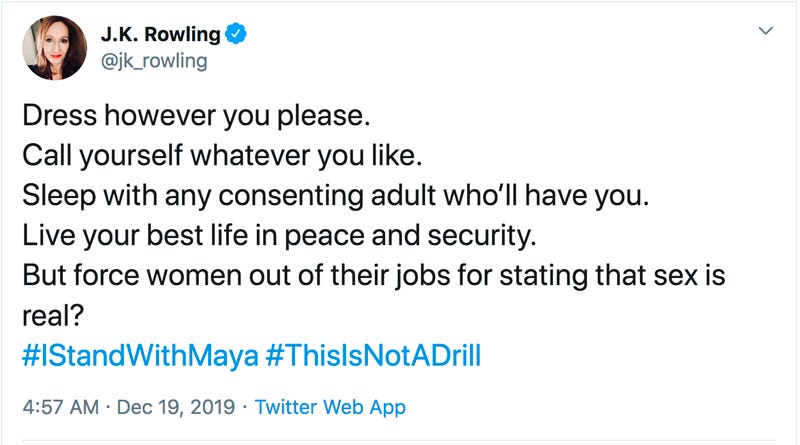
Rowlings first statement was:
Dress however you please
Call yourself whatever you like
Sleep with any consenting adult that will have you.
Live your best life in peace and security.
But force women out of their jobs for stating that sex is real?
#IStandWithMaya #ThisIsNotADrill
Firstly, Rose seems to imply that Rowling's original intervention was a gentler way of saying that sex is real. I don't think that's what Rowling was doing at all. Rowling was not advancing a biological claim in that tweet. She was advancing a liberal principle.
Rose, as she explicitly says, is making truth claims about biological sex being real, definitive of whether one is male or female and immutable. Rowling, however, was making a defence of freedom of speech. Her tweet defends people’s right to believe, speak and live as they see fit, provided it does no material harm to anyone else nor denies them the same freedom. Once beliefs are imposed on other people under threat of penalty, the issue ceases to be one of individual liberty. It becomes one of harm and coercion, and liberalism has always recognised that distinction.
Truth claims and principles are categorically different things. Truth claims cannot soften into principles, nor can principles harden into truth claims. They answer different kinds of questions. People may hold the same truth claim while applying very different principles to it, or share the same principles while disagreeing profoundly about what is true.
At the time of Rowling’s first tweet, we did not even know whether she held gender-critical beliefs herself. It is entirely possible to believe that gender identity is more authoritative than biological sex and still object to a woman losing her job for holding the opposite view. A liberal would oppose anyone being dismissed simply for expressing either belief, regardless of which, if any, they personally held.
Let's take another example involving something about which I hold strong views to look at this outside the context of the gender debate. I see no good reason to believe that any god exists and, unless compelling evidence emerges, I will continue to work on the premise that none do. I am also concerned that religious belief—overwhelmingly belief in the Abrahamic God within my own culture—can inspire deeply illiberal attitudes and practices, particularly towards non-believers, women, children and same-sex attracted people. In that respect, my concerns about religion map quite neatly onto concerns about gender identity ideology.
I could say,
Believe in any god you please.
Identify with any religion or denomination you like
Worship in consensual communities of people who share your beliefs.
Live your best life in peace and security.
But impose your beliefs on other people?
#IStandWithApostates #ThisIsNotADrill
I may also argue that no gods exist and openly reject the truth claims of religion. I have done so in the past. But that is a categorically different argument. For me, individual liberty is the higher-order principle. I will defend religious freedom and gladly work alongside religious believers who also defend the right of others not to believe in their god or any god at all. It is not the case that, if enough religious fundamentalists were viciously abusive towards me, I would abandon that liberal principle and simply start telling them that God does not exist and that salvation cannot be attained by believing in the right religion, even though I believe those things to be true.
So I don’t think I “might as well just tell the truth.”
It is not only that truth claims and liberal principles are different kinds of argument. I also think the latter are often the stronger and more persuasive. I would love for nobody to believe in God, but I do not imagine that simply asserting his non-existence will persuade believers or win much sympathy from society more broadly. People have been insisting that their own religious beliefs are true and arguing over them for millennia. Defending everyone’s right to believe what they wish and live accordingly, free from discrimination or harassment, while insisting that they not harm others or coerce them into affirming those beliefs, is a much more compelling proposition. Religious believers who are not authoritarian zealots can happily endorse that principle alongside non-believers, and we need not be conciliatory towards those who reject it. It also resonates with the liberally minded majority, who are not deeply invested in theological disputes and mostly just want people to be left alone unless they are harming someone else.
I think the same is true of debates around gender identity. I suspect that competing groups of activists simply asserting the truth claims “Trans women are women” or “Trans women are men” have relatively little effect on the opinions of society as a whole. What seems to have resonated much more widely are arguments grounded in liberal principles of freedom, fairness and the prevention of harm. I have argued before that I believe a strong case can be made that the entry of J.K. Rowling into the debate and her reasonable, liberal arguments were deeply influential on making the general population aware of the nature of the problem in a way that made them sympathetic to the cause.
These statements and this stance and this much-loved bestselling author became focal points of the Gender Critical Feminist movement to the point where billboards in support of the Gender Critical view simply said “I <heart> J.K.Rowling” (and were also identified as transphobic and removed by authorities captured by the Critical Social Justice movement). So reasonable and liberal was this stance that it mobilised people outside the movement who had also grown increasingly alarmed by the authoritarian CSJ movement. They began to recognise that the Gender Critical movement was the most organised, committed and, likely, effective, way to push back CSJ at least in the realm of Trans Activism, and give it their support.
…
The line really had been crossed between believing, speaking and living as one sees fit and causing material harm to others and interfering with their freedom to do the same. Placing women in a position where a sex offender can self-identify as a woman and gain access to places where women are vulnerable ranging from changing rooms to shelters to prisons does cause material harm to women. Nobody has to believe that trans women are inherently sexually predatory to acknowledge this reality. Material harm is also caused when a female athlete loses her winning place and potential scholarships, sporting career or financial reward because somebody with the benefits of male puberty competes against her (or charges into her). The rallying cry of “Let Women Speak!” was particularly powerful to the liberal mind and so liberals on the left, right and centre increasingly began to demand that right.
Because so many people are fundamentally liberal in the sense of “anti-authoritarian” and because the cause was presented to them as fundamentally liberal, thus quelling fears of appearing to be prejudiced against a minority group, the Gender Critical Movement gained critical support.
I think Rose is absolutely right about one thing. Authoritarian trans activists are no more likely to be persuaded by compassionate, liberal arguments than by blunt, factual ones if those arguments reject the claim that trans women are women in every respect and every context. Someone who affirms the right of trans people to identify and dress as they choose, while arguing that concerns about safety, fairness or freedom of belief justify limits in particular contexts, is still likely to be vilified by zealous activists.
The wider public, however, is a very different audience. Most people are not especially interested in debates about gender, but they do care about fairness, freedom and the protection of vulnerable people. They object both to discrimination against minority groups, including trans-identified people, and to authoritarian attempts to silence disagreement or policies they believe threaten the safety of women and children. YouGov polls show a dramatic increase in awareness of trans issues and a decided shift towards concern in public attitudes over the last eight years, including among women and young people who have been the most sympathetic to trans causes.
Now a new YouGov study, the fourth in a series reaching back to 2018, shows an increased scepticism towards transgender rights across the board – and particularly in the two and a half years since our previous wave of this study.
Notable in this most recent study – conducted in mid-December – is the growing resistance on transgender rights among those groups that are typically more permissive on the issue, like women and young people.
In fact, the only question on which women now take the permissive view on transgender rights is saying that people should be able to change their gender socially, although at 55% this still represents an eight point drop since the 2022 survey.
Although YouGov frames these findings as growing scepticism towards "trans rights", the largest shifts in public opinion have occurred in areas where many people perceive a potential for harm. Support has grown for protecting women's spaces and sports, while opposition to the medicalisation of children and to legal transition has increased. By contrast, the public remains considerably more accepting of social transition, provided it does not entail any of those policies, although support for this has also declined somewhat.
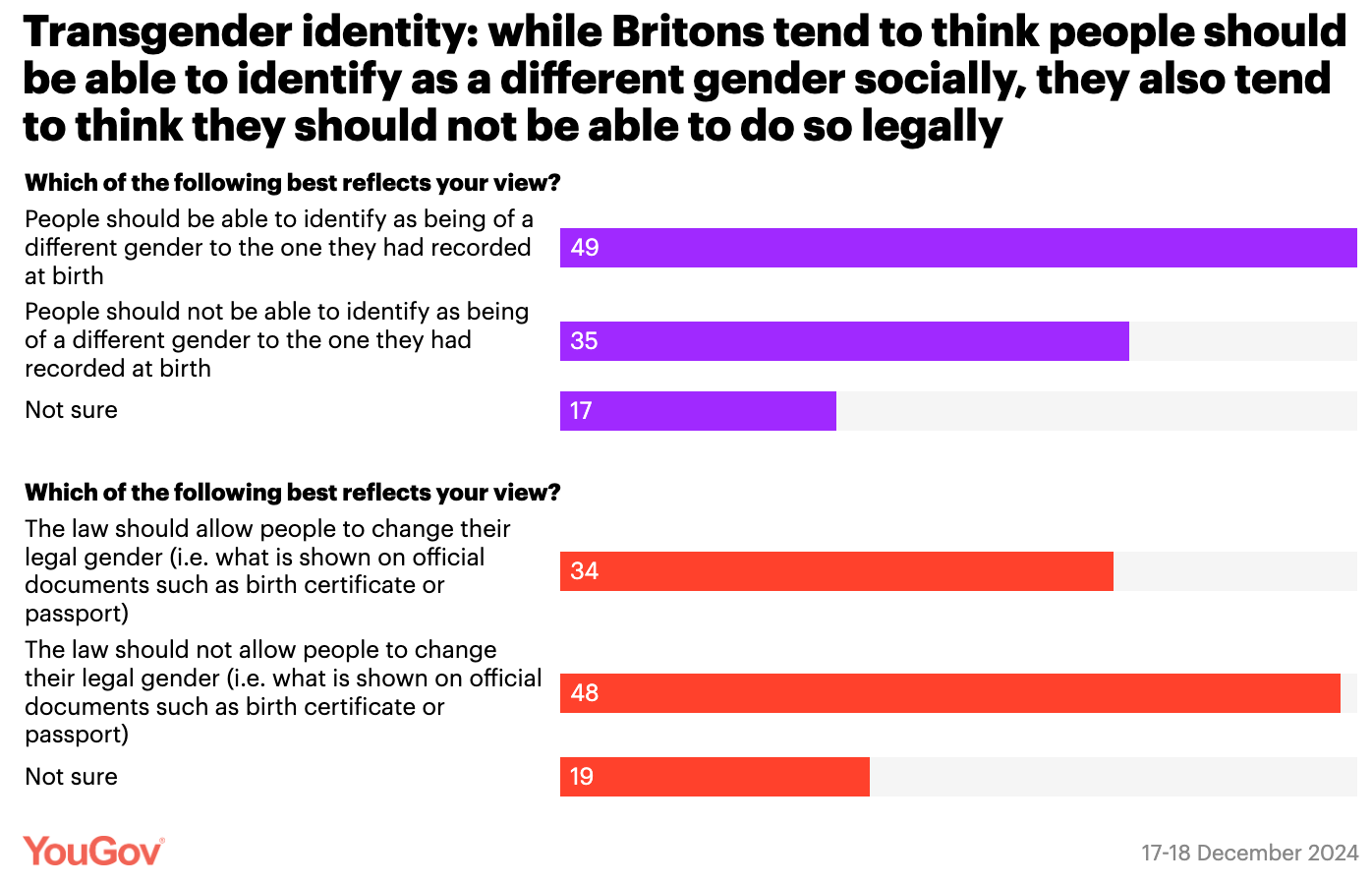
There are, of course, a number of ways to interpret this shift, including the distinction many respondents appear to draw between social transition (allowing people to dress as they please and call themselves whatever they like) and legal transition (granting access to spaces and categories on the basis of gender identity rather than biological sex). One plausible interpretation is that these distinctions reflect a broadly liberal public instinct. Many people appear willing to support trans-identified people living as they choose while becoming increasingly reluctant to endorse policies they believe create risks for women and children or require others to affirm beliefs they do not share. I think that interpretation is consistent both with the polling data and with the kinds of arguments that have proved most publicly persuasive over the last several years.
That is why I ultimately part company with Rose. She is surely right that authoritarian activists are no more likely to be persuaded by liberal arguments than by blunt factual ones. The most important question, however, I would argue, is not how to persuade a small (but highly vocal) band of zealous ideologues. It is how to persuade everyone else, so that they do not tolerate this behaviour from the ideologues in the mistaken belief that they are simply protecting the interests of a vulnerable minority.
Liberal principles have a unique advantage here. They do not require people to have thought deeply about or formulated a strong position on the issue of ‘gender’ before deciding where they stand. They ask a much more general question, one that most people have already considered and upon which they already know where they stand: should people be free to live and present according to their own beliefs where this materially impacts only themselves, while being prevented from harming others or coercing them to affirm those beliefs? Many more people who are not especially invested in debates about gender are likely to answer 'yes' to that question than to commit themselves to defending a particular truth claim about gender. That is why principles are often more persuasive than truth claims: they do not require people to agree on what is true, or even to have a settled view about it, only on how people should treat one another despite disagreeing about it. In the context of religion, this is the principle of secularism that allows people of different faiths and none to co-exist peacefully.
That was the argument Rowling made first. It remains, I think, the strongest argument of all. So how would I answer Rose's question, "What have we learned from that?" We have learned that this is how you win. Not by persuading the committed ideologues, who were never going to be persuaded anyway, but by persuading everyone else. Defend people's freedom to dress as they please and identify as they wish. Draw a firm line where claims about identity begin to endanger women and children or coerce other people into affirming beliefs they do not share. That is a position millions of people can recognise as fair, even if they have never formulated a strong opinion about gender itself. Keep telling the truth about biological sex, certainly. But never underestimate the importance of the liberal principles that keep debate open and allow that truth to prevail.
The Overflowings of a Liberal Brain has over 6500 subscribers! We are creating a space for liberals who care about what is true on the left, right and centre to come together and talk about how to understand and navigate our current cultural moment with effectiveness and principled consistency.
I think it is important that I keep my writing free. It is paying subscribers who allow me to spend my time writing and keep that writing available to everyone. Currently 3.8% of my readers are paying subscribers. My goal for 2026 is to increase that to 7%. This would enable me to write full-time for my own substack! If you can afford to become a paying subscriber and want to help me do that, thank you! Otherwise, please share!
You identify a very important distinction here. Thank you. I think it's one of your best pieces.
K, that did it. Paid up.