


(Audio version here)
It is very important to recognise if one is defending a cause one agrees with or freedom of speech. One is about what should be believed while the other is about how disagreement should be handled. It is valid to be doing either or both but confusing and conflating them leads to incoherence, inconsistency and counterproductive arguments.
This confusion and conflation is particularly prominent in online discourse around the Evangelical Christian activist, Enoch Burke. Burke was suspended from his job as a secondary school teacher for gross misconduct. This followed his interruption of a school religious service to protest against the school’s acceptance of a child’s gender transition and they/them pronouns. When the headteacher told him she would speak to him later, he refused to accept this and pursued her until others had to intervene.
He was subsequently issued with a court order to stay off school premises. He repeatedly ignored it and was jailed for contempt of court. He remains in jail, which he can leave at any time by agreeing to comply with the injunction. Burke has said he will stay in jail for 100 years if necessary, because he obeys God, not man.
The case has resurfaced because Burke’s mother, Martina, and sister, Ammi, were arrested and jailed for disrupting court proceedings by shouting and roaring. Mr Justice Cregan remarked, “We live in a democracy governed by the rule of law, not a theocracy governed by the Burke family.”
Interest surged again when Elon Musk shared a report of their arrest, commenting simply: “This is crazy.”
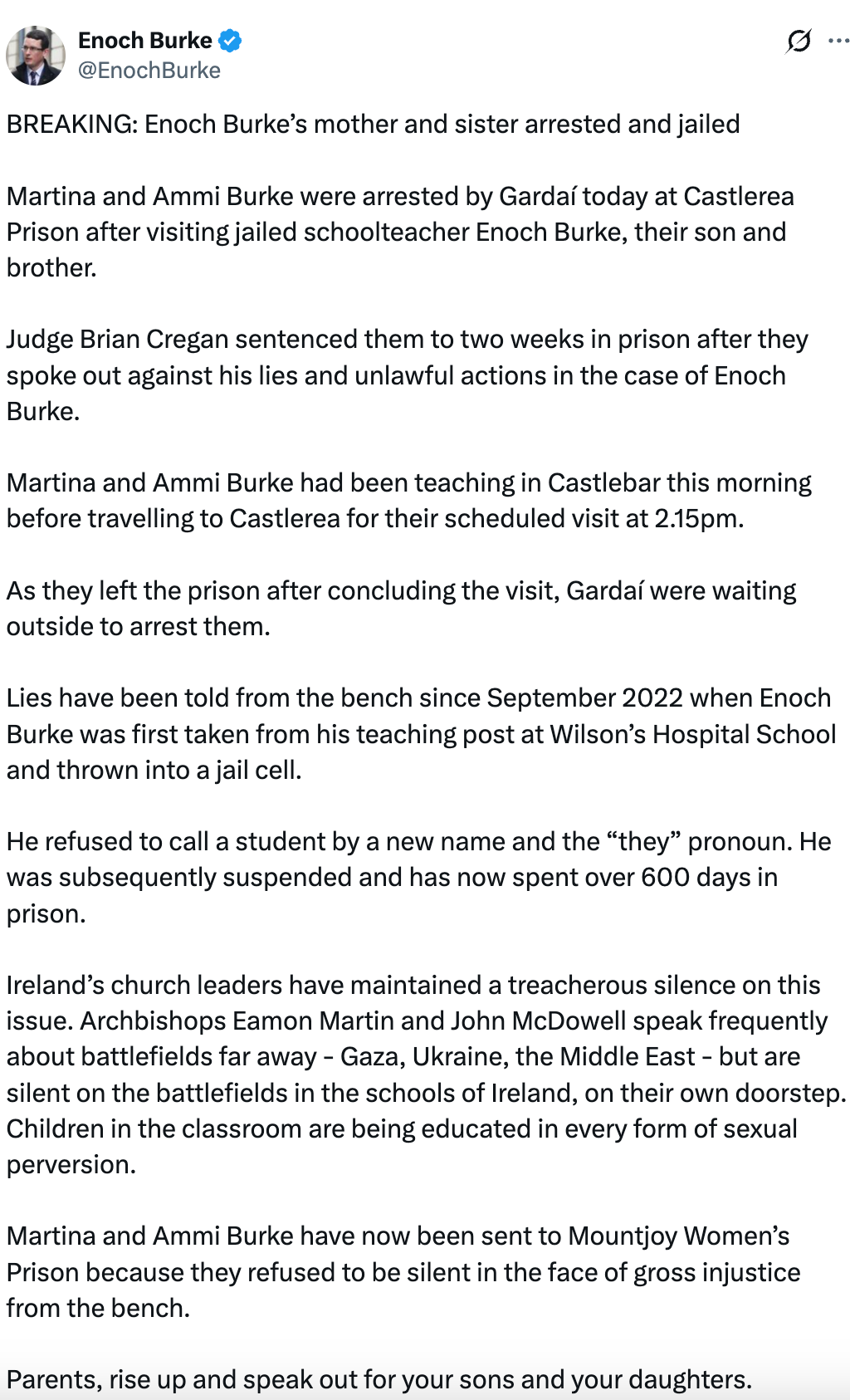
Musk did not clarify what he thought was crazy, and many who agree with him appear similarly unclear.
They are, broadly, making one of two arguments.
1. That belief in gender identity is false and harmful, particularly in children, and that Burke was right to oppose the school’s actions forcefully. These arguments support the cause of those who oppose its acceptance
2. That Burke and his family are being punished for expressing their beliefs, and that this constitutes a violation of freedom of speech. These arguments are about the principle of freedom of speech.
These are not the same argument, and they require different standards of reasoning.
When people fight for a cause, they do so because a specific issue matters to them urgently. The goal is to draw attention and force recognition.
The cause is primary
Urgency justifies escalation
Tactics are flexible
Consistency across issues is not required
Suffragettes were not defending a universal right to chain oneself to railings. Environmental activists are not defending a general right to block roads or throw soup on paintings. They are pursuing attention for causes they consider serious and urgent, often accepting arrest as part of that strategy.
Those who defend the Burkes on these grounds can do so coherently. They need not claim that disrupting assemblies, pursuing headteachers, defying court orders or disrupting court proceedings is generally acceptable. The claim is simply that this issue is important enough to justify such actions.
When people are defending freedom of speech, they do so because of a commitment to a principle which they believe should apply universally.
The principle is primary
The content is secondary (even irrelevant)
Consistency across viewpoints is required
The principle constrains behaviour
To defend free speech is not to defend this speech, but all speech, including speech one strongly opposes. Organisations such as the Foundation for Individual Rights and Expression (FIRE) defend speech across political divides for this reason, often supporting individuals with directly contradictory views. When editing Areo, I applied the same principle, publishing arguments that took opposing stances, most of which I myself disagreed with. Consistency is key.
Those who wish to defend the Burkes on the grounds of free speech could do so coherently, but, in practice, they do not. Because this is a principle, doing so would require them to universally defend the form of activism the family uses, including for activists with entirely opposing views.
If you are somebody who feels sympathetic to the Burkes, try this thought experiment. Imagine the school had refused to affirm a student’s gender identity, and Burke had been a trans activist protesting that refusal. He disrupts a religious service to demand that the school affirm gender identity, pursues the headteacher to insist she listen to him immediately, ignores a court order and trespasses repeatedly leading the school to need to hire security and keep the children inside. His mother and sister shout and roar in court disrupting proceedings because they also believed he should be able to engage in this kind of activism in a school.
Do you still feel sympathetic to these hypothetical, counterfactual Burkes? Or do you feel that such disruptive trans activism on school property and in a court of law is unacceptable and justifies suspension and prosecution? If it is the latter, you are not defending a universal (and very radical) principle of free speech. You are sympathetic to the cause of opposing affirmations of transgender identity in schools and believe that this is such an important and urgent issue that it justifies disruptive, intimidating and law-breaking activism.
This is not a criticism of activism which can absolutely be justified ethically. Most people will be able to think of some cause that would justify them becoming loudly vocal and disruptive, defying workplace and institutional policy and engaging in civil (or uncivil) disobedience that is likely to result in arrest. Absolute, uncritical deference to authority on principle is neither common nor desirable.
It is perfectly ethical to fight for a cause passionately. It is also perfectly ethical to defend free speech as a higher-order principle. What is not ethical is to conflate the two and confuse and collapse the distinction. People typically do this when they care about a specific cause first, but wish to appear more principled and less partisan. They claim the moral authority of a universal liberal principle which few people are overtly authoritarian enough to explicitly reject. But by using the principle as a tool, they abuse it, and weaken that authority. If appeals to freedom of speech become recognised as primarily a cynical ploy to further a specific political agenda, the cultural value placed on that essential freedom principle will erode. This is how freedom of speech dies.
The Overflowings of a Liberal Brain has over 6000 readers! We are creating a space for liberals who care about what is true on the left, right and centre to come together and talk about how to understand and navigate our current cultural moment with effectiveness and principled consistency.
I think it is important that I keep my writing free. It is paying subscribers who allow me to spend my time writing and keep that writing available to everyone. Currently 3.8% of my readers are paying subscribers. My goal for 2026 is to increase that to 7%. This would enable me to write full-time for my own substack! If you can afford to become a paying subscriber and want to help me do that, thank you! Otherwise, please share!
Thats a very common view here, not very far from Burke's school. 'I agree with what he says, but not the way he goes about it'
Its also well known here, with a degree of cynicism, that they family are known 'operators'. As in activists, known for butting heads with the law to prove various points.
As someone who also agrees with Burkes central point, and woukd go as far as to say disruptive tactics are necessary, I still feel he is poisoning the well
Defending free speech as a principle in no way requires defending the Burkes’ actions (nor that of the hypothetical trans activist):
Trespassing & contempt are the crimes.
Yelling at them from the street might be too, if it’s harassment or stalking.
But the words they want to say?
All still can be uttered, but only under shared societal constraints on how to resolve differing points of view.