


(Audio version here)
The Overflowings of a Liberal Brain has over 6000 readers! We are creating a space for liberals who care about what is true on the left, right and centre to come together and talk about how to understand and navigate our current cultural moment with effectiveness and principled consistency.
I think it is important that I keep my writing free. It is paying subscribers who allow me to spend my time writing and keep that writing available to everyone. Currently 3.8% of my readers are paying subscribers. My goal for 2026 is to increase that to 7%. This would enable me to write full-time for my own substack! If you can afford to become a paying subscriber and want to help me do that, thank you! Otherwise, please share!
We currently appear to have a problem with illiberal factions on the furthest right denying terms that accurately fit their own description of their positions. It makes communication very difficult. The terms most likely to be objected to and denied are “Racist”, “Far-Right” and “Ethnonationalist.”
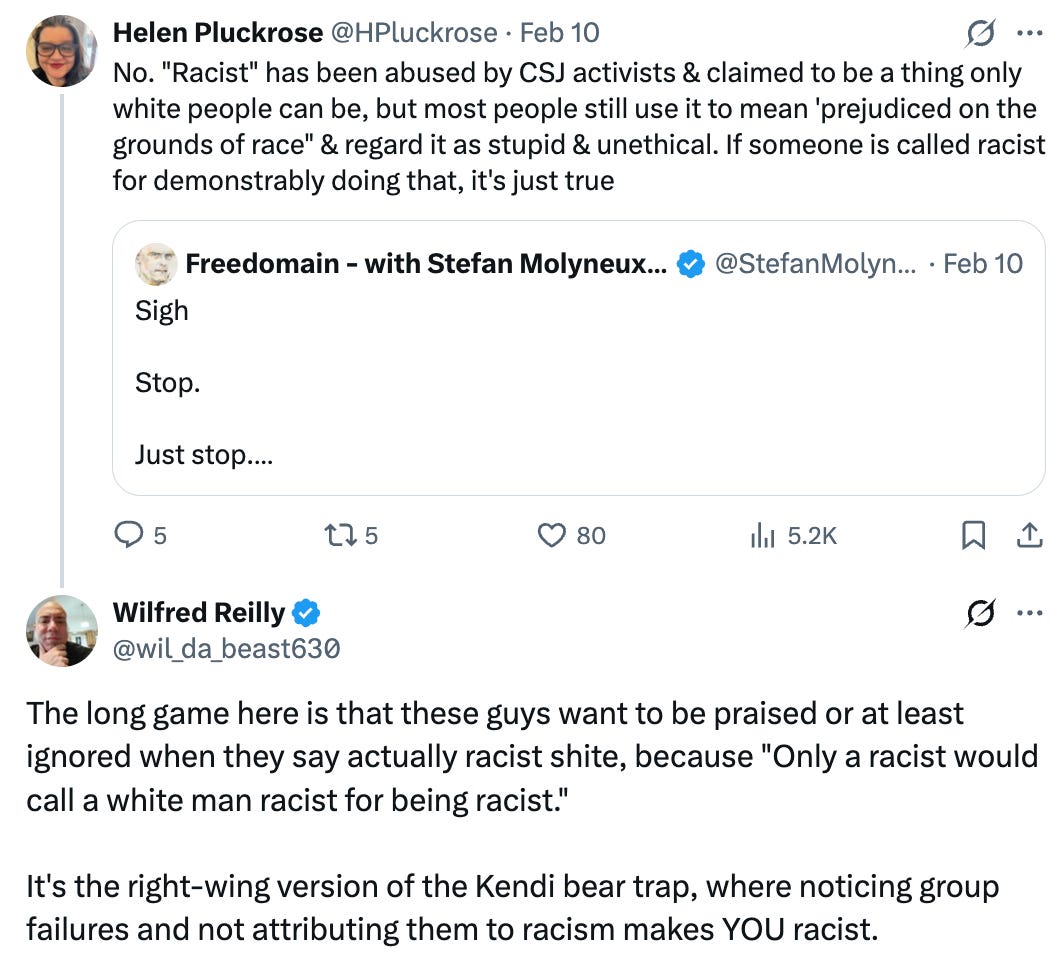
The simplest and most widely used definition of ‘racism’ is “prejudice and/or discrimination on the grounds of race.” Yet, we currently have people who openly say that they believe certain races to be inferior and advocate discriminating against them hotly rejecting the term ‘racist’ to describe their stance.
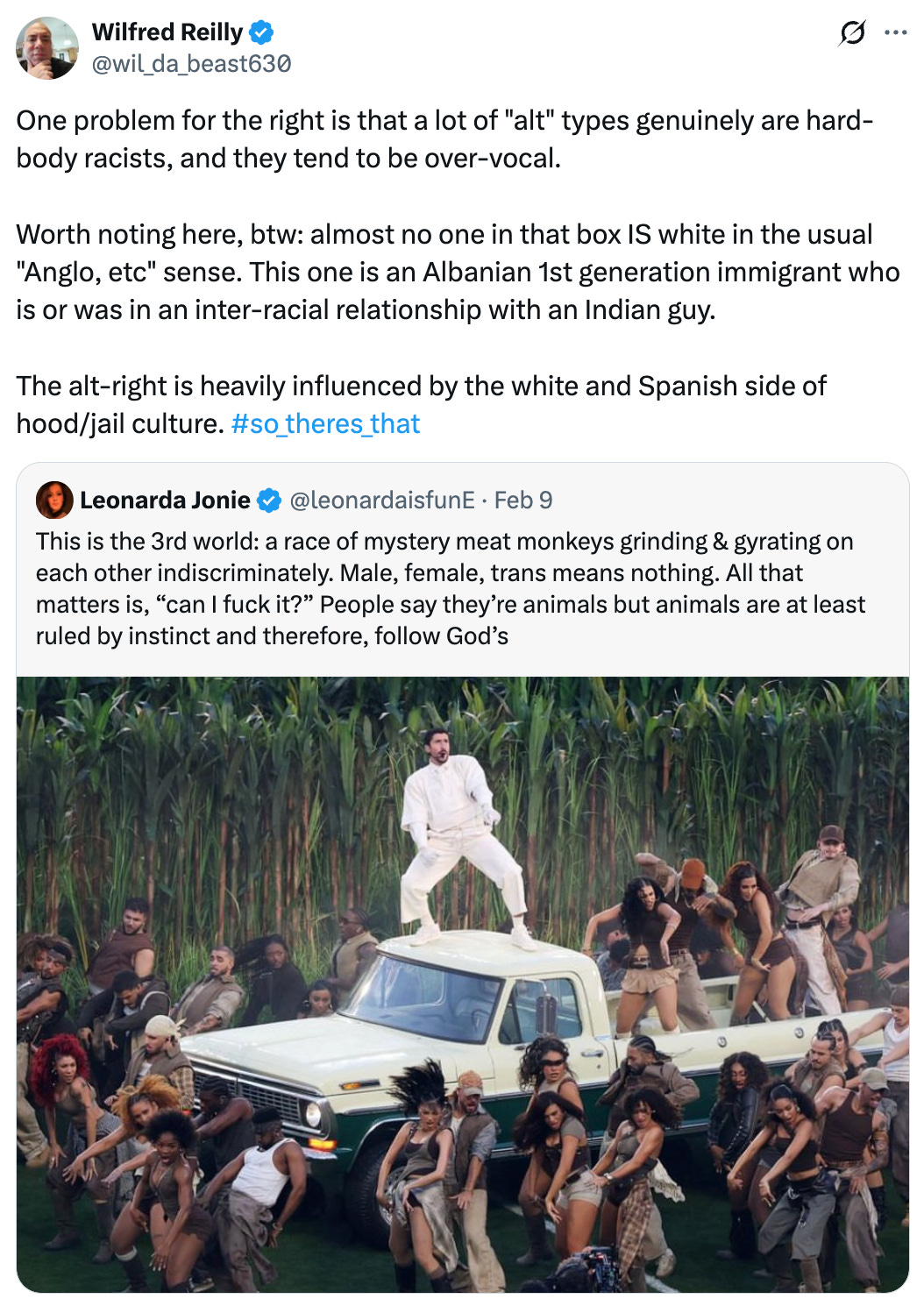
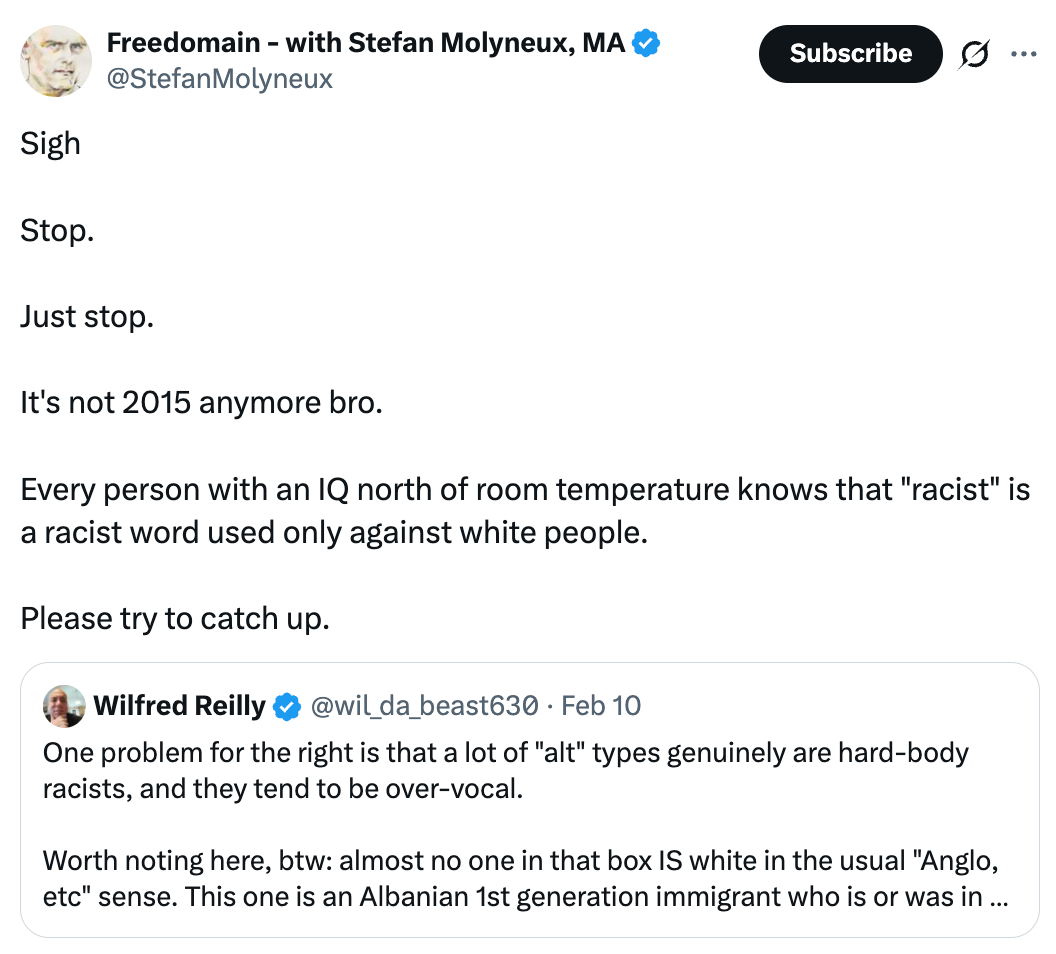
The simplest definition of ‘far-right’ is ‘people on the furthest right end of the political spectrum.’ What this actually means in terms of values and beliefs is therefore dependent on the range of any political spectrum in any country in any period. The far-right in Saudi Arabia does not look like the far-right in the United States, and the far-right in the eighteenth century does not look like the far-right today. Nevertheless, we have people who openly acknowledge themselves to be on the right of the most right-wing parties in the UK or US objecting to being called ‘far-right’ and indicating that this is a slur.
In the same way, the word ‘ethnonationalist’ refers to people who are nationalists and whose perception of national belonging is centred on ethnicity. Yet we see people who hold precisely this position objecting to being described by the most literal term for it.
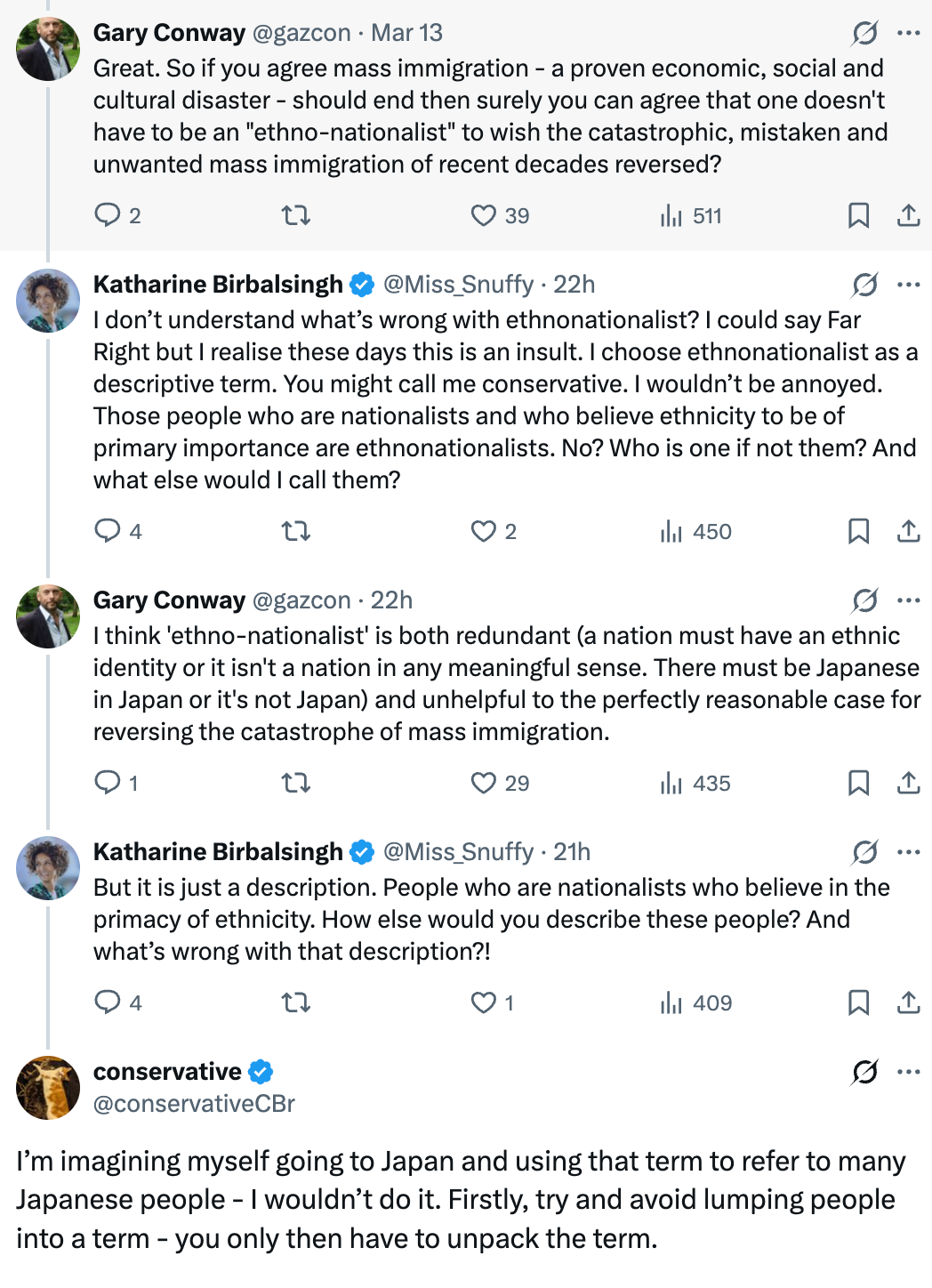
But if ‘ethnonationalist’ simply means ethnicity-centred concepts of nationalism, there is nothing more to unpack. This is not a complicated or ambiguous position. It’s irrelevant whether someone can imagine himself describing a Japanese person this way or not. If that is a Japanese person’s position, that is simply what they are.
There are, I would argue, three related reasons that people do this.
Firstly, there is the issue where these terms have been abused and fired at people whether they apply or not as a condemnation by activists of the Critical Social Justice movement. When a descriptive term becomes synonymous with ‘bad person’ this will produce instinctive ‘No, I’m not!” denials from people who are driven more by vibes and feelings than by definitions and reason. It also enables people with a more sophisticated but intellectually dishonest mindset who know very well what words mean to cynically redefine them as ‘terms that identify their speaker as the worst of our political opponents” to dismiss the accusation without addressing it. Wilfred Reilly is correct to note that this functions as the same kind of trap used by activists of the CSJ movement.
Secondly, and relatedly, ideologues are prone to denying labels which both apply to them and indicate that theirs is a fringe position. This is because they want their position to be understood as simply being the morally good, reasonable or evident one. We saw this with the Critical Social Justice movement too when it resisted any terms other than ‘Social Justice” to define itself. They claimed that what people began to call ‘woke’ to distinguish it from the aim for a just society (which is something we all want) was just being an empathetic person, addressing social realities and caring about their fellow human beings. Similarly, identitarian ideologues on the right want racism, far-right positions and ethnonationalism to be understood as simply reasonable, ethical and evidence-based views held by people who care about the good of society without doing the work of convincing people that this is, in fact, the case. Making fringe beliefs rejected by most people as unethical and divorced from reality harder to talk about by resisting definitions of them makes them harder to criticise and marginalise them out of mainstream political discourse.
Thirdly, there is the issue of shame and denial. These are people who are morally conflicted. They are typically genuinely very conservative and they feel a lot of anger with the identitarian left and a sense of urgency about immigration levels and problems with cultural cohesion particularly in relation to Islam. However, they are not naturally inclined either by disposition or by their longstanding principles to the radical, reactionary, collectivist mindset that enables a genuine commitment to racism, far-right views and ethnonationalism. They are not entirely convinced that this is who they want to be and that these values are ones they can ethically justify. Consequently, they are motivated to ‘soften’ and minimise the stance they are taking into something they consider more respectably conservative that they can live with and react defensively to having it pointed out that it is, in fact, far-right, racist ethnonationalism they are endorsing.
We need those on the far-right taking these stances to own them honestly. Those who knee-jerk react to having the views they actually espouse named accurately with a defensive “No, I’m not!” because those views are widely considered bad need to recognise the difference between genuinely not holding them and believing them to actually be good. This is what they would do if they genuinely believed the ideas were morally good, reasonable and evidence-based in a way that should appeal to the majority of people of good will and common sense. Some already do, of course, and will proudly declare their racism, ethnonationalism and position on the far right. This is not pretty but it does at least allow them to be seen as they really are and to be accessed for strong and accurate criticism in a way that prevaricating about labels impedes. It also makes it much more difficult for the morally conflicted trying to deceive themselves about what these views actually are to do so. It enables conservatives who reject those stances to distinguish themselves from them and offer a better alternative.
Those of us trying to engage with people who hold racist, ethnonationalist far-right views from a critical standpoint need to be able to cut through this self-protective tactic of linguistic evasion. We need not to enable proponents of them to get away with obfuscating what they are advocating and merge these views with much more justifiable ones about immigration levels and cultural cohesion, and ask them to justify these positions specifically. This is very difficult when they will not allow them to be named, but not impossible.
I have, for some time, been avoiding the term ‘far-right’ because it simply makes people identify me as a leftist who dismisses everybody who disagrees with her as ‘far-right’ even though I am not. Instead I have been saying ‘those on the furthest right of the political spectrum.” Even though this means exactly the same thing, it does not trigger the same ‘discourse recognition’ reflex and makes people less likely to categorise me as a political enemy and more willing to acknowledge that this is what they are. In the same way “people who evaluate others by their race” and “people with an ethnicity-centred concept of nationalism” can convey exactly the same views as ‘racists’ and ‘ethnonationalists’ without triggering the same defensive denial response. This makes it more likely that you will be able to get to discussing the central issues of substance.
Insisting on addressing substance is the only way to get at bad ideas and defeat them. This, at root, is the primary reason that ideologues attempt to make their own ideas difficult to criticise, including by quibbling over what they are called. If someone truly believes their ideas are good, reasonable and supported by evidence, they should have no difficulty defending them clearly and honestly. The refusal to name those ideas accurately is a strong sign that the person advancing them is not entirely convinced themselves. Ethical conservatives will be best placed to challenge obfuscation on the illiberal right that seeks to conflate radical, fringe positions with their own defensible ones and make them mainstream, but to do that they will need to pin their proponents down. Political disagreement can only be productive when we are willing to describe positions plainly and defend them honestly. When the argument becomes about whether those positions may be named at all, discussion collapses into evasion.
I left my local Quaker meeting about 50 years ago over their unwillingness to see that racism in the Rhodesia sense was roughly equivalent to inter-tribal discrimination and domination in the more General African context. People are not blank slates and subpopulations are not identical in their characteristics. I look for people to treat one another based upon their individual characteristics and behavior, not upon perceived or believed group properties. And by this measure many of the strident anti-racists fall into the classic racist camp - all the while denouncing their opponents as evil racists.
The 'racist' term has been so broadly overused that to me it has lost its impact.
I am a grumpy old meritocrat - evaluating at the individual basis.
I agreee with this in principle. But at the same time it's also true that some terms shift in de-facto meaning in the dominant culture to the point where they really can't be used in their original meaning even by people who fulfill the literal definition of the term, and believe there's nothing BAD about doing so -- because more or less everyone will judge them as identifying with the NOW dominant usage of the term, as opposed to the original and often literal meaning.
A good example of this is the term "incel" -- in a literal sense it means involuntarily celibate. A neutral term that describes someone as being celibate, i.e. having no sexual partners, and that the celibacy is involuntary. In other words it distinguishes someone who is celibate because of not having found a suitable and willing partner but wanting one, from someone who is celibate by choice.
But despite the fact that this is clearly the literaly meaning of the word, and historically if I'm not mistaken it was first used by a woman to describe herself -- *today* the culturally dominant usage of the word is quite different.
Today it usually means something like "Straight man who is celibate because he's unable to find any women interested in having sex with him, and who responds to this with some mixture of entitlement and misogyny." -- Pretty often the term even gets abused even further to mean something like: "Man who expresses any kind of frustration in any way about any part of dating"
You could say someone who fulfills the literal definition of the term "shouldn't" mind having the term applied to them. But in a world where the term de-facto DOES mean "awful person" and not just "person who isn't having sex", there's pretty good reason for people to reject the label.