


(Audio version here)
Since the presumed suicide of Jason Arday, political narratives over who was to blame have escalated in intensity and extremity. These competing narratives tend to collapse several separate questions into one: why Arday reached such a prominent academic position, why concerns about his work were not addressed earlier, why the eventual media scrutiny became so intense, and what ultimately led to his death.
For many on the identitarian left, the culprits were clearly the media which every day broke new stories about different claims made by Arday, previous attempts by academics and journalists to raise the issue of plagiarism, the shutting down of such inquiries by Arday and Cambridge using the police and legal pressure, interviews with people who knew him as well as opinions on the psychological cause of his inventions and particularly on the issue of ideological capture by Critical Social Justice theories and whether and how this played into the appointment of Jason Arday and failures to take concerns about his academic integrity seriously.
To many public commentators from this tribe of the left, the sheer volume of these stories amounted to harassment which hounded Arday to his death. Further, the motivations for such an intense interest in the case could only be a culture of white supremacy that resented black people gaining professorial roles. Soon the media attention to the case was being deemed a ‘lynching’ - the illegal killing of an individual by an angry mob - including by prominent voices within the realm of critical theories of race. Organised demands for censorship of the press escalated. These focused primarily on state or institutional regulation on reporting of misconduct that could cause any subject of this distress or specifically those of racial minority.
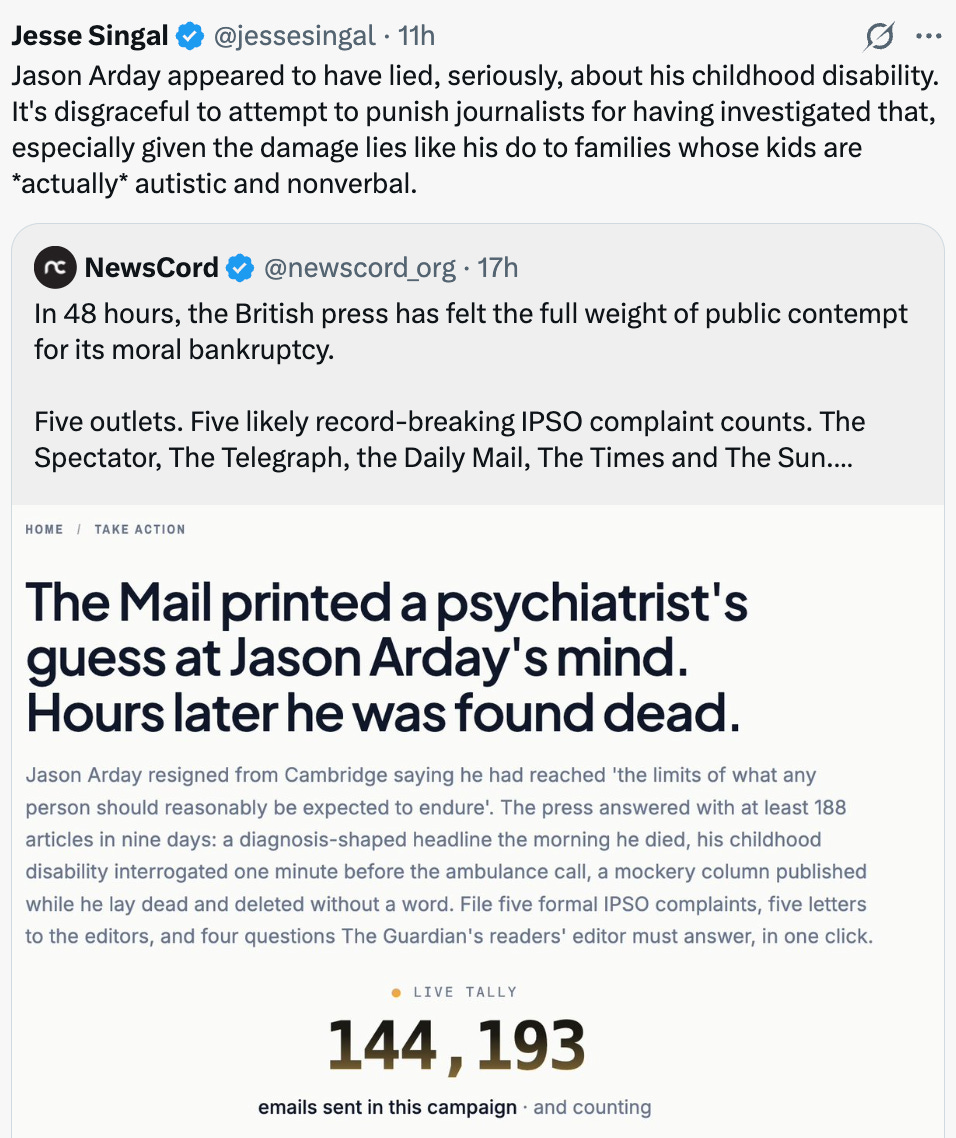
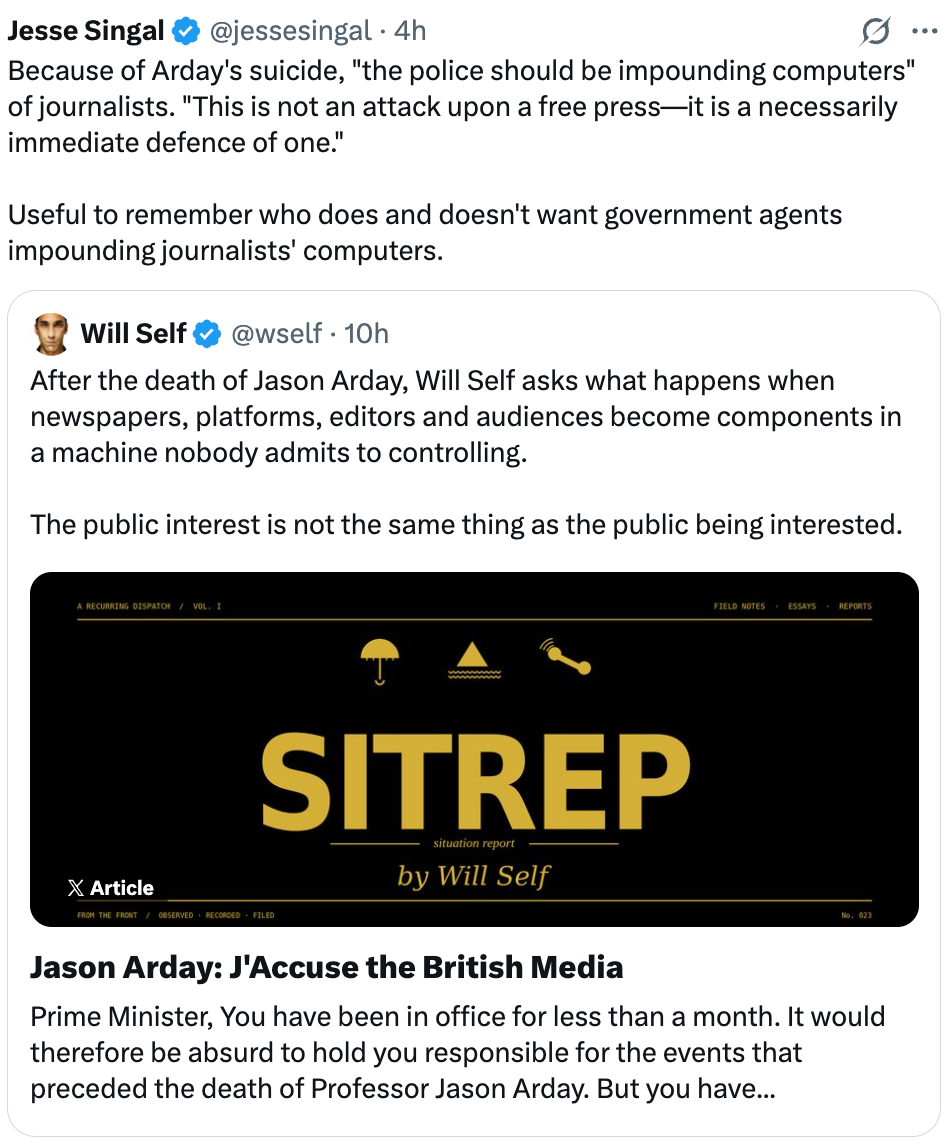
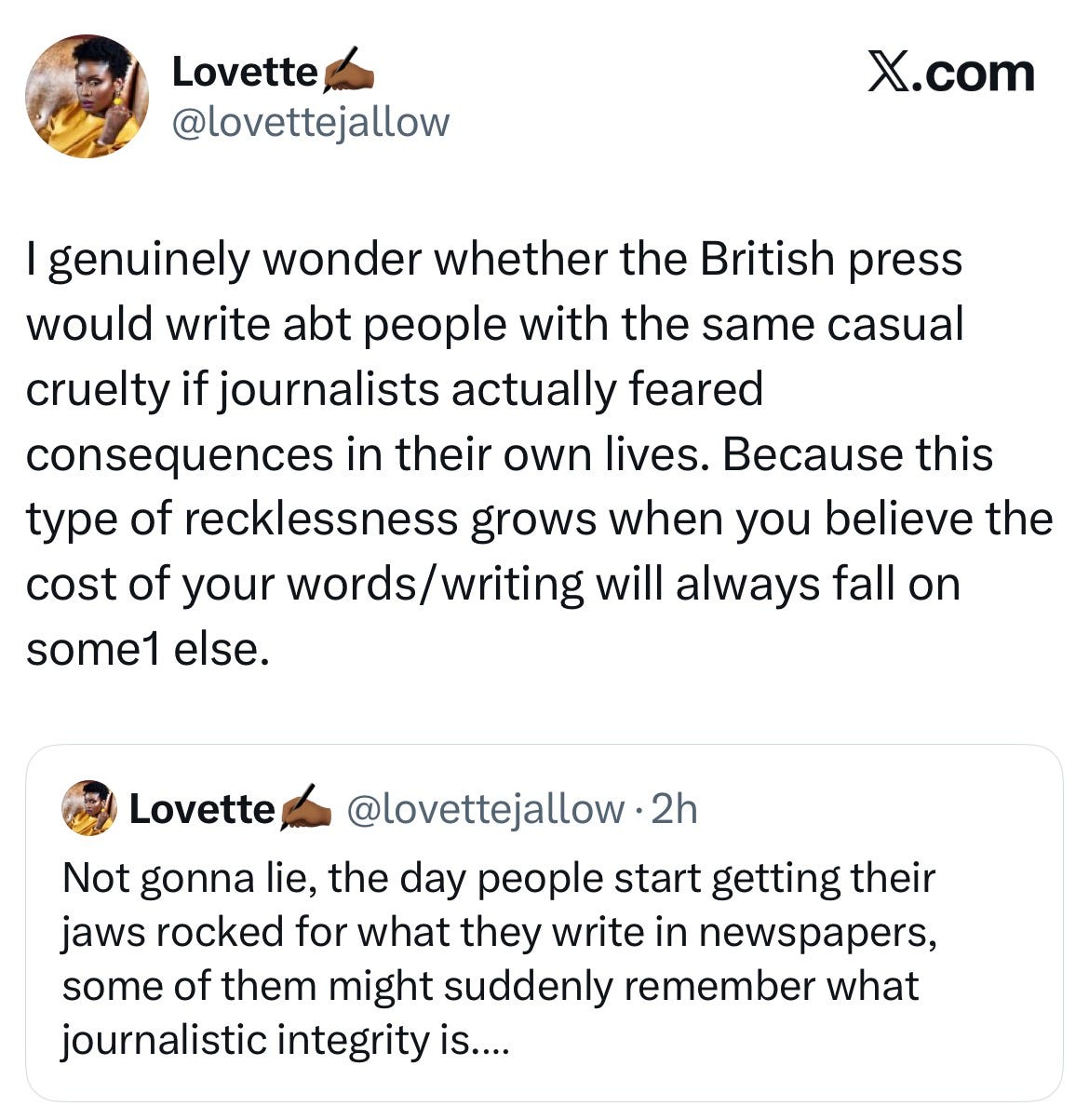
There have also been a handful of alarming threats to individual journalists who report in ways deemed unacceptable.
For many others, but especially critics of the Critical Social Justice (CSJ) movement, significant responsibility for Jason Arday’s death lies with Cambridge University and the culture of universities more generally and their ideological capture by this movement. This stance is underlain by two connected claims. The first focuses on the appointment and promotion of Arday himself. It argues that Cambridge’s interest in Arday was not his academic excellence (his publication record was thin and previous positions brief and unremarkable) but his racial and neurodiverse identity, his focus on Critical Race Theory and his personal story of having overcome great obstacles to do remarkable things. His attraction, in short, was as a symbol of diversity, equity and inclusion and it placed a psychologically vulnerable man of 37 in a high profile position with responsibilities that exceeded his capabilities. Some argued that this was done purely for the optics of his intersectional marginalised identities and personal story and cited reports that it displaced two women of racial minority whose CVs were much more suited to the expectations of the post. This was argued to be unjust not only to the women but to Arday himself. Because he was not able to meet the expected standards and because of his extravagant fabulism, the façade was bound to come crashing down at some point and the toll on him would be excruciating.
The second, related claim is that the intense media scrutiny on Arday was facilitated by the university itself and again because of an authoritarian commitment to the optics of Critical Social Justice. If Cambridge had responded appropriately when other academics first raised concerns about potential plagiarism, the argument goes, the issue could have been dealt with internally and privately. Instead, the response from both the university and Arday himself was to shut down such inquiries, reporting a colleague and a journalist to the police for harassment and engaging an aggressive law firm to defend him from scrutiny while creating a culture which intimidated fellow academics out of voicing any concerns. When institutional processes to detect academic misconduct fail, the job falls to investigative journalists. Because investigation revealed the stories Arday had told of his life to be so extravagant and the truth of them was in the public interest due to a claimed £1.4 million book deal, the media machine was set rolling.
This argument also applies more generally to the ability to criticise the work of scholars using Critical Social Justice theories. Much of the interest in this case has been due to pre-existing concerns about the unquestionability of theories like Critical Race Theory within universities themselves. Academics wanting to make a critique of truth claims or ethical principles within this branch of theorising or argue that it is not fit for the purpose of addressing racism, sexism, homophobia etc. have found themselves accused of holding those bigoted views and threatened with professional consequences, leading to self-censorship.
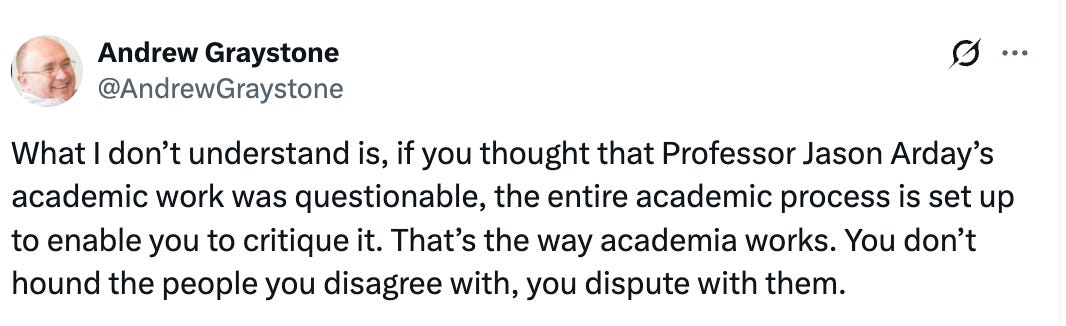
This would be a perfectly reasonable objection if academia did, in fact, still work like this. A university is the place where ideas like Critical Race Theory should be disputed. This has been made increasingly difficult over the last 15 years and resulted in the formation of alternative spaces - heterodox, gender critical, anti-woke etc. - in order to critique these ideas. These have been valuable but also vulnerable to becoming echo chambers and increasing atomisation and polarisation. Because critique of ideas which have significant power and influence within universities has largely had to come from outside universities, the system of internal critique by which Prof. Arday’s work as well as his alleged academic misconduct could have been addressed more quickly, thoroughly and without massive public attention were lacking. Consequently, the ideas and misconduct have become inextricably connected and media reports have, with some justification, focused on both of them as different facets of the same problem of ideological capture within universities.
Others have argued that by focusing on the press or the universities as the problem, people are neglecting the primary driver of both the media attention on Jason Arday and his death which is Arday himself. It was he who made the decisions which led to highly credible accusations of plagiarism and fabulism and he who took his own life (assuming that indications of suicide are correct). There is validity here too. The tendency to portray Jason Arday as the passive victim of external systems has manifested in an infantalising process that stops seeing Jason, the man, as a human being with agency and reconfigures him purely as a symbol. This has happened on both sides with his defenders frequently referring to him as a vulnerable young man (he was 41 with an adult daughter) preyed upon by racist forces and critics portraying him as a pawn and ‘poster child’ for Equity, Diversity and Inclusion. Neither of these give him the dignity of being an adult human being in his own right with his own combination of personal qualities and values who makes his own decisions for which he can praised or criticised.
At its most unsympathetic, those taking an uncompromising ‘personal responsibility’ stance insist that we look at the situation as one man making a decision to plagiarise the work of others for his own advancement and tell tall tales in order to secure a profitable book deal. When his deceptions were discovered, he then made a cowardly decision to end his own life rather than face professional consequences and selfishly inflicted great pain on his wife and children and left them to deal with his mess. In this telling, Arday was simply a bad scholar, bad father and bad person.
I cannot support this interpretation. We cannot read the mind of Jason Arday and he cannot now tell us what his thought processes were. If we accept that he was guilty of plagiarism and fabulism, there are two explanations for this: dishonesty and mental illness, potentially in some combination. The most charitable view we can take is that he was not purely dishonest and that some part of him believed his own stories or had genuine difficulty separating them from reality or his own ideas from those of other people. This interpretation is supported by how extravagant and easily disproven some of his claims were. They were bound to be exposed at some point. Those who are fully in touch with reality and seek simply to advance themselves dishonestly usually make efforts to keep this plausible.
I keep imagining the thought processes of Jason Arday. If it was the case that he was a man who, for reasons psychiatric or neurological, had difficulty distinguishing grandiose stories from reality or his own thoughts from other people’s, then he was, indeed very vulnerable. As such a figure sought to understand himself, find his place in the world and form connections with other people and did this via the creation of stories that received warmth and approval, he could be extremely vulnerable to being fed into political narratives and incentivised to keep creating the stories that facilitated his warm reception.
Isn’t this interpretation of events pure speculation on my part produced by a combination of empathy for a man who was surely on some level, vulnerable, and is now dead and a pre-existing concern that the Critical Social Justice movement reductively tokenises those it claims to champion and coerces them into affirmations of its own belief system? Yes, clearly it is. I cannot claim to know the truth of the matter any more than anybody else can. I, like so many, am falling into the trap of making Prof. Arday into a symbol of vulnerability in ways that confirm my own prior assumptions and creating stories about him. The best I can do is be self-aware about this and say honestly, “I don’t know the truth.” I will read him charitably and assume that he was not purely self-interestedly dishonest. I will not use him as a symbol of “victim of all that is unethical with the CSJ movement” but base my criticisms of that movement on what I can know. I will consider his suicide a tragedy and, rather than regarding it as selfish or cowardly, feel deeply sorry for the intensity of desperation and despair that must have led him to that radical act.
At the centre of these positions about who is responsible for the death of Jason Arday - a racist media, an ideologically captured university or Arday himself - are arguments about why precisely the media chose to focus so intensely and for so long on this particular case.
Was it because we live in a society permeated with white supremacist beliefs that will take every opportunity to dunk on a black man who had the temerity to obtain a professorship?
Was it because there is such widespread legitimate concern about ideological capture within universities and an inability to address this within universities?
Was it because this individual case was just extremely compelling on its own terms and there was great public interest in its details?
A badly underappreciated explanation for the intense media scrutiny is the last one, which is also the simplest. People asking, “Explain why this particular case of plagiarism gained so much attention when these comparable cases perpetrated by white scholars did not?” seem not to have considered this at all. To my knowledge, there are no comparable cases in terms of the ability to fascinate. Cases of plagiarism generally involve one scholar being found to have appropriated the work of another for banal motivations of advancing their career. This is a problem but not a terribly interesting one. The Arday case included shamanic prophecies, dismembered animal corpses, brain tumours, amnesia, medical miracles, well building, time travelling to feature in TV shows before his birth, millions of pounds raised for charity, masked knife wielding assailants & world class endurance feats undertaken on a broken leg. In terms of sheer sensationalism, this was compelling. From a purely commercial point of view, it was a page turner that would have readers returning to read the next installment. Every day some new story was uncovered to add to the full account of a truly bizarre unfolding story. Those expecting the public to simply look away were not being realistic.

It was this aspect of the case that made some commentators who had long been very critical of ‘wokeness’ (including me in my first piece on the subject) uneasy about focusing on Arday personally as a dishonest scholar-activist of the kind we had so often criticised. It seemed likely that he was mentally unwell. As Nigel Biggar, a longterm strident critic of ‘wokeness’ wrote,
He’s trapped in a world of fantasy. Whatever his personal guilt, there’s a tragic quality to his predicament. For, when reality does finally break through, Nemesis will enter, too. A terrible reckoning will cause the self he’s constructed to disintegrate. I fear for his life.
They urged focusing instead on the institutions which had colluded in shutting down those trying to raise concerns about plagiarism. It remained in the public interest to uncover these stories and determine which had some truth in them and which could be disproven given that a book based on many of these stories was forthcoming. But for those of us focused on seriously addressing problems in the academy and within left-wing identitarian movements, capitalising on the exposure of one academic who appeared to be, as conservative politician, James Cleverly put it, ‘a vulnerable fantasist’ felt dishonourable.
This argument is also well-supported: the Arday case attracted widespread interest because he was a high-profile academic at a top university whose work and personal story placed him firmly within Critical Social Justice, amid pre-existing concerns about ideological capture in universities and an inability to address this within universities. I made this case on X in response to Ash Sarkar’s claim that the intense media interest was because he was black.
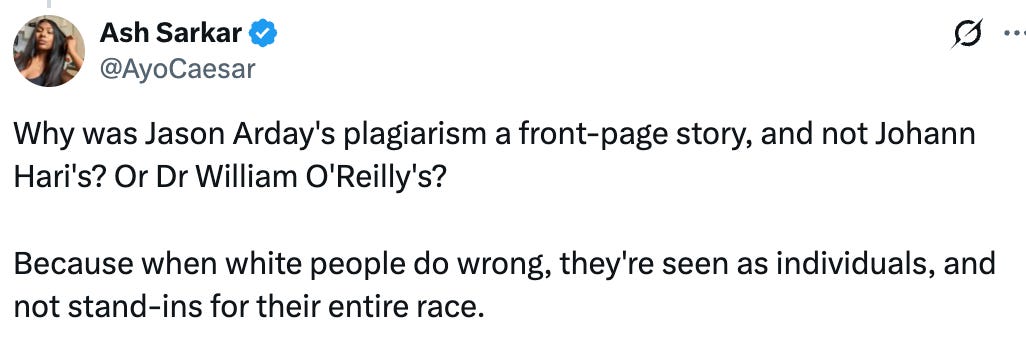
I replied that this was incorrect. I agreed that Jason Arday was responded to not purely as an individual but as a member of a group towards whom there was public animus but that that group was “Critical Social Justice scholars and activists’ rather than “black people.” I pointed out that the media was not treating him as a representative of black people but of those scholars and that the broader context the case was being tied into was not “What does this tell us about black people?” but “What does this tell us about the state of academia?” These are very different things. This thread was shared 500 times and, before long, I was subjected to a social media pile-on that accused me of justifying the lynching of a black man and my X account is currently unusable. I am not particularly troubled by this and have come to accept it as part of being a political and cultural commentator who annoys illiberal types on both the left and right.
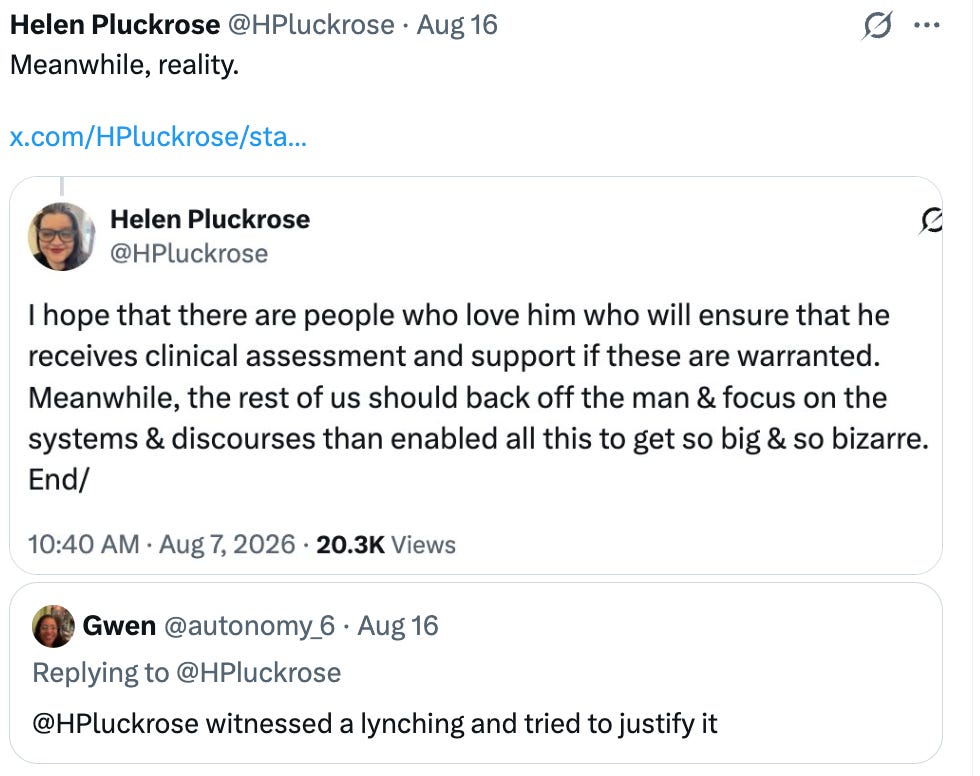
I stand by my claim that the critical media coverage of this case which saw the Arday affair as an example of a larger problem affecting society overwhelmingly presented that problem as the ideological capture of universities by left-wing identitarian politics and not as the appointment of black individuals to professorial roles.
Some people have presented as evidence that the motivations of the media are racist the fact that critical reporting has been particularly intense from right-wing outlets. This does not demonstrate that. Right-wing outlets being the most vocal about institutional problems on the left is hardly remarkable. Nor is it inherently suspicious. Leftwing outlets are also most vocal about institutional problems on the right. We might wish that they would each focus just as much on problems on their own side, but they do not. All we can do is have expectations of them that they make their critiques well-informed and honest and regard as unreliable those which do not, while individually reading both right-wing and left-wing outlets to minimise our own political bias.
In fact, this case has been remarkable in that it has not just been the right recognising and addressing the problem. A particularly good balanced review came from the New York Times, and the Guardian has also published several pieces on it. Among the most popular opinion pieces on the issue have been analyses of the role played by ideological capture in universities by black academics who are able to offer both principled objections and personal accounts. These include postcolonial scholar, Femi Owolade, left liberal John McWhorter, and socialist Tyler Austin Harper.
It is very important that we reject the Critical Social Justice movement’s conflation of their own ideas with black people. CSJ is a particular Western political theoretical framework which includes theories about race. Black people are human beings who may or may not subscribe to this theoretical framework. The claims of the CSJ movement to represent the views of black people are contradicted by evidence that black people, like white people, are politically and philosophically diverse. Claims that to be critical of CSJ is to be prejudiced against black people are therefore false. People can, do and should oppose racism from a variety of ethical frameworks.
For many of you reading my work, that framework will be liberalism - the philosophy of individual liberty. Liberals oppose racism on the grounds that people should be treated as individuals of equal inherent social and moral value and with equal right to life, liberty and the pursuit of happiness. Any attempts to constrain or limit individuals on the grounds of their race, sex, sexuality or other immutable characteristic are illiberal, intolerable and must be resisted. We typically oppose CSJ because it does constrain individuals on these grounds and seeks to impose specific views, values, beliefs, experiences and knowledges on people according to their identity and deter dissent using authoritarian means.
Does this amount to a claim that none of the media response to the Arday affair or none of the appetite to read about it was motivated by racism? No. We can, and I would argue should, reject the hypothesis that the intensive media focus on this case is driven by a pervasive culture of white supremacy that objects to black people having professorial roles, but the claim that racism has manifested around this case is supported by evidence.
There have been some blatantly racist responses to the story online and some extremist outlets have also been unambiguous in their belief that black people are intellectually inferior and cannot be academics.
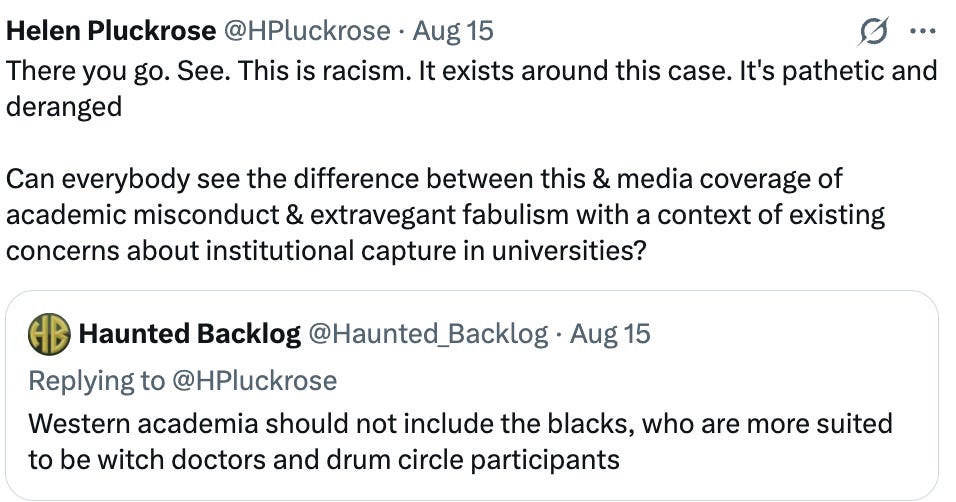
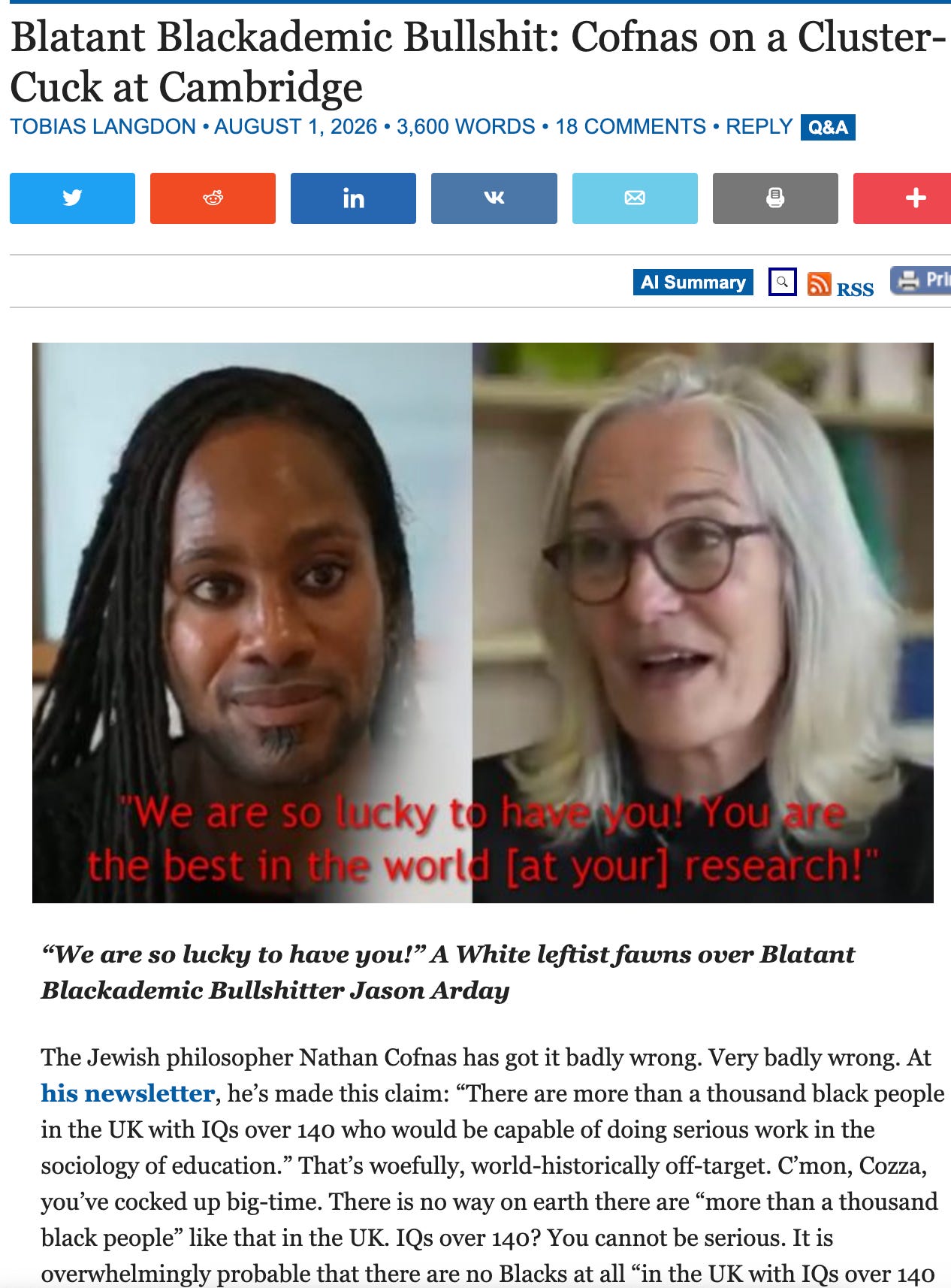
Equally, and potentially more concerningly (due to the plausible deniability inherent within it), some people with genuinely racist views do use legitimate concerns about ideological capture by Critical Social Justice theories and associated DEI (or in the UK, EDI) policies and programmes to their own ends. Their concerns are not genuinely about shoddy epistemology, dubious and inconsistent ethics, counterproductiveness in reducing racism or authoritarian speech control among the scholars and activists of this movement. They were either always rooted in racial animus and white identity politics or have become so in an illiberal, tribal reaction to the CSJ movement’s identity politics and conflation of their own theories with black people.
This is a problem that exists and it is essential that it is acknowledged to exist and addressed. This is best done by those of us who criticise CSJ on the grounds of epistemology, ethics and effectiveness. We come in all races and from all over the political spectrum and are the best placed to detect and object to racism or other identity-based illiberalism masquerading as principled critique.

Nevertheless, we cannot dismiss all critique of CSJ as dishonourably motivated or refrain from principled critique because some of it is racist. There are legitimate and important reasons to criticise this school of thought and its authoritarian movement for those who care about reliable knowledge production, individual liberty and effective methods of addressing social problems. We must instead identify and marginalise bad faith engagement with the problem that seeks to exploit good and principled arguments.
There may be some grounds to criticise the media for its coverage of the Arday case, but current claims to that effect do not seem to be supported by strong evidence and many solutions that advocate suppressing the media in cases like this are alarming in their bias and authoritarianism. I would support a rigorous, empirical investigation into the focus of the reporting on this case purely for informative purposes. I do not anticipate that it would find evidence of a ‘racist feeding frenzy’ as claimed by Cambridge’s chancellor. I suspect that it would find a combination of focus on the details of Jason’s Arday’s stories in response to public interest in the bizarre nature of them and criticism of the case as evidence of ideological capture at Cambridge to address this preexisting concern about the state of academia.
The death of Jason Arday is a tragedy and questions can and should be asked about how he came to be in such a vulnerable position where so many extravagant tales of overcoming adversity to achieve great things failed to pass a fact check and credible allegations of significant plagiarism could be made against him and why this was able to happen at one of the UK’s oldest and most prestigious universities. This will not save Jason Arday, but it could provide information on how to recognise, support and protect both vulnerable individuals and important institutions. Turning such a complicated human and institutional tragedy into a simplistic activist morality tale, will not help us understand what happened, protect vulnerable people or improve the institutions involved. There are no winners here.
The Overflowings of a Liberal Brain has over 6500 subscribers! We are creating a space for liberals who care about what is true on the left, right and centre to come together and talk about how to understand and navigate our current cultural moment with effectiveness and principled consistency.
I think it is important that I keep my writing free. It is paying subscribers who allow me to spend my time writing and keep that writing available to everyone. Currently 3.8% of my readers are paying subscribers. My goal for 2026 is to increase that to 7%. This would enable me to write full-time for my own substack! If you can afford to become a paying subscriber and want to help me do that, thank you! Otherwise, please share!
Many thanks as ever for this miraculous overview and analysis of the overflowing river on all aspects of the intriguing Jason Arday story. For most of us who struggle and fail to even read a fraction of the stuff let alone know how to get our heads around it all, reading a careful balanced account is wonderful. It's therapeutic in the way great investigative journalism or great history or great inquiry reports are therapeutic. But those take years if not decades of team work to produce. Helen does it in a few days, and presumably single handed. The key feature is her simple recognition of the limits of what she can and can't be sure of, her own biases, and what she said that she now revises. It wouldn't be therapeutic if you didn't trust your therapist!
PS Further evidence of superhuman powers is to do this decade of work in a few days while playing "speed chess" with scores of dissenters on X to the point of (let's call it) "being cancelled" for now, and not need a few weeks convalescence to recover.
PPS And like the NHS you get the same service as those who subscribe (aka pay our taxes!)
In 2001, Spike Lee did a university lecture tour in which he lamented Hollywood's use of the damaging trope of the Magic Negro. Presumably he did not visit Cambridge.