

(Audio version here)
The Overflowings of a Liberal Brain has over 6000 readers! We are creating a space for liberals who care about what is true on the left, right and centre to come together and talk about how to understand and navigate our current cultural moment with effectiveness and principled consistency.
I think it is important that I keep my writing free. It is paying subscribers who allow me to spend my time writing and keep that writing available to everyone. Currently 3.8% of my readers are paying subscribers. My goal for 2026 is to increase that to 7%. This would enable me to write full-time for my own substack! If you can afford to become a paying subscriber and want to help me do that, thank you! Otherwise, please share!
The political discourse to the right of the UK’s Conservative party is currently highly conflicted and fractured. The problem is not simply that the British right disagrees about policy. It disagrees about something more fundamental: what Britain is. Within the current discourse three distinct and often incompatible answers have emerged: ethnic, religious and cultural. Within this debate are explicit and coherent differences of opinion about what it is conservatives who did not feel the Tories were conservative enough should be conserving. However, the larger popular discourse is characterised by a shared sense of a need to restore “Britishness” or “Englishness” to the realm, but considerable confusion about how that is defined. This appears to be due to a lack of shared first principles and conflation of ethno-biological, cultural and religious factors.
Since the Tories faced a dramatic dwindling of confidence over the space of a few years resulting in being voted out of power, the British right has been struggling to develop a coherent vision for its replacement. Nationwide, the loss of confidence was multifaceted and related to a variety of failings over a range of policy decisions. However, for those on the right, the problem was overwhelmingly about the failure to produce functional immigration policies. Consequently, Nigel Farage’s Reform Party, running on a platform of prioritising addressing immigration with a view to dramatically reducing it surged ahead in popularity polls, quickly outstripping both of the main parties in our previously two party system.
For those of us on the liberal left, the big question has been whether Starmer’s Labour can effectively address growing national concerns about immigration effectively and resolve other major causes of mass discontent by focusing on practical policies that benefit the working class before the next general election and prevent a Reform landslide. Then, last month, a spoke was placed in Reform’s wheel by the emergence of Rupert Lowe’s Restore Britain Party. Lowe had been a central figure in Reform and significantly on the right of it, before being ousted due to conflict with Farage and Chairman Zia Yusuf. Those who felt that even Reform was not radically right-wing enough and was, in fact, turning into a recreation of the Tories flocked there, egged on by Elon Musk.
The name “Restore Britain” and Lowe’s air of radical simplicity spoke successfully to that sense on the furthest British right of urgently needing to restore Britishness or Englishness. The party is still unclear about its first principles and what, precisely, it wishes to restore, despite making strong statements on a range of issues that appeal to voters seeking radical change.
For Co-founder and spokesman, Charlie Downes, Britain is defined by both British ethnic ancestry and the Christian faith. He rejects the view that British values are defined by liberal principles like democracy, tolerance, the rule of law and mutual respect for people of different faiths and beliefs and, instead, makes Christianity central. Others in the party have rejected this, pointing out that white Brits are the demographic least likely to have any religious faith and that, realistically, one can either increase Christianity or decrease immigration, but not both. Others have argued that trying to produce Christian Nationalism in the UK is both a non-starter and also an unpatriotic attempt to produce American-style politics and called for the ‘deyankification’ of the British right.
For many ethnonationalists who also reject liberal principles and want to ‘remigrate’ all black and brown people and have joined Restore with this view in mind, Christianity is either irrelevant or alien. As Steve Laws, leading campaigner for ‘remigration’ who has joined Restore, put it, “Blood is what makes you British but the people aren't ready to hear that yet. It's about your heritage, your ancestry and your roots to this land. Blood & soil. Our people existed before Christianity and they’ll exist after.” For some, Christianity is itself a Middle Eastern import that should be rejected in favour of the pre-existing Paganism. Ultimately, however, for ethnonationalists, genetic ancestry is everything and culture and religion mean very little.
Meanwhile, many former Reform members who switched allegiance to Restore, believing it to be more proactive but who still hold some degree of liberal principles and see these as central to the British philosophical traditions they wish to conserve, reject both of these positions. They insist that Restore is simply about preserving British culture and addressing immigration effectively and being welcoming of everybody who is already here and is patriotic and committed to conserving British values.
Often, members of these different factions - Christian Nationalist, Ethnonationalist and culturally conservative - speak as though their view is the defining one and anybody not understanding this is deliberately missing the point. Some, however, have begun to address the problem.
Tommy Robinson, whose primary focus has always been opposing Islam recently addressed this confusion, speaking from the “cultural preservation” position and posting from the United States:
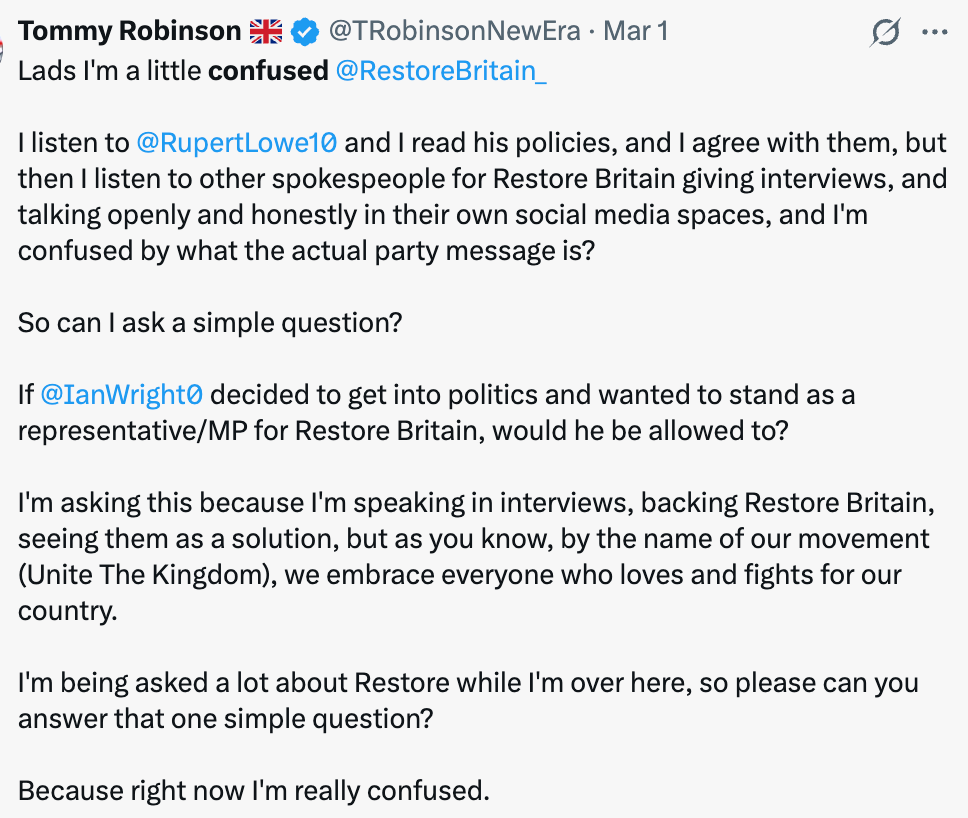
Political scientist, Eric Kaufman, accurately categorised Robinson as speaking from the culturally-conservative-in-a-way-that-conserves-liberalism camp when he responded: “Tommy Robinson rejects ethnonationalism in favour of a kind of anti-Islamic English liberal nationalism.” Ben Habib, who is of mixed English and Pakistani origin and is the former deputy leader of Reform and now head of Advance, another political party to the right of the Tories also asserted the cultural position when he challenged ethnonationalists among Restore members: “I am English and British. A darn sight more English and British than the prejudiced idiots who say otherwise.
We might all well be confused by the current mess on the British right. While some prominent figures have taken a decided position that the Britishness or Englishness that is to be restored is defined by Christianity or ethnic ancestry or commitment to the history, culture and traditions of Britain, many people engaging in general discourse seem to flit between the positions often conflating religion with culture more broadly, religion with race and race with culture.
This conflation and confusion occurs because the position being taken here is so often reactive. This is something that happens when people define their goals by what they oppose rather than what they stand for. This leads to reacting against specific examples of a perceived threat by reaching for whichever stance is most opposed to it. People typically call upon Christianity most strongly in response to objectionable manifestations of Islam or any manifestations of Islam but may not practice Christianity on a regular basis or at all. Race becomes the salient issue when somebody committing a crime or just holding an opposing view is black or brown but not Muslim but may become less relevant in the case of people with shared views. People typically call on elements of British or English culture and tradition in response to manifestations of other cultures and traditions but may not generally uphold those in their lives either. Liberalism is most commonly reached for when freedom of belief or speech is denied or when the rights of women or same sex attracted people are threatened but this may not indicate a commitment to protecting any of those consistently.
The mess is created by a profound failure to clearly articulate any first principles at all, let alone to organise around shared ones. This does not mean that no consistent features can be identified, only that no coherent framework has yet emerged among the factions to the right of the Conservatives that could form the basis of a stable consensus. What is clear, however, is that the proliferation of parties and movements clustering around immigration issues indicates a genuine and widespread public concern about ineffective immigration policy and cultural cohesion. The scale of support for these movements suggests that this concern is not marginal or fringe but widely felt.
Nor is it limited to the white majority, as illiberal identitarians on both left and right often imply. Surveys consistently show significant concern about immigration among ethnic minority Britons as well, with around 45% of Black Britons and 50% of South Asian Britons believing immigration levels are too high. Nor is the issue confined to the political right. Labour has significantly toughened its rhetoric and policy proposals on immigration, drawing criticism from some within its own ranks as well as from the Green Party.
Restore is not helping with coherence and this appears to be a feature rather than a bug. By leaving its first principles vague, the party can appeal simultaneously to ethnonationalists, Christian nationalists and traditional cultural conservatives. Each faction is able to imagine that its own interpretation of “restoring Britain” is the one the party actually supports.
This ambiguity may be politically useful in the short term, but it leaves the movement an unknown quantity and makes organising around shared goals difficult. It is hard to build a stable political project when its supporters are imagining fundamentally different things. The result is likely to be fragmentation and schism as those incompatible visions eventually collide, much as Reform itself fractured under the strain of its own internal disagreements.
As someone on the liberal left, the incoherence, schisms and factional infighting on the right can hardly be unwelcome, and neither can the emergence of Restore to divide Reform’s vote. I do not want to see large numbers of my fellow citizens become effectively organised around values such as ethnonationalism or Christian nationalism. These are damaging, illiberal ideologies that fundamentally undermine the liberal democratic philosophical tradition that developed in England — a tradition of which many of us remain patriotically proud.
Liberals on the left, however, cannot simply hope that the rise of the illiberal right will resolve itself by confusing and contradicting itself into an incoherent mess and then disappearing. A healthy liberal democracy requires a strong and coherent culturally conservative presence on the right. It is essential that such a movement be guided not by reactive grievance but by clearly articulated principles and that those principles be liberal. What we need to see, therefore, are liberal conservatives stepping into this role: those who wish to conserve the liberal philosophical tradition that produced modern Britain — individual responsibility, meritocracy, freedom of belief and speech, and equality before the law.
This is also what is most likely to work. When we examine the three competing conceptions of Britishness or Englishness currently circulating on the right, only the culturally conservative appears compatible with either social reality or political stability.
Christian nationalism is highly unlikely to succeed in Britain because Britain is simply not a religious country. Nor is the decline in active and literal belief in Christianity a recent phenomenon. English culture has long been temperamentally suspicious of religious zealotry. One might facetiously say this began when our Puritans became so troublesome we persecuted them out of the country and sent them to America. That is, of course, a simplification, but it gestures toward a deeper cultural tendency.
When the United States won its revolutionary war and wrote its constitution asserting that there would be no establishment of religion, much was written in England predicting that the country would quickly become faithless and atheistic. Instead, the opposite happened. Christianity remained culturally central in the United States while it gradually declined in England. Historians have often argued that this divergence emerged precisely because Americans had to build their own religious communities, whereas England retained an established church. Paradoxically, the existence of a state religion appears to have encouraged religious moderation and gradual secularisation.
As the Church of England settled into a moderate, mainstream institutional presence, it increasingly came to function as a kind of cultural background noise rather than a source of intense belief. Literal belief steadily declined. Today, just over a quarter of Brits believe in God, including only 56% of self-identified Christians. Culturally, we tend to respond to explicit declarations of religious faith with the same mild embarrassment reserved for people oversharing private matters. As a result, many English people are tolerant of Christianity as a personal belief but uncomfortable with attempts to bring it into the public sphere. (This is something people from more devoutly Christian minority ethnic groups have found difficult). Attempts to build a national identity around Christianity among white Britons are therefore unlikely to succeed. The resistance to Charlie Downes’s attempt to frame Restore Britain in explicitly Christian terms illustrates this cultural reality.
Ethnonationalism faces an even deeper problem. Proponents often insist that defining Britishness or Englishness ethnically is “not hard” and that it is simply a matter of ancestral DNA. They tend to pounce upon those of us referring to black or brown people as “British” or “English” and accuse us of denying biology and ‘explain’ that English (and sometimes British) is an ethnic group. They frequently end with “This is not complicated.” Well, no, it’s not. The rest of us are not confused. We just disagree with you.
It is, I would argue, ethnonationalists who are going against biology. They are trying to make people think in ways human brains do not naturally think. In practice, human beings do not naturally organise themselves with reference to ancestral DNA. Our brains were simply not built to attend to race because, unlike sex and age, this was not a significant feature over evolutionary time. Studies repeatedly show that when individuals cooperate toward shared goals, they retain an awareness of the sex and age of their collaborators but quickly lose track of racial categories.
Our evolved social psychology is built to detect cultural alliances, not genetic lineage. We recognise shared language, norms, customs and values as indicators of group allegiance far more readily than we recognise skin colour or other aspects of ‘race.’ That is, we recognise culture. In order to make oneself regard race as significant one has to consciously take on a belief system that ties ethnicity into group loyalty. Only then will the cognitive mechanisms we have to detect allies and enemies attach themselves to racial categories. Ethnonationalists clearly have done this and remain bewildered and frustrated that the rest of us have not.
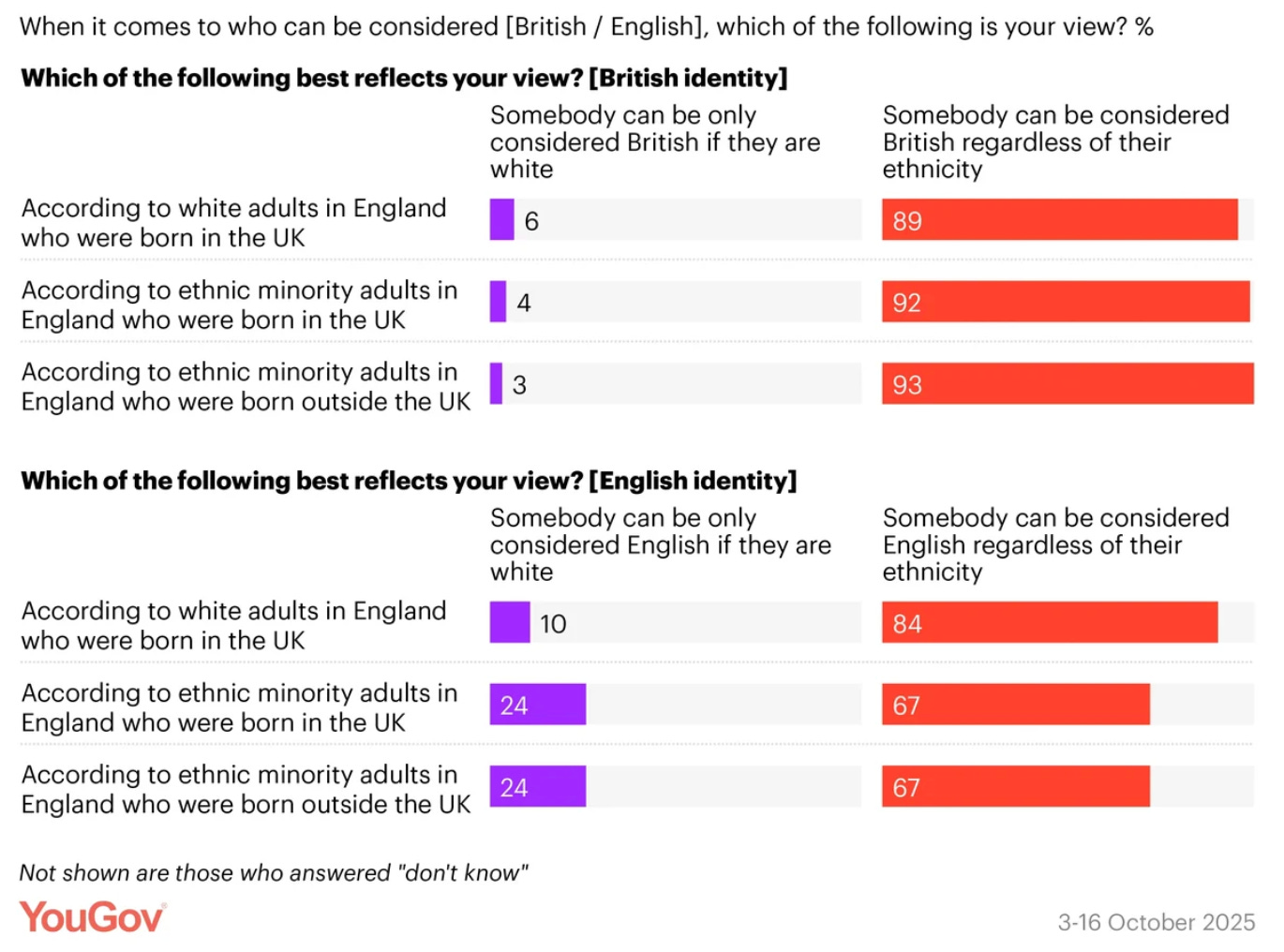
For most people, cultural recognition remains far more immediate than racial categorisation. It is profoundly difficult to stop recognising friends and neighbours who share one’s language, humour, mannerisms and social norms as “one of us” simply because they have a different skin colour.
I was reminded of this while visiting San Francisco. Walking down the street I heard the accent of my home town, London, behind me. Instinctively I felt that small jolt of recognition: “my people are here.” When I turned around I discovered that the voices belonged to a group of South Asian Sikh lads. I stopped to say hello. They recognised my accent as readily as I had recognised theirs and grinned at me. We chatted. Over the course of the week we ran into one another a few more times and always exchanged smiles and greetings.
What produced that moment of recognition was not shared ancestry but shared culture: speech patterns, humour, mannerisms and the countless subtle signals that mark a shared social code. In a city thousands of miles from home among people with different speech patterns, humour and mannerisms, those cues immediately created a sense of familiarity and ‘home’.
This is the kind of social recognition human beings evolved to perform. Attempts to persuade people to ignore these powerful cultural signals in favour of ancestral lineage are therefore likely to struggle. Ethnonationalists are not appealing to the way human social cognition naturally operates, but asking people to override it.
The conception of national identity that aligns most closely with both human social instincts and Britain’s historical development is therefore cultural. This can include those small markers of what we often call “national character”: understatement, self-deprecation, the gratuitous use of irony for no good reason, politeness, emotional reserve, beginning conversations with strangers by saying “Sorry,” and much else besides. These are the kinds of things people mean when they tell me that I am “very English.” They are not saying that, by looking at me, they can detect an entirely Anglo-Saxon genetic profile. This is fortunate, because genetically I am mostly Welsh with a dollop of Italian and a smidgeon of French and English. What they are really saying is that I embody a familiar cultural stereotype of Englishness. I do. I am extremely English, and for the most part nobody feels any urge to dispute this.
But the cultural understanding of Britishness or Englishness is far larger and more important than these small social markers. Britain is the home of the great philosophers of liberalism: John Locke, Adam Smith, Mary Wollstonecraft, Thomas Paine and John Stuart Mill. The culture that developed around their ideas shaped how people in Britain came to understand politics, institutions and civic life. People recognise themselves as belonging to a shared culture expressed through ways of speaking, debating, organising institutions and resolving disputes. Britishness and Englishness have long been defined less by ancestry or religion than by a distinctive political and cultural tradition: parliamentary democracy, the rule of law, equality under the law, freedom of speech, religious tolerance, an understanding that only material harm justifies coercion and the expectation that individuals should be judged by their conduct rather than their identity.
When people criticise multiculturalism, they are commonly criticising an imperative to accommodate people who do not uphold these views and do not wish to integrate themselves into this culture. These criticisms are absolutely valid and they are at the root of cultural conservatism. These concerns are also widely shared among people on the left and the right, people of all races and people from a variety of religions and none. Immigration policies that require those who wish to live here to commit to the fundamental principles of a liberal democracy can command broad consensus in a way that demands for ethnic or religious conformity never could.
For this reason, cultural conservatism can work, but only when it remains liberal. A cultural conservatism rooted in liberal principles preserves precisely the traditions that many people who half-heartedly and inconsistently invoke Christianity or ancestry actually wish to defend: freedom of belief, stable institutions, civil disagreement and a society in which people from different backgrounds can participate under the same rules. With these values, people actually have shared first principles and they are standing for something, which enables coherence and consistency.
Without those liberal foundations, British cultural identity itself cannot survive. A movement defined primarily by opposition to perceived enemies or threats quickly becomes incoherent, shifting between incompatible definitions of itself. A movement grounded in shared liberal principles, by contrast, possesses a stable framework within which cultural continuity and political disagreement can coexist.
And that is ultimately the question facing the fractured British right today: not whether Britain should be restored, but what it is that they believe Britain actually is.
Useful overview which essentially argues that three competing ideas of national identity are now circulating on the British right – ethnic, religious and cultural – and that only the cultural-liberal version is politically viable. I agree.
The section where you describe “speech patterns, humour, mannerisms and the countless subtle signals that mark a shared social code” is a particularly good illustration of what really binds a culture together. It gets at something most thoughtful people intuitively understand.
If only the technocratic class could grasp the point rather than getting tied up in category errors (the inability to distinguish between Islam as an ideology and Muslims as people being the most pernicious example, repeated again just yesterday by Wes Streeting).
We should probably also stop talking about things being “to the right of the Tories” as if the Conservatives have been meaningfully right-wing for the past fifteen years rather than a kind of zombie Blairite distortion.
What the UK actually needs to rediscover is cultural conservatism rooted in Enlightenment liberalism.
When I seize power, it shall be thus.
Thanks for summarising it so well 👌