

(Audio version here)
I am frequently told that the word ‘liberal’ has become so confused and contested, and so deeply associated with the (often illiberal) left in the United States, that attempts to defend it as a distinct philosophical tradition are no longer worthwhile. While I generally agree that it is futile to try to reclaim words to their ‘proper’ meaning, liberalism is not simply a word that can be replaced with another word. It is the term for the cluster of concepts that form the philosophical foundations of modern Western liberal democracies. To explain why I believe it remains essential to preserve the concept of liberalism, it is worth taking a historical and geographical look at how liberalism came to be associated with different political positions in different countries and what would be lost if we abandoned the concept altogether.
As a general rule, I believe it is futile to try to hold onto words when their meanings have changed in common usage. Language evolves naturally in response to a variety of pressures to serve the purposes of communicating changing ideas and concepts. I have always argued that if this is reflective of a worrying cultural shift, it is better to engage with the ideas and concepts than to try to remedy the problem by insisting on universal recognition of what the word ‘really means.’ At best, the conversation shifts to a discussion of semantics which does not address the core issue. At worst, one ends up looking like an angry, old man yelling “‘Gay’ means ‘happy’, I tell you!”
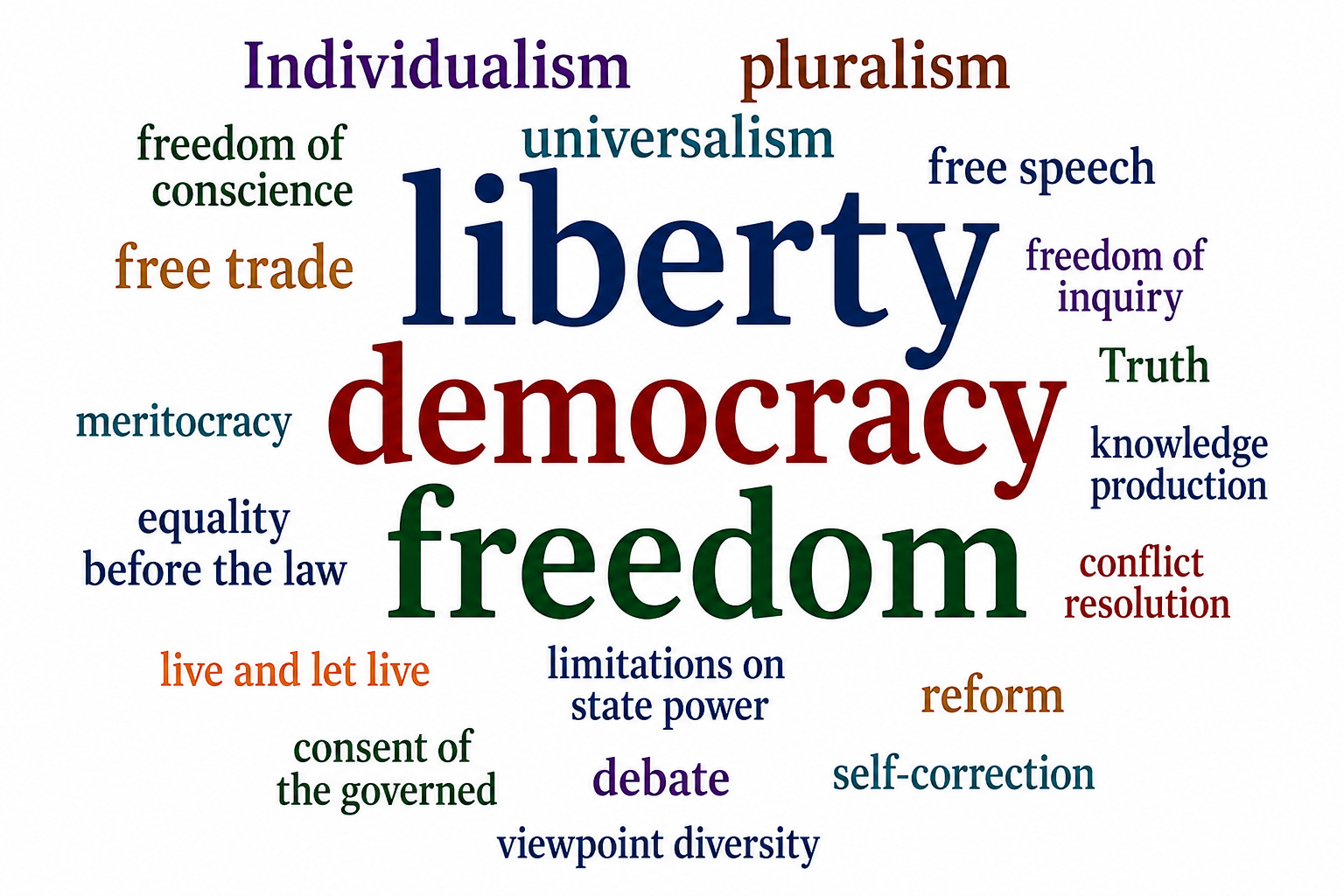
When it comes to liberalism, however, we are not talking about a word which could potentially be replaced by another word, but about the cluster of concepts underlying the foundation of modern Western liberal democracies. These include individual liberty, universalism, freedom of conscience, free speech, free trade, freedom of inquiry, meritocracy, equality before the law, support for viewpoint diversity as an engine of knowledge production and conflict resolution, a willingness to live and let live provided this does no material harm to others, firm limitations on state power, a preference for reform over revolution and a democratic system which governs by the consent of the governed.
Once we stop using the word ‘liberalism’ to describe this philosophical tradition, we find ourselves having to list all those concepts individually every time. This makes for rather laborious conversation. In practice, it also risks separating these concepts from each other and losing a sense of the cohesive philosophy which binds them together and defines the modern west.
The fact that ‘liberalism’ is used to define such different positions on the left/right political spectrum in different countries is illustrative of the history of this philosophy. When I speak about liberalism in other countries, the part where I clarify what I am not talking about varies widely. In America and parts of Europe, I have to stress that I am not referring to the left. In Australia and other parts of Europe, I must clarify that I do not mean the right. Liberalism does not belong to either the left or the right but uses of its name for such positions are revealing of what its principles were competing against historically in a particular country.
In countries where the main threats to liberty have been monarchy, feudal systems, nationalism, religious conservatism or traditional social hierarchies, liberals have been the people pushing for reform, civil liberties, secularism and democratic rights. Consequently, liberalism became associated with the left. We see this history in France, Spain and Portugal. It is also very much the case now outside the Western world in religiously conservative countries where people push for religious tolerance, women’s rights and the rights of same sex attracted people. The ‘woman, life, freedom’ protests in Iran following the death of Mahsa Amini in the custody of the Morality Police is very much a liberal protest against state authoritarianism.
In countries where strong socialist or Marxist movements emerged, liberals became the defenders of markets, private property, free trade and constitutional constraints on state power. Consequently, liberalism became associated with the right. We see this in Eastern Europe after communism, in Germany, the Low Countries and much of Latin America. Interestingly, we also see this in Australia where the Liberal Party is the conservative party. This is because Australia was established as a British colony after the major great liberal battles had been won. It never had to oppose a powerful feudal order, monarchy or church. Australia did have to deal with powerful rising Labour Movements and consequently the free trade, free enterprise and minimal government interference elements of liberalism emerged most strongly and associated liberalism with the right.
Both the United States and the United Kingdom are interesting cases within this general pattern. The US - the first country to be explicitly founded on liberal principles following its (liberal) revolution against authoritarian state power from England - has retained a strongly libertarian ethos and deep suspicion of state overreach. America has also never had a significant Marxist electoral force. Both its left-wing and its right-wing currents have supported free trade and free enterprise. It has also retained a significantly stronger cultural influence of Christianity than all the other English-speaking countries and much of the West. Consequently, its political conflict has largely been between religious conservatives and progressives within a capitalist framework. As a result, “liberal” came to be associated with the progressive side of politics, particularly after the New Deal and Civil Rights eras.
The UK, as the home of John Locke who developed the philosophical foundations of liberal government, Adam Smith who articulated economic liberalism, Thomas Paine who argued for democratic liberalism and John Stuart Mill who synthesised liberty, free speech, individuality and representative government, has a history in which liberalism developed as a distinct philosophical tradition separate from left and right-wing politics. Further, it developed into a significant political force of its own creating a three-way political distinction: Labour (socialism and economic redistribution), Conservatives (tradition and social order) and Liberals (individual liberty, constitutionalism and equal rights). Because liberalism existed as its own political tradition, the meaning remained somewhat clearer than it did elsewhere. Unfortunately, because the UK is currently so deeply tuned into US political and cultural debates, we are increasingly hearing ‘liberal’ used to describe the (often illiberal) left.
What these histories demonstrate is that although the word ‘liberalism’ has come to be used to refer to different positions on the political spectrum in different countries, its underlying function has remained remarkably consistent. Whether liberals were opposing monarchies, feudal system, theocratic authoritarianism, nationalist movements, military dictatorships or socialist states, they were engaged in the same fundamental freedom-oriented project. The specific threats to liberty liberals have found themselves opposing have varied according to time and place and, consequently, came to be associated sometimes with the left and sometimes with the right. What remained consistent was its commitment to individual liberty, freedom of conscience, freedom of inquiry, viewpoint diversity, universalism, constitutional constraints on power and democratic government. The history of liberalism is therefore not the history of a particular faction within the left-right spectrum, but of a long chain of people in different times and places committed to a philosophical tradition rooted in protecting people from authoritarian power and enabling people with different ideas and values to live together peacefully within free societies.
This is why I continue to defend the term ‘liberalism’ despite generally being skeptical of attempts to police linguistic change. If liberalism were just a word, it would not matter very much if it drifted in meaning or fell out of use. Words come and go. Concepts evolve.
The problem is that liberalism is the irreplaceable name we have for a coherent philosophical tradition that binds together an array of political, intellectual, economic and social freedoms. These are not simply a collection of attractive but unrelated values that we can pick and choose from. They form a cohesive system. Each principle supports and reinforces the others.
Once we stop thinking in terms of liberalism, it becomes easier to think of these principles as separable. We begin to imagine that we can keep democratic systems while abandoning freedom of speech, or preserve viewpoint diversity while weakening freedom of inquiry, or uphold individual liberty while expanding the powers of the state into the private lives of individuals. Keeping the concept of liberalism intact and true to its philosophical heritage reminds us that these commitments belong together because they emerged together and have historically succeeded together.
This matters because liberalism is not simply one political philosophy among many. It is the philosophical foundation of modern Western liberal democracies. When conservatives speak of defending Western civilisation, this is surely what they are seeking to defend. When progressives speak of hard-won civil rights victories, this is the philosophical tradition to which they are indebted. We cannot have a society in which conservatives lose sight of what they are conserving and progressives fail to recognise what achieves progress. The institutions, rights and freedoms that many of us take for granted did not emerge naturally or inevitably. They were won through centuries of intellectual, political and social struggle against myriad authoritarianisms. Liberalism was the tradition that united these struggles and articulated the principles on which modern democratic societies would be built.
If we lose the concept of liberalism, we lose sight of the philosophy that distinguishes liberal democracy from authoritarianism, democratic citizenship from subjecthood and modernity from the medieval world. We lose the language that enables us to recognise these principles as parts of a coherent whole and to defend them as such. For this reason, ‘liberalism’ is one term I am not prepared to surrender. The word is worth defending because the philosophy it names is worth defending.
The Overflowings of a Liberal Brain has over 6500 subscribers! We are creating a space for liberals who care about what is true on the left, right and centre to come together and talk about how to understand and navigate our current cultural moment with effectiveness and principled consistency.
I think it is important that I keep my writing free. It is paying subscribers who allow me to spend my time writing and keep that writing available to everyone. Currently 3.8% of my readers are paying subscribers. My goal for 2026 is to increase that to 7%. This would enable me to write full-time for my own substack! If you can afford to become a paying subscriber and want to help me do that, thank you! Otherwise, please share!
Would you consider laying this argument out in memes? I'm specifically thinking of side by side photo style memes...
"This is a Liberal." "This is NOT a Liberal."
"This is Liberalism." "This is just malignant ass-hattery disguised as Liberalism."
I really hope I never land on the wrong side of that second meme, but fair play is fair play.
Thanks for this piece here, Helen, I again appreciate the clarity of your thinking.
A challenge that I see comes with the assertion that core "given" of the Liberalism we want to keep in mind is the concept of individual liberty. This is certainly true and helpful in many ways, but still sets up an easy ability to mistakenly see the word "individual" there more as an adjective and "liberty" as the noun. Which then leads to all kinds of unhelpful debates and arguments over what we mean by "liberty," as well as most of the regressive thinking around diversity, equity, and inclusion where the actual individual human is often entirely negated.
In my opinion, viewing the "individual" as the noun, claiming the related characteristics of self-sovereignty and inalienable dignity as givens, then allows liberty to be seen as one of many natural consequence of this framing. This centrality of the individual also supports all the other terms and concepts in your word cloud, such as equality before the law, free speech, consent of the governed, etc...
It also directly implies Democratic participation (everybody gets one equal vote), the Scientific Method (focus on process and evidence, controlling for biases), and almost every other socio-cultural component of Modernism. Additionally, putting the individual back at the center automatically course corrects many of the illiberal downsides of both the woke left and woke right.
So much juicy territory here, thanks again for your high quality "overflowings"!