

(Audio version here)
The Overflowings of a Liberal Brain has over 6500 subscribers! We are creating a space for liberals who care about what is true on the left, right and centre to come together and talk about how to understand and navigate our current cultural moment with effectiveness and principled consistency.
I think it is important that I keep my writing free. It is paying subscribers who allow me to spend my time writing and keep that writing available to everyone. Currently 3.8% of my readers are paying subscribers. My goal for 2026 is to increase that to 7%. This would enable me to write full-time for my own substack! If you can afford to become a paying subscriber and want to help me do that, thank you! Otherwise, please share!
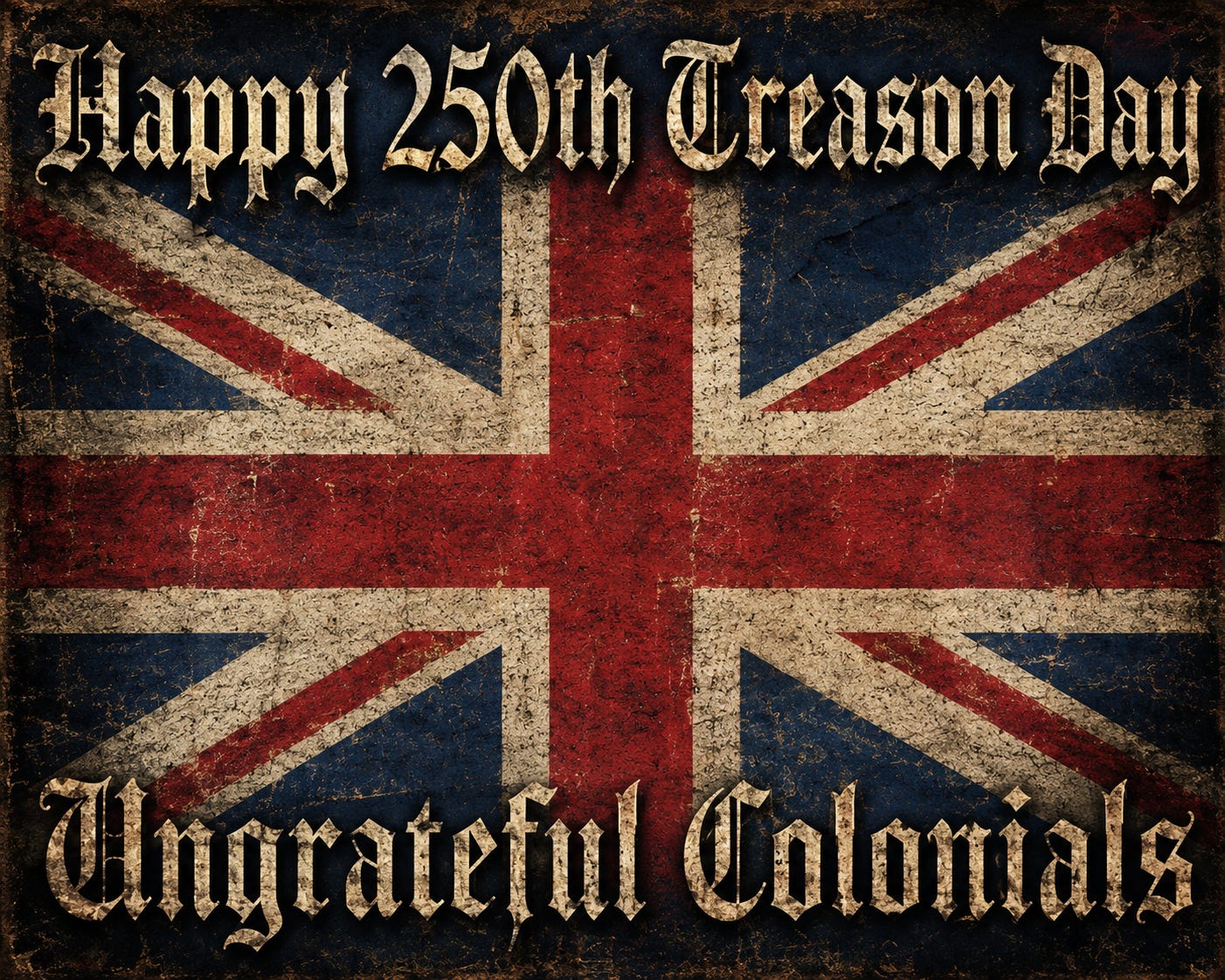
I have a longstanding tradition with my American followers on Twitter. For the last fifteen years, every Fourth of July, I have posted some variation of the above meme. I am then immediately deluged with memes of eagles freedoming superciliously, tea being thrown into harbours, and men in star-spangled underpants behaving ill-advisedly in hurricanes.
Every year, I feign disgust at Independence Day, when Americans celebrate having thrown off British rule and established themselves as an independent state. Every year, Americans feign continued resistance by gleefully and inventively showering me with memes celebrating that victory. I thoroughly enjoy it.
I am a proudly patriotic Briton who celebrates the Fourth of July. Why?
The American Revolution was a thoroughly liberal enterprise
All too often, people criticise liberalism as weak and ineffective. They imagine it to be defined by endless discussion: talking about ideas rather than acting decisively. This is a profound misunderstanding. Liberalism is defined by the pursuit of freedom—individual liberty, freedom from arbitrary state interference, free speech, free enterprise, government by the consent of the governed, and the rights to life, liberty and the pursuit of happiness.
These principles were not established through polite debate. Liberalism was forged in centuries of struggle against illegitimate authority: battles to limit the power of rulers, secure representation in government, and establish the freedom of individuals to choose their own paths without coercion. If liberalism can now seem characterised by arguments over how best to preserve and extend these freedoms, it is because those earlier struggles were, to a remarkable extent, successful. Liberal democracy became established as the framework within which such debates could take place.
That was not always so. Those freedoms had to be fought for, and nowhere was that struggle more clearly articulated or more decisively realised than in the revolution that founded the United States of America.
One particularly valuable overview of liberalism for its sheer intuitive graspability is Adam Gopnik’s A Thousand Small Sanities: The Moral Adventure of Liberalism. In it, Gopnik includes a feature of liberalism as a preference for reform over revolution. Unlike theocratic or communist regimes, liberalism does not seek to overthrow societal systems and impose new regimes on citizens by fiat. It seeks to effect societal change by the will of the people as established through democratic processes.
This preference does not foreclose the possibility of revolution, however. In order for the will of the people to be expressed, a liberal order in which they can do that has to have been established. To paraphrase Gopnik, revolution is entirely compatible with liberalism when:
Its goal is liberal (the expansion of freedom);
Its aims are specific rather than simply to destroy the existing order;
Those aims could, in principle, be achieved through democratic processes; and
Those democratic processes are unavailable.
The American War of Independence exemplifies this.
It sought freedom from external colonial rule.
It sought to establish an independent liberal order based on self-government.
Those goals could almost certainly have been achieved democratically had the colonies possessed democratic institutions through which to pursue them.
They did not.
This was a thoroughly liberal revolution.
Does the establishment of liberal principles as the foundation of a society mean that it will immediately become perfectly liberal and remain so forever? Clearly not. The principles enshrined in the Declaration of Independence and the Constitution were drawn directly from the philosophy of Locke, Paine and other Enlightenment thinkers, much of it developed in Britain. Britain, meanwhile, continued to colonise so many other countries that there is now an Independence Day celebrated somewhere in the former British Empire roughly every six days. America, despite establishing itself on the principle that it is self-evident that all people are created equal and endowed with the rights to life, liberty and the pursuit of happiness, took considerable time to recognise that black Americans are people to whom this applies.
There are many, particularly on the identitarian left, who point to this reality and conclude that liberalism is itself oppressive. This is mistaken. The coexistence of liberal principles and illiberal practices is a reality that our deeply imperfect species will likely always have to contend with. The crucial point is that liberal principles provide the means by which those practices can be recognised, criticised and reformed. Slavery, colonialism, feudal class structures, patriarchy and the persecution of religious and sexual minorities were not inventions of liberalism. They always existed. Liberalism provided the moral and political framework by which they could be identified as illiberal and increasingly recognised as intolerable.
Those of us who now live in liberal democracies are the heirs to, and beneficiaries of, this philosophical tradition and system of government. We are the current custodians of liberalism, and it is our responsibility to understand, value and uphold the principles that have done so much to advance human freedom, human rights and knowledge. We must remain vigilant against state overreach and against the rise of illiberal ideologies that seek to undermine our shared philosophical inheritance, and we must be prepared to oppose them consistently and decisively, especially when those illiberal currents emerge among our own tribes.
Celebrating Independence Day, for me, is a celebration of those enduring liberal principles and of the continuing commitment to defend them. As a patriotic Brit currently visiting America, I am delighted to be able to go out and celebrate it with you today.
Happy Independence Day. Long may the experiment in liberty continue.
Deeply grateful for Helen’s work. She cuts through the tribal noise to remind us that liberalism is a self-correcting engine for human progress, not an oppressive trap. And honestly, the sheer shock and awe of her annual "Happy Treason Day" meme is the exact antidote we need right now—a rare, brilliant reminder of how to laugh at ourselves instead of weaponizing wit to hurt each other. We might have ruined some perfectly good tea in 1776, but we kept the best part of the British Enlightenment. Cheers to a brilliant mind for keeping us grounded, laughing, and thinking. I just love our English cousin Helen!
Happy 4th, Helen! Thanks for your beautiful, lucid exposition of liberalism. Exactly what we Yanks need on our 250th birthday!