


(Audio version here)
Yesterday, the feminist Substack account, Liberating Motherhood, published a letter from a female reader struggling with a profound mismatch in needs for emotional intimacy in a heterosexual relationship. The response from the writer of that account, Zawn Villines, has annoyed me intensely. It seems to me to be a perfect example of our current problem with ‘battle of the sexes” narratives getting in the way of good and reasonable people with much to offer a partner being able to have healthy relationships. In writing about this, I found myself returning to arguments I was having with other feminists thirty years ago, and to some of the experiences that shaped my commitment to liberalism in the first place.

The writer of the letter reveals having a much higher need for emotional intimacy than her partner. She describes her attempts to get him to talk more about his feelings and the relationship as gaining in intensity and urgency as she became more insecure. She acknowledges having pursued him and “talked things to death trying to find a way to understanding and repair.”
This appears to have overwhelmed her partner to such an extent that he has withdrawn almost entirely, leaving their shared home and wanting very little contact with her. He has said that her mode of emotionally expressive communication makes him feel flooded and anxious and that he has serious reservations about her approach to conflict and boundaries. Two therapists working with him think he’d benefit from an assessment for autism and that this could explain both his low level of emotional expression and his “overwhelm” response. Their couples counsellor has recommended she respond only minimally when he initiates contact and focus on caring for herself.
The writer clearly feels a great amount of shame that her attempts to reconcile their differences have focused on her own need for emotional intimacy and not enough on his need for emotional space. As a hyperverbal person myself, I feel deeply sympathetic to her compulsion to resolve issues by ‘talking them to death,’ even though this is clearly counterproductive given his withdrawal. I think her decision to go beyond therapists with in-depth knowledge of them both and consult a feminist outlet for “mothers who are pissed off about sexism, household chore inequality, and endless misogynistic bullshit” was ill-advised.
Zawn Villines responds to the letter from a political standpoint which sees men and women as cogs in a system designed to oppress women. She diagnoses the writer’s problem as having been socialised by patriarchy to undervalue herself and her needs. She interprets her partner’s behaviour as a power play in which men weaponise psychological terminology around attachment to get women to shrink themselves and attend only to men’s needs.
Villines claims to be able to see the future because she has seen this pattern repeatedly in heterosexual relationships, but then attributes behaviours to this man that the woman has not described. She depicts him as making endless demands and requiring his partner to be his emotional caretaker when what she has actually reported is his asking her to leave his emotions alone and give him more mental space. She accuses him of meltdowns, tantrums and childishness when his response has been to become anxious and withdraw.
Villines then confidently asserts that he will either demand she give up her career to support his or demand she become the breadwinner while undermining her career. The letter-writer has indicated nothing like this. She also predicts that, if they have children, he will become physically or emotionally abusive to them and their mother. Villines declares that his behaviour will always make his partner feel unwanted and unhappy, leaving no room for the possibility that, despite being emotionally inexpressive, he might care deeply for her and show this through practical support, loyalty and commitment.
Villines does offer two useful pieces of advice. She says it does not matter whether this man’s low level of emotional expression and discomfort with large amounts of emotional expression is caused by autism. It does not. One does not need a neurodevelopmental disorder to be legitimately emotionally private or to find excessive emotional expression uncomfortable. She also says the writer needs to accept that this relationship might not be right for her. It might not be. They may be able to accommodate their very different needs, but they might also each be happier with somebody closer to their own place on this spectrum.
The rest seems like absolutely terrible advice which, if taken to heart, is likely to encourage a woman who currently recognises that insecurity causes her to verbalise emotional distress in ways her partner finds overwhelming to recast herself as the unambiguously injured party. This will not help her current relationship or future ones. Their best chance is for her to continue recognising and working on this tendency while considering his need for emotional space, and for him to recognise how difficult his low level of emotional expression is for her and find clearer ways to communicate his care and commitment despite not naturally being emotionally expressive.
When people are reading the world through ‘battle of the sexes’ narratives, these kinds of individual solutions that focus on the people involved as they really are and seeks to get each individual to better understand the other and find ways to resolve differences can never be considered. They focus only on ‘men’ and ‘women’ as groups with interests and power dynamics theorised to dominate everything according to theories of ‘patriarchy’ or, conversely, ‘gynocentrism.’ Every situation is therefore interpreted towards this end, leading to an utter dearth of consistent principles, empathy, compassion, reason and recognition of the individual human being who loves and seeks to be loved.
Imagine that the writer had been a man reporting that he felt he had overwhelmed his female partner with his emotional expression and urgent insistence that she share all her feelings with him and repeatedly affirm her commitment to the relationship to an extent where she had left their home and was avoiding contact with him? He was aware that he had been centring his own needs by communicating in this way and needed support in giving more consideration to those expressed by her? Is it at all likely that somebody reading the situation through a feminist lens like Villines’ would respond that he was undervaluing himself and his own needs and that she was being abusive and he should flee the relationship? I think not. Instead, this admission would likely be used as evidence of the devaluation of women’s needs and controlling behaviour produced by having been socialised into patriarchy where men feel entitled to continuous emotional support from women at their own expense.
Meanwhile, on the other side of this toxic coin, those contenders in this destructive battle who believe that men are systematically disadvantaged and it is women’s needs which are constantly prioritised and women who have an entitled attitude, would read the situation very differently. They would see the woman in this account not as somebody who struggles with insecurity but loves her partner deeply and wants to repair the relationship via the very communication he is finding so overwhelming, but a mentally unstable, emotionally abusive control freak who believes herself entitled to ignore reasonable boundaries and could potentially become dangerous. In our current discourse, “Borderline Personality Disorder’ would be likely to be diagnosed and weaponised and even argued to be women’s natural state of being and enabled by the “feminisation of society.” If it had been the woman who had withdrawn from the relationship due to becoming overwhelmed by a male partner’s volume of emotional expression and demands for emotional availability, this would be interpreted as women lacking in accountability, being emotionally abusive and manipulating the man via ‘the silent treatment.’
It is all a horrible, toxic mess which threatens to greatly increase misunderstanding and loneliness for anybody who buys into either narrative.
I would argue that there is a direct equivalent in (misandrist variations of) feminist analyses of mismatched needs for emotional intimacy between men and women, on average and (misogynist variations of) men’s rights activist analyses of mismatched needs for physical intimacy between men and women, on average. It is, of course, entirely possible for the man in a heterosexual relationship to be one who has a greater desire for emotional availability and frequent discussion of feelings and the state of the relationship or for the woman to have a greater desire for sexual intimacy and more frequent sex. However, statistically, this mismatch much more commonly manifests in more women complaining that men are insufficiently emotionally available and more men complaining that women are insufficiently sexually available. Consequently, this is what has found its way into the battle of the sexes and I have engaged with the latter on X many times.
The arguments over a mismatched desire for physical intimacy typically take the form of those who consider themselves to be arguing in the interests of men insisting that women in relationships who lose interest in sex or have never had a high libido are failing in their duty to their male partners and should have sex whether they want it or not. This is often accompanied by a threat of sanctions for not doing so. “Tell her you’re not in the mood for paying the mortgage if she tries that” is a common refrain. Other men always respond to this by saying they have no wish to have sex with an unwilling partner and it is men’s job to inspire the desire for sex in women. However, men are very likely to believe that regular sex is an essential part of a romantic relationship and, aside from times of illness or other physical barrier, that a sexless relationship is unsustainable. Women are the sex most likely to report a loss of sex drive and finding their male partners’ continued appetite for it very stressful and anxiety-inducing, sometimes leading them to dread bedtimes and avoid any form of physical touch in anticipation of being invited to sex and facing disappointment and frustration if they decline.
I get drawn into these arguments when I counter arguments that sex is something women must provide if they want their husband to continue being the main breadwinner by pointing out that this closely resembles Second Wave Radical Feminist arguments that marriage is a form of prostitution for women (or that women typically also have jobs now). However, I have drawn more fire for responding to someone making a strong and, I would argue, insupportable claim that men repeatedly asking for sex (pressuring) or saying that they will end a relationship in the absence of sex is a form of rape.
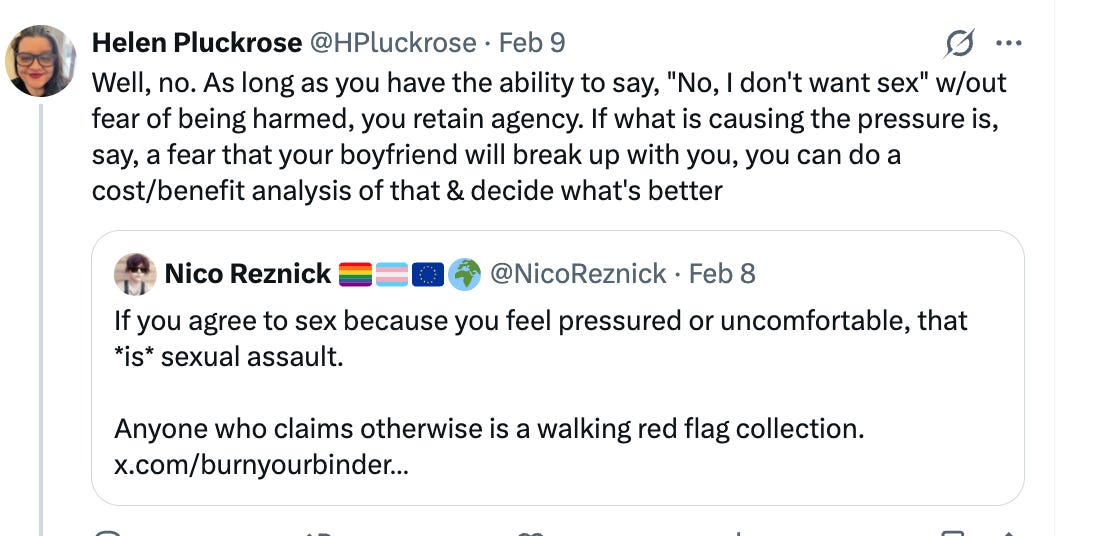
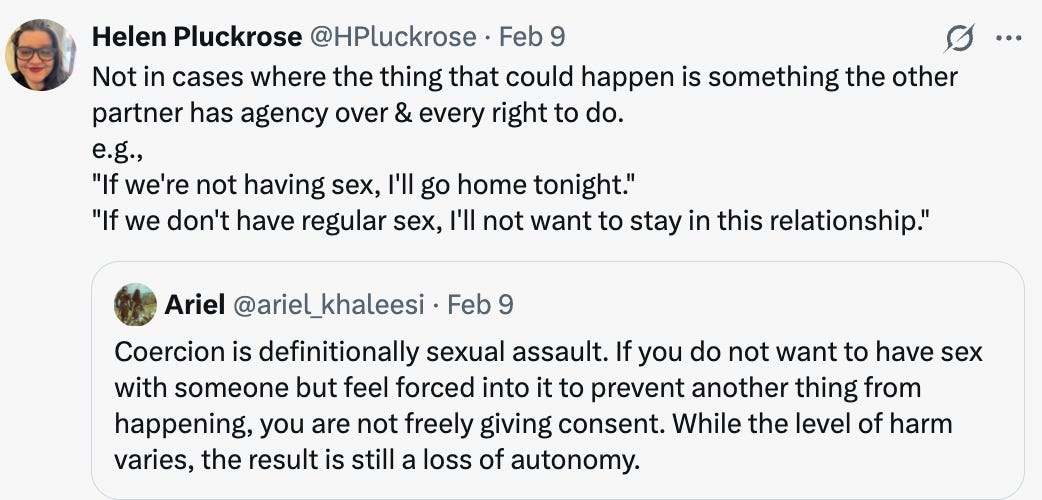
I have argued repeatedly both that women must always have the absolute right to decline sex with their partner (or anyone) and that it is not abusive for men to continue to initiate sex and become dissatisfied in a romantic relationship that does not include it. I think the parallel with mismatched needs for emotional intimacy should be clear here. Men must always have the absolute right to decline to share their own feelings or devote significant time to listening to a partner’s and it is not abusive for women to continue to initiate such discussions and become dissatisfied in a relationship which does not include emotional sharing. This stance is most simply defined by accepting that two things can be true at the same time:
Being in a committed relationship with someone does not grant you automatic and ongoing access to either their body or their mind. The individual holds sovereignty over both and his or her bodily or mental autonomy must be inviolate.
People can legitimately become dissatisfied with a relationship which does not meet either their sexual or their emotional needs. They can then legitimately seek a compromise, agree an alternative arrangement or end the relationship.
It is not inherently abusive for one member of a couple to either try to initiate sex or a conversation about feelings and relationships or to decline either. Other factors around this dynamic can make it abusive, of course. If one partner threatens to make the other’s life miserable or become violent or end the relationship and deny the other person access to shared children if they do not have sex/disclose their innermost thoughts and feelings on demand, this can become part of an abusive relationship featuring coercive control. Saying, “No, I don’t want to have sex/talk about my feelings right now or as often as you’d like me to or, even, ever again” is not, in itself, abusive. It is stating a personal decision that every individual has the right to make. In a healthy relationship, we’d expect ‘not now’ to be simply accepted, ‘not as often as you’d like’ to be discussed thoughtfully and ‘not ever again’ to prompt a serious conversation that results in either a new kind of relationship or the end of a relationship.
I argued about this a lot with other feminists in my early twenties when I was an active liberal feminist. This was inspired by being one of many individuals who don’t fit typical psychological sex differences in regard to emotional expression. Although I enjoy analyses of people’s thoughts, feelings and relationships including my own, I am not an emotionally expressive person and I have always required a great deal of mental and emotional space to process and understand my own thoughts and feelings in my own time.
This mentality caused me some difficulties in my romantic relationships with both men and women, but particularly with women who were more likely to want to know what I was thinking and feeling before I had fully processed this myself and worked out whether it was reasonable and something I wanted to share. I was frequently accused of being emotionally unavailable (not necessarily in those words which were not commonly used at this time), wanting to be on my own too much, requiring a silent environment and becoming overwhelmed and irritable with too much talk of any kind, but especially highly emotive talk. Attempts to live with three boyfriends and one girlfriend all failed because I felt crowded and given inadequate mental and emotional space.
When I was 26, I met the man who was to become my husband of (now) 25 years. I had decided by this point that I would never be able to live with someone else. I first told him that ours would be a one-night-stand and then a casual once-a-week dating relationship, then that we could spend weekends together but leave me my weekdays to myself, before I accepted that he was somebody I could share my life with. My David, while sociable and extroverted himself, is an extremely easy-going person who simply accepted that I am someone who needs quiet and to be alone for much of the time and was happy to accommodate that. He liked that I had absolutely no objection to him going out with friends of both sexes without me and actively encouraged this. Previous girlfriends had objected to this. He, while sociable, is also emotionally private and had also been accused of being emotionally unavailable by previous partners. He liked that, if I noticed he was upset about something and asked him what it was, he could tell me that it was nothing for me to worry about and he’d tell me when he’d worked it out and I would accept this. In short, our temperaments are utterly compatible and the relationship works.
In my early twenties, I felt much more under siege about this. At the same time that I was aware that people I had romantic relationships with saw me as emotionally unavailable, feminist discourses were evolving in ways that theorised such attitudes among men to be a product of patriarchy conditioning them to be stoical and resist emotional expression. It is my memory that there was a wave of such ideas in popular feminist culture in the mid nineties although, pre-internet, this may just have been in my circle. There was certainly a drive at this time to decondition men from emotional reserve and get them to open up about their feelings and relationships. I found myself sympathetic to the men on the receiving end of this, due to being very guilty of the condemned reserve myself.
I developed an argument specifically targeted at fellow feminists who were strongly, consistently and rightly arguing that women must have complete control over their own bodies and the absolute right to decide who had access to it. This followed on from legislation in the UK that finally made rape within marriage a criminal offence. I insisted that we should extend this concept of individual autonomy not only to bodies but also to minds. I argued that the right to grant or deny access to one’s own mind was equally important as the right to grant or deny access to one’s own body and attempts to force entry to either were abusive in different ways.
I even raised an objection to the euphemism ‘selling herself’ to describe sex work. I argued that feminists should never use this term because it implied that a woman’s ‘self’ was located in her vagina or other orifices used in sexual activity when, really, a woman’s ‘self,’ like a man’s, is located in her brain. I said that those who sold the products of their minds and creative imaginations could more justly be said to be selling themselves and that they had the right to choose to do so, but that the contents of one’s mind can only legitimately be bestowed willingly. Any attempts to coerce others to disclose the contents of their minds or, worse, to tell them what they must believe and affirm was as abusive and wrong as coercing them into sex or physical labour. This ‘freedom of belief’ intuition would later guide my early objections to the rising Critical Social Justice (woke) movement.
My views on this received a mixed reception among feminists in the mid-nineties because I was arguing from individual autonomy rather than women’s interests as a sex class. Radical feminists were critical of it because they believed that women’s interests could only be advanced by foregrounding women’s interests as a class as theorised by feminism. They valued ‘consciousness raising’ as a way to get everybody seeing the same structures of patriarchal oppression that they did. I felt this subordinated individual women’s preferences, goals, intellects and personalities to a collective and consequently constrained the way individual women must think and live their lives. (If you ever see radfems criticising ‘choice feminism,’ they are talking about liberal feminists like me)
Liberal feminists were more receptive to this idea but they often regarded the ‘liberal’ component of their liberal feminism as secondary to the feminist component. That is, they were feminists focused on the interests of women, first and foremost, and they committed to doing this in a liberal (anti-authoritarian and respecting of individual liberty) way. I gradually came to realise that I worked the other way round and was a liberal, first and foremost, and my activism and writing could be described as feminist when the individuals who were being denied individual liberty were women and they were being denied it because they were women. In the same way, my objections to prejudices like racism and homophobia were not motivated by having the interests of racial or sexual minorities as a guiding star, but having individual liberty as that core principle and objecting to racism and homophobia because it denied that to individuals who were black, brown, gay or lesbian.
I continue to believe that a commitment to individual liberty - liberalism - remains the most ethically consistent way to address social problems whether on a grand political scale or a small personal one. By keeping the individual at the centre of social analysis, we protect ourselves against the kind of motivated reading illustrated above in which the wrongdoer is always going to be identified, not by the specifics of the situation or the personalities involved, but by which demographic group they belong to and the power structures theorised to exist around that.
I am not at all convinced that there is a wrongdoer in this situation and I think political analysis is likely to be the opposite of helpful. I see a woman struggling with deep insecurity which is causing her great emotional distress and to be responding to it in ways that are counterproductive, but still trying to be self-aware and consider the impacts of her responses on a man she clearly loves very much. I have nothing but respect and sympathy for her. I see a man overwhelmed by the verbal manifestations of distress and finding them very difficult to deal with, but he is still hanging in there and engaging with couples counselling, indicating that he cares deeply for her too. I feel deeply sympathetic to him. I hope they find a way to navigate the differences in their temperaments and degrees of emotional expression and find a way back to each other. If they do, it will not be by taking advice from proponents on either side of the battle of the sexes.
The Overflowings of a Liberal Brain has over 6500 subscribers! We are creating a space for liberals who care about what is true on the left, right and centre to come together and talk about how to understand and navigate our current cultural moment with effectiveness and principled consistency.
I think it is important that I keep my writing free. It is paying subscribers who allow me to spend my time writing and keep that writing available to everyone. Currently 3.8% of my readers are paying subscribers. My goal for 2026 is to increase that to 7%. This would enable me to write full-time for my own substack! If you can afford to become a paying subscriber and want to help me do that, thank you! Otherwise, please share!
You are like a clarity megaphone. Thank you!
Of course (well, in the sense that anyone who knows me here would know) I agree with you on all matters of substance here, but with no familiarity at all with this Villines lady, and going straight to the post after reading this, I see that her answer begins, "Oh, honey. Friend. Questions are anonymous, but I am of course able to see who asks them. You are a beautiful, impressive, brilliant, highly accomplished woman. Seeing you contort yourself into pretzels, willing to give up your whole self only to get nothing in return, left me weeping."
So I can only really take it that this Substack is about cheerleading and validating a woman who feels emotionally distressed rather than giving truly fair-minded and practically valuable advice. And sometimes there is a need for a friend to hype you up and all. But I don't think this should be some talking head on the internet who will try to make inroads in a gender war in the process of doing so.