


(Audio version here)
The Overflowings of a Liberal Brain has over 6000 readers! We are creating a space for liberals who care about what is true on the left, right and centre to come together and talk about how to understand and navigate our current cultural moment with effectiveness and principled consistency.
I think it is important that I keep my writing free. It is paying subscribers who allow me to spend my time writing and keep that writing available to everyone. Currently 3.8% of my readers are paying subscribers. My goal for 2026 is to increase that to 7%. This would enable me to write full-time for my own substack! If you can afford to become a paying subscriber and want to help me do that, thank you! Otherwise, please share!
Unfortunately, the “Men and women can never be friends” discourse is happening again. Here are recent examples:
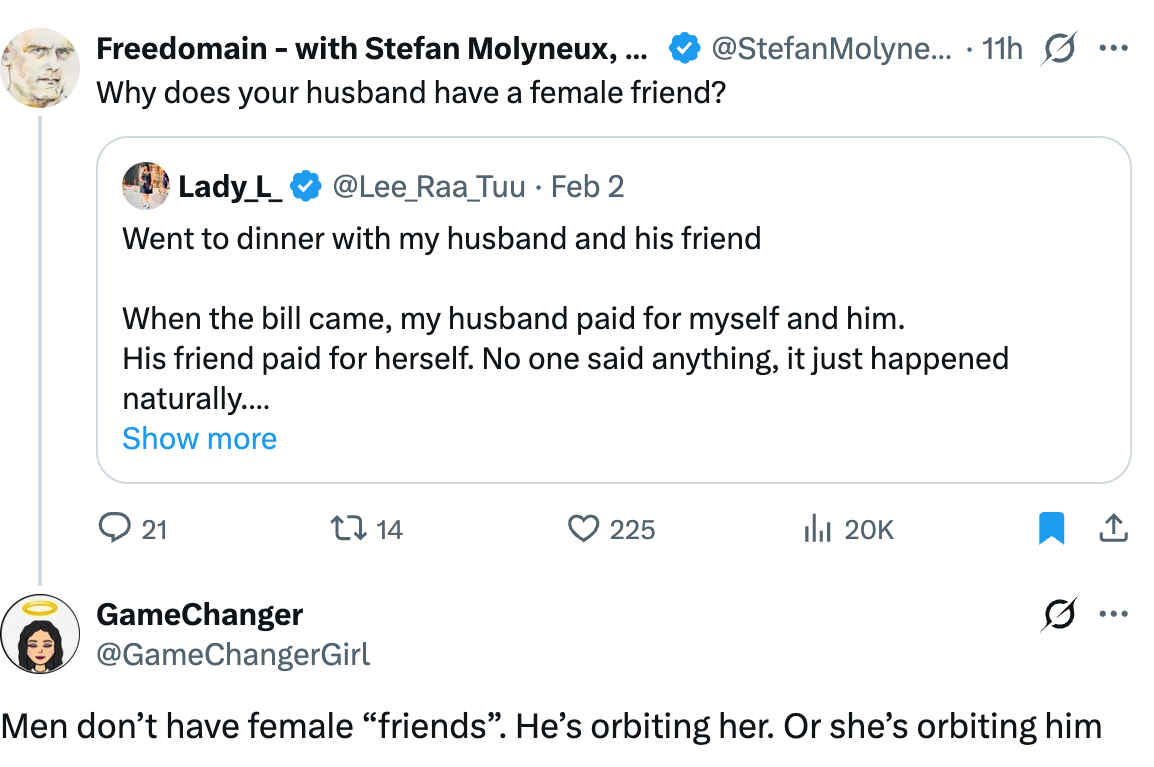


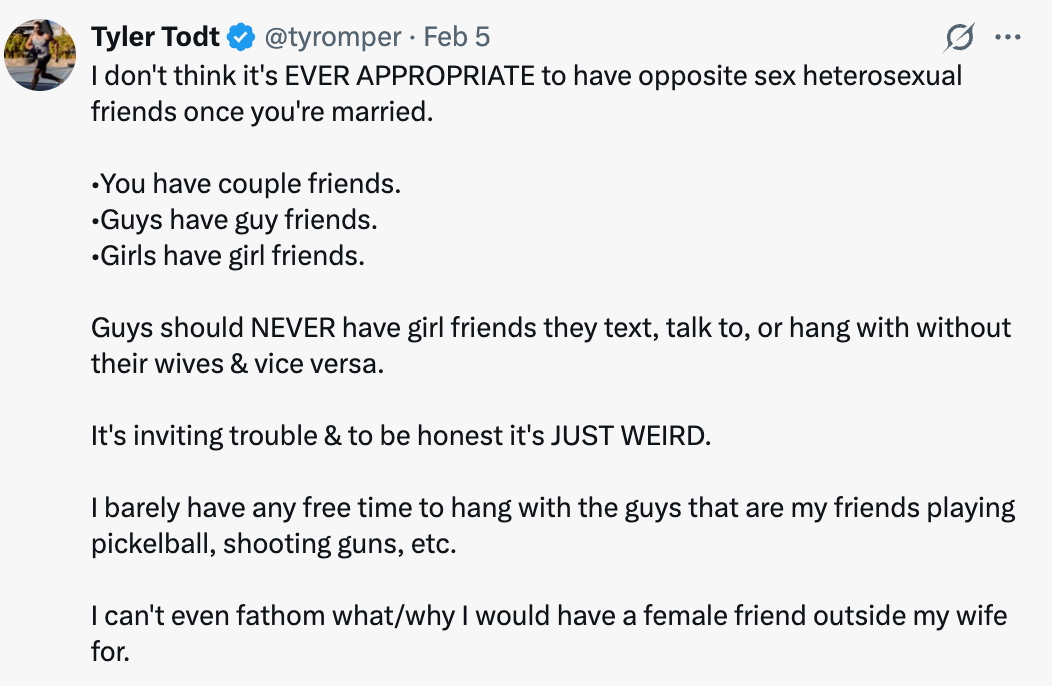
The idea that people should simply exclude half the human population from the pool of potential friends is extraordinary to me.
If you genuinely cannot fathom why anyone would ever have a friend of the opposite sex, I would suggest that you cannot really fathom friendship at all. At best, you can imagine a limited category of companionship organised around convenience, proximity, or shared activity. Within that framework, individuals cease to be unique human beings and become largely interchangeable placeholders that fill a particular social function. I imagine the selection process as something like a person who doesn’t care very much for fashion buying shoes. “I need some for work, some for the gym, some for special occasions, and some for casual loafing. Yes, those will do. Make sure they’re all the same colour.”
Anybody who recognised that every friendship is unique because it arises from the interaction of two distinct minds could not think like this. The claim that men and women cannot be friends therefore seems to me to rely on not valuing individual minds at all. I must conclude that is the stance of people who do not like to think.
The fear beneath the dogmatic claim that heterosexual men and women cannot be friends is, of course, that friendship might lead to romantic or sexual attraction, with all the complications that could follow, particularly if one or both people are already in relationships. But this concern reflects a curiously immature understanding of human relationships. Mature human beings generally move through the world encountering many attractive people while simply not acting on that fact. Attraction does not compel any action and, in partnered adults with rudimentary impulse control, it generally functions as an observation that passes through the mind and passes out again.
Humans are almost unique among species in forming close and lasting bonds with individuals to whom we are neither related nor seeking to mate. The name for this bond is “friendship,” though it seems we often have very different ideas about what it actually is.
Admittedly, friendship is an expansive concept. It ranges from casual acquaintances we occasionally meet up with to people we bond closely with for life. It also takes many forms depending on our interests and circumstances. A friendship might revolve around a shared activity such as sport or music, a shared environment like work or school, or simply enjoying each other’s company at social gatherings. Parents often form friendships with other parents through their children’s schools. Some friendships centre on partying or shared hobbies. Others grow from intellectual or professional admiration, where people seek out those whose work they particularly appreciate.
These gradations of friendship have long been recognised. One frequently cited formulation is attributed to a poem by Brian A. “Drew” Chalker which begins: “People come into your life for a reason, a season, or a lifetime.”
Friends we make for a reason can be people we genuinely care about and respect, but the relationship exists to serve a particular purpose. It might arise around a work project, a group of mutually supportive mothers of young children, or a coalition of people engaged in a shared cause. It is fundamentally collaborative.
Friends we make for a season may overlap with this category, or they may simply be people with whom we spend time during a particular phase of life. These are the friends we might bond with quite intensely at the time, at university, perhaps, or within a particular social milieu, and whom we will always remember fondly. But when we move on from that era of our lives, they do not come with us.
While the individuals in these two groups are, of course, unique, the kinds of friendships we form with them are to some extent interchangeable. We expect, and often hope, to form similar friendships again when we move on to a new project, a new environment, or a new phase of life.
Friends for a lifetime, however, are rare and precious. These are the people with whom a genuine meeting of minds occurs — something unique and important that we recognise as worth protecting. They are the people who truly see how our minds work, and whose own minds work in compatible or complementary ways that delight us. Such friendships are not interchangeable with any others. If they are lost, other friendships may become just as meaningful in different ways, but they are never the same.
This popular formulation captures something people intuitively recognise about types of friendship, but the idea itself is ancient. More than 2,300 years ago Aristotle made a very similar distinction in his Nicomachean Ethics between friendships of utility, friendships of pleasure, and friendships of virtue.
Aristotle’s friendships of utility are those collaborative friendships ‘for a reason.’ Of them he says, “Those who love each other for their utility do not love each other for themselves but in virtue of some good which they get from each other,” and “Those who are friends for the sake of utility part when the advantage is at an end; for they were lovers not of each other but of profit.”
He is perhaps a little uncharitable here. Humans do need to cooperate and collaborate for mutual benefit, and it is certainly better if we can do so with warmth, liking, and genuine respect than in a purely detached or transactional fashion. Nevertheless, friendships founded primarily on utility do tend to end when their purpose has been served.
Friendships of pleasure are typically seasonal because what we enjoy changes. For this reason Aristotle associates them most closely with the young:
The friendship of young people seems to aim at pleasure; for they live under the guidance of emotion, and pursue above all what is pleasant to themselves and what is immediately before them… This is why they quickly become friends and quickly cease to be so; their friendship changes with the object that is found pleasant.
Here again Aristotle is perhaps a little dismissive. The friendships we form as we pass through different phases of life and grow out of as our interests mature and change can still be genuine and important to our development. Nevertheless, they are the friendships that do not necessarily put down deep roots, and in which individuals do not grow together over time.
Friendships based on virtue, however, are all about growing together. These are the most significant friendships and the most likely to endure. Of these Aristotle says, “Perfect friendship is the friendship of those who are good, and alike in virtue,” and “Such friendships are rare, because such people are rare.” Some translations render this as ‘men’ rather than ‘people,’ but the Greek itself does not specify a sex, and Aristotle explicitly allows for friendship between husband and wife, which can be based on any of the three categories. Where such friendships are based on virtue, the couple delights in each other’s virtue and helps to strengthen both their partner’s and their own.
In any case, we need not be bound by the assumptions about gender roles that prevailed in Ancient Greece or anywhere else to recognise that humans who care about what is good can recognise something admirable in each other’s character and intellect. They may be drawn to each other through admiration for the other’s thinking and the desire to engage with it and think together. Sometimes we are drawn to people who think very much as we do; sometimes to those who think differently but whose complementary strengths make the results of that engagement particularly valuable. Such friendships involve intellectual companionship: collaborative thinking, challenging each other, correcting each other, and the kind of insightful emotional support that arises when two people truly understand how each other’s minds work. These are the friendships in which people help each other clarify their values, strengthen their thinking, and become better versions of themselves.
Friendships like these are not exclusive relationships. If you are open to close friendships, you may hope to have several of them, and the dynamics of each are different. Humans are complex and multi-faceted, and the people we meet interact differently with the various facets of ourselves. It is always a mistake, I think, when people expect their romantic partner to meet every emotional, psychological, and intellectual need they have. That expectation creates unrealistic pressures and often leads to resentment and disappointment. My husband is, in my opinion, the best man in the world and, if I had to be stranded on a desert island with one person for the rest of my life, it would certainly be him. But he cannot fulfil every emotional and intellectual need I have, nor can I fulfil all of his. We both need friends and not merely friends who enjoy the same activities we do, but friends who can meet different aspects of our minds.
Among my closest friends, there is one who tends to fall into the same kinds of psychological tangles that I do. This is incredibly helpful, because that is the friend who can always tell when I am underestimating or sabotaging myself, why I am likely to be doing it, and point it out immediately. I can return the favour. In addition to standing for absolutely no bullshit from each other, we are the fiercest defenders of each other’s competence and capability. Often clarity and perspective emerge when one of us asks the other the simple question: “What would you say to me if I described myself to you like that?”
Another friend is the one I go to when I require a particularly keen and rather ruthless analytical mind — someone who can examine my thinking on subjects both intellectual and personal with the fervour of a prosecuting barrister armed with a fallacy-detecting microscope, and who will absolutely relish the opportunity. A third has the gift of zooming out and considering whatever issue we are discussing in the light of multiple intersecting contexts, making connections that illuminate matters considerably. A fourth is exceptional at putting the brakes on my tendency to overthink everything in multiple directions, each with several competing hypotheses, by listening carefully and then saying some variation of: “Well, this seems to be the most salient issue, and here is what you could do about it.”
Two of these friends are female and two are male. Can you guess which ones? When I first wrote this, I did not intend for you to try. But if you know something about average psychological sex differences and if I tell you that these friends all happen to be fairly typical for their sex you probably can. The friend with whom I most analyse my own psychological tangles, and the one who considers problems through multiple social lenses, are women. The friend who subjects everything to intense formal logic and the one who immediately converts problems into strategic goals with measurable outcomes are men. And I value them all enormously.
The point is not that men and women think in rigidly different ways, but that the small number of people whose minds complement our own in important ways will inevitably include both. Such friendships are already rare, and to deny ourselves the possibility of forming them with half the population on the basis of their gonads is one of the most self-limiting things a person can do. It is nonsense to think that when you meet someone whose mind syncs with your own in some uniquely valuable way, you can say, “Yes, I like you, but I really need one of you in a male version,” or “a female version.” That is not how friendship works. People are not shoes.
People who think this way appear to miss out on that third and most important category of friendship. They remain confined to friendships of utility that exist for a reason, or friendships of pleasure that shift as tastes and circumstances change. Consequently, they are left with a transactional or immature model of friendship which is very much what their commentary on the subject on social media reflects. They never achieve the kind of bond formed through mutual admiration of character and mind and the joy of bringing them together. In limiting their friendships, they limit their own minds.
I feel a certain pity for people who regard a world of individual human beings, each with their own potential to form a network of unique friendships, in such a restricted way. They are missing, I think, the primary wonder of what it is to be human: a creature with a complex mind capable of growth, development, and shared discovery. If you approach relationships in a purely transactional or immature way, it is hardly surprising that you cannot imagine friendship across sexes. But that is not because such friendships are impossible. It is because you have misunderstood what friendship is.
This type of prohibitive thinking assumes that you are sexually attracted to your friends and would want to sleep with them given the opportunity. No offense to my male friends, but I'm just not THAT into you.
I agree with you. I find that when my female friends want to hear the truth instead of being puffed up, they call me up. A real friend is loyal and wants to keep you on the straight and narrow. Even if it hurts