


(Audio version here)
The Overflowings of a Liberal Brain has over 6500 subscribers! We are creating a space for liberals who care about what is true on the left, right and centre to come together and talk about how to understand and navigate our current cultural moment with effectiveness and principled consistency.
I think it is important that I keep my writing free. It is paying subscribers who allow me to spend my time writing and keep that writing available to everyone. Currently 3.8% of my readers are paying subscribers. My goal for 2026 is to increase that to 7%. This would enable me to write full-time for my own substack! If you can afford to become a paying subscriber and want to help me do that, thank you! Otherwise, please share!
Today, I came upon a note on Substack which claimed that somebody who believes that housing should be treated as a human right in public policy but does not take homeless people into their own home is not being true to their principles. This kind of argument appears repeatedly on both left and right. It is a category error. The political stance: “I believe society should be arranged in such a way as to facilitate X” belongs in a different category to the personal stance “I feel I have a responsibility to implement X in my own life.”
The most common variation on this from the right is a claim that people who support immigration would offer their spare rooms to immigrants if they weren’t hypocritical.
The most common variation on it by progressives is that those who oppose abortion would adopt many children if they weren’t hypocritical.
People can be hypocritical in relation to either of these stances. Occasionally, a Brit declaring that a country belongs to those whose ancestors built it and that others have no business living there turns out to be making this declaration from Spain or Dubai, where they themselves now live. Sometimes somebody who thinks abortion is always morally wrong and should be illegal is found to have had one while publicly proclaiming that position. But the ethical inconsistency comes from proposing societal rules to apply to other people that they are not willing to apply to themselves. This is an entirely different issue to believing that society should implement policies without being willing to take a personal role in the implementation of all of them. This isn’t actually possible.
If you are someone with a range of mainstream positions on how society should be run and what public policy should be, you could legitimately have a range of stances which you do not implement personally. You might think violent criminals should face long prison sentences without volunteering to turn a room in your own house into a cell and guard a prisoner there. Likewise, you can believe your country should have a stronger military defence without joining the army. You can reasonably campaign for school reforms without becoming a teacher and you can think borders should be more strongly defended without becoming a border guard.
The difference between public policy and individual moral obligation is generally tacitly accepted by people who live in complex, modern societies. In a small community of a few dozen people, an individual who wants something done could perhaps reasonably be expected to take responsibility for doing it. A society comprising millions of people cannot function that way. This is why we formed governments, democratic systems, institutions and policies in the first place.
We do not hear people say, “If you really believe the council should fill those potholes, why aren’t you out there with a bucket of asphalt?“ We understand the claim “public roads should be properly maintained” to be a position on how our authorities should spend taxpayers’ money, not a commitment to a personal project. Notably, if private citizens were to take on responsibilities their political goals deem should be a matter of public policy, this would undermine those political goals and be significantly less effective. We all know this when it comes to mundane issues but people tend to become strategically confused about distinctions when the issue is morally or politically charged. This is, of course, because they don’t approve of those political goals and don’t want them to become public policy, but feigning confusion is not a respectworthy way to further that cause.
In liberal democracies, this process of organising responsibilities takes the form of electing governments which operate by the consent of the governed. Political parties who want to be elected set out their policies and then citizens vote for the ones they want to see implemented. This happens within a context of broader public debate in which people make arguments for why certain policies are better than others practically and ethically and others evaluate and counter these arguments. This liberal democratic and dialogic process is complex, messy and sprawling but has been very effective and has created the most successful and prosperous societies humanity has ever known.
People who live in liberal democracies generally do have a basic understanding of how they work. Those who pretend not to know this typically wish to shut down those with whom they disagree while avoiding the part which engages with arguments and makes counterarguments. It is the childish and tiresome recurring theme of contemporary political discourse that made this X post go viral, but it is certainly not limited to the left.
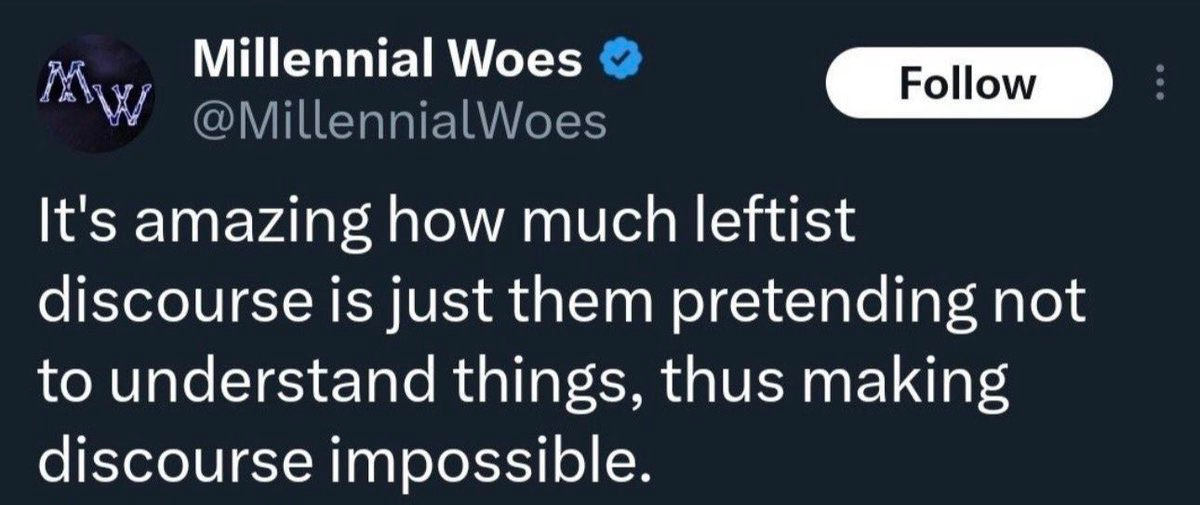
The right way to disagree with somebody making a claim about what rights should exist or what public policy should be is to dispute the proposition itself.
If somebody takes a blanket position in favour of immigration, objections should be made on specific ethical and practical grounds. Ethical grounds could involve stressing the importance of vetting individuals for values compatible with those of a liberal democracy and the pre-existing culture. Practical ones could consider the unsustainable pressure on housing, infrastructure and public services. “Why don’t you house immigrants in your spare room?” contributes nothing to this discussion.
Likewise, someone who thinks abortion is morally equivalent to killing a child should be presented with arguments that counter that proposition. Ethical arguments could include arguing that consciousness and viability matter to moral status, and that the bodily autonomy of the pregnant woman is of paramount ethical importance. Practical ones could consider the likely social consequence of the emergence of dangerous backstreet abortions and people having more children than they can care for. “How many children have you adopted?” does nothing to establish that abortion is morally justifiable.
I suggest that when people take the “pretending not to understand things” stance in place of good faith argumentation, we should take them literally and respond as though to a small child who has not yet learnt how society works or someone who has previously lived in a monastery of some kind cut off from wider human society. Take the objection at face value and patiently explain the distinction it requires you to believe the person doesn’t understand.
That doesn’t work because we live in a very big and complex society. It has millions of people in it and requires thousands of policies to govern rules, rights and responsibilities. We manage these via the system of democracy. Democracy is when every adult individual gets a say on a collection of policies….
This can be surprisingly effective at getting people to stop feigning confusion and I would argue that it is justifiable in such circumstances. It is not gratuitously insulting the purportedly confused person’s intelligence or knowledge. It simply takes claims of ignorance or incomprehension more sincerely than the claimant wanted them to be taken. Trusting that other people mean what they say and responding sincerely to it is generally good practice. If they did not sincerely mean what they said, the fault lies with them, not the person assuming good faith.
This does generally irritate the strategically confused and they will likely object that you are being patronising and assert that they are not a total idiot who does not know how the world works. You can then respond that, in that case, they should probably stop pretending to be one. Instead, they could join the rest of us in arguing for or against certain propositions and policies, as befits the inhabitants of a liberal democracy.
Just as a personal matter, I love reading smart, understated humor like this: "We understand the claim 'public roads should be properly maintained' to be a position on how our authorities should spend taxpayers’ money, not a commitment to a personal project." But on the larger issue before us, I wouldn't have thought to address it, as Helen does, as a matter of the scale and complexity of modern societies (containing the many issues about which we may care) and the "strategic confusion" we might be tempted to deploy to misunderstand those who disagree with us. As I type this, it also occurs to me that those of us who disagree with capital punishment probably shouldn't challenge our fellow American citizens who support the death penalty to carry it out themselves.
You are really very perceptive. I’ma big admirer. My only counter argument is that in these days of 10-word attention spans, the only retort that is likely to get a response before the person switches channel is: Why aren’t you using your spare room to house immigrants? Even Cambridge professors these days find it difficult to judge if statements like “I ran multiple marathons on a broken leg” need verification. Which brings me to why you do not have the number of paid subscribers you deserve. There simply aren’t that many people with money and interest in intelligent commentary.