


(Audio version here)
The Overflowings of a Liberal Brain has over 7000 subscribers! We are creating a space for liberals who care about what is true on the left, right and centre to come together and talk about how to understand and navigate our current cultural moment with effectiveness and principled consistency.
I think it is important that I keep my writing free. It is paying subscribers who allow me to spend my time writing and keep that writing available to everyone. Currently 3.8% of my readers are paying subscribers. My goal for 2026 is to increase that to 7%. This would enable me to write full-time for my own substack! If you can afford to become a paying subscriber and want to help me do that, thank you! Otherwise, please share!
During the third trimester of my pregnancy, I was overwhelmed with fears of postnatal psychosis. I had never experienced psychosis but I did suffer from OCD and my greatest fear was that I could temporarily lose my judgement or self-control or simply fail to pay attention in some vital way and the result would be harm to another person. At one point, I was unable to travel on the tube due to intrusive thoughts that I might somehow lose my mind for a second and push somebody under a train. I was never remotely likely to do anything harmful to another person. OCD works by playing on the sufferer’s greatest fears which are typically contrary to their behaviour. My diagnoses over the years have been ‘scrupulosity’ “harm OCD” and “Responsibility OCD.”
By the time I got pregnant at 29, I was mostly on top of this. I had an arsenal of techniques to interrupt these thoughts and prevent them from getting a grip. I was aware that being a first-time mother and the anxiety this entails could put these to an unprecedented test and was preparing for that. Then I found out about postnatal psychosis. A horrible news story in which a mother suffering from the condition and experiencing delusions in which she was entirely disconnected from reality had put her newborn baby in the oven, killing it. She did not realise that what she had put in the oven was her baby and was so floridly psychotic that she was taken immediately to a secure psychiatric facility. I found myself dwelling on the horrific nature of that baby’s death but also the feelings of the mother when she came out of the psychosis and was informed of what she had done. I feared that I could be prone to postnatal disorders because my mother had suffered severe postnatal depression, a failure to bond with me and intense anxiety about being able to care for me.
At the time I was pregnant, we lived on the 11th floor of a tower block. I feared that I could, in a state of psychosis, drop my baby out of the window. I had my husband nail the windows closed. I had him and my parents promise me that if I seemed even the slightest bit confused and not myself, they would separate me from my baby and not wait to see if it improved. When I was told I would need a C-Section, my first thought was, “Good. I will be in the hospital for five days. If I immediately become psychotic, there will be people who recognise it and they will protect my baby.”
In the event, nothing like this happened. My daughter was born and I immediately felt an overwhelming sense of love and confidence that I knew exactly what she needed and that I was capable of meeting all those needs. I found the early months easier than most of my friends reported finding them and coped well with initial mood swings and then the sleep deprivation. My fears of postnatal psychosis are now a family story about extreme maternal anxiety and the time I had my husband nail the windows shut.
It might seem that this history could well make me sympathetic to Lindsay Clancy, the mother currently on trial for strangling her three children before jumping from the window in an attempt to end her own life. Her defence is that of postnatal (‘postpartum’ in America) psychosis. I do not know that I am. This entirely depends on what her mental illness did to her understanding of what she was doing, its wrongfulness and her capacity to control her actions. The news reports of the trial include testimony that she was suffering from very profound postnatal depression and a mood disorder and that she had been prescribed a number of psychiatric medications that had produced negative effects to her mood. There are descriptions of her suffering from paranoia and experiencing hallucinations and delusions which, if true, certainly meet the definition of psychosis, but this is contested and it is unclear whether or not she knew what she was doing when she killed her children. This matters.
In addition to this, the case has tapped into the culture wars and particularly the battle of the sexes. There are hundreds of women in pink outside the courtroom expressing their sympathy for Clancy and many are conflating her case with all manner of emotional struggle women may have ranging from hormonal surges to postnatal depression to sleep-deprivation to unsupportive partners. The issue of psychosis and its distinctness from various forms of emotional distress or other mental illnesses is getting lost in the mix. On the other side are those who like to conflate this case with issues like abortion, low birthrates and perceived female entitlement, narcissism, lack of accountability and lack of appreciation for hardworking fathers who enable women to stay home with children. Neither of these is remotely helpful.
Then there are those who make a different kind of conflation between the seriousness of the crime and the responsibility of the person who committed it. This argument goes that if the crime committed is heinous enough, the perpetrator cannot be considered insane, even though these two things are not dependent on each other. If somebody in a state of florid psychosis wades into a pond because she believes a duck is telling her to, she may have committed only a minor park regulation breach, but she still needs to be removed to a place of safety to receive an urgent psychiatric assessment. If somebody hits his mother with an axe because he believes she is not his mother but a demon and only killing the demon will release his mother, he is experiencing a delusion he has no control over and does not know he is killing his mother, even though he has committed a terrible crime. I have addressed this before.

Imagine a scenario in which a woman has just got her baby down to sleep in its nursery and she hears a terrible crash and snarling. She runs into the nursery and finds a wild animal of some kind in her baby’s crib mauling the child. She picks up a chair and repeatedly smashes it into the animal’s head until it goes limp. She snatches up her badly injured baby and runs downstairs to call an ambulance. The ambulance comes and takes her and the baby away. Later, in the hospital, the doctor comes to see her and tells her that her baby is dead. With him are two police officers and they tell her there was no wild animal. The baby died from the blows she swung with the chair. She had been hallucinating.
Imagine that you could know this scenario were absolutely true. You had somehow been able to watch it from her perspective like it was a movie. Would you hold her responsible for behaving in the way she did or was her behaviour entirely morally justifiable based on what she saw with her own eyes? What else could she have done? Run into the room and seen the animal attack and thought, “I’d better not do anything about this in case it is a hallucination and I accidentally hurt the baby and am then charged with that.” Of course not. Nearly every time anybody sees such an attack, it is actually happening and the right thing to do is save the baby.
I would argue that because psychotic delusions, brought on through no fault of the sufferer’s own, really can be indistinguishable from reality and because there are occasions on which violence in self-defence is both morally and legally justifiable, there must logically be situations in which a violent crime can occur and the perpetrator of it should not be held morally or legally responsible. But this is how high the bar needs to be. There must be evidence that the individual did not know what they were doing or that they could not meaningfully comprehend that it was wrong or that they could not prevent themselves from doing it for them not to be morally responsible for their actions.
The question is whether this case was one of those occasions. Did Clancy know she was killing her children or did she believe she was doing something that could not harm them? Did she know the small figures she had in her hands were her children or did she believe them to be some kind of animals or demons that were trying to harm her or her children? The defence has provided psychological testimony claiming that she was ‘like a puppet and someone else was pulling the strings” and “had no appreciation of the wrongfulness of her act.” It claims that she was hearing voices. Meanwhile, the prosecution’s forensic psychologist said she did know she was killing her children and that this was illegal and “her moral awareness of this killing was influenced by her strong desire to die and, if she was dead, not to leave her children behind.” They dispute the claim that Clancy was hearing voices due to lack of prior or subsequent reference to this. The prosecution also presented evidence that Clancy sent her husband out shortly before killing the children which, prosecution argued, indicated an intention to commit an act which she knew he would have prevented. I am not sure, from the evidence reported publicly, that there is reasonable doubt about her criminal responsibility.
The misogynistic rhetoric around this case is contemptible. Those who want to tie this case into their grievances about women not being sufficiently appreciative of men or having become entitled and pampered and resentful of their ‘rightful’ role as mothers and homemakers do not add anything of value to the conversation.

Postnatal depression or psychosis, sleep-deprivation and the psychological toll of spending all one’s time with small children are not social constructs and they cannot be shamed away. People have always had hormones and predispositions to mental illness as well as a physiology that requires sleep and a psyche that needs adult company and intellectual stimulation. Principled social conservatives who wish for a more universally favourable view on motherhood would do better to accept this reality and propose practical remedies such as family support, community support, childcare etc.
That women’s minds can become disordered and their judgement impaired by the toll of giving birth and breastfeeding has long been recognised to the extent that many countries (but not America) recognise infanticide as a crime equivalent to manslaughter rather than murder. This still requires evidence of mental disorder directly related to the effects of giving birth or breastfeeding.
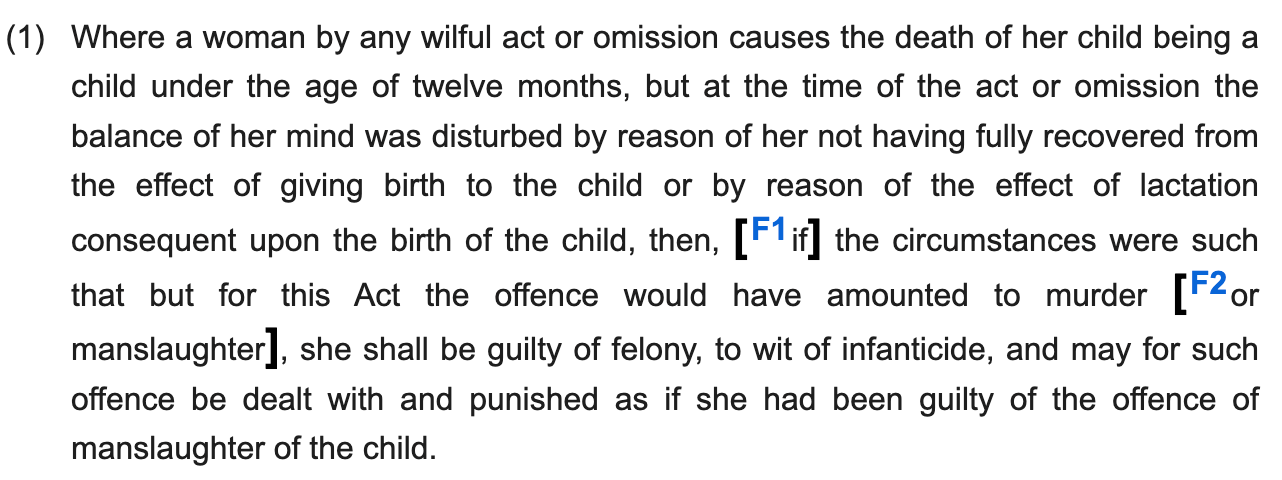
In many times and places in the darker history of our species, the killing of a baby by its parents was considered a decision parents had the right to make or something that was inevitable due to limited resources. Even when it was criminalised by religious or secular law, these laws were frequently ignored or simply not investigated, especially when the mother was married. This rightly appalls us now. We recognise children as having individual rights to continue their existence and we have systems in place to care for them when their parents cannot. The law recognises much evidence that childbirth can, on occasion, produce profound mental disorder which may substantially diminish responsibility. Whether or not it has done so in any given case must be assessed on the details of that case rather than tied into a political narrative.
This is why I believe feminists who try to subsume this case into a vast category of any kind of psychological or practical difficulties women may experience after having a baby or when caring for a number of young children are also very wrong. The existence of genuine postnatal psychosis does not mean every form of maternal suffering belongs on the same continuum of diminished responsibility. Speaking as though it does can only serve to reduce sympathy not only for Lindsay Clancy but for any woman suffering from postnatal psychosis. The need to provide better postnatal care, mental health support and practical support is better addressed practically and without collapsing everything from unsupportive partners to depression to sleep deprivation to psychosis into one mass.
I have a family member who had a history of depression and suffered terrible postnatal depression and struggled to cope. Social workers were aware of this and kept a close eye on the family. This made her extremely anxious and ashamed. She was both terrified that her daughter would be taken away and also so deeply sunk in the ‘worthlessness’ experience of depression that part of her believed she should be. One day, after a sleepless night and a morning of incessant crying, she got on a bus to the social services office, planted her baby on the reception desk, saying, “Take her. I can’t cope and am not fit to be a mother.” She then went home. She believed she had now lost her baby and felt suicidal. Shortly after this, her social worker arrived with the baby and told her this was not the case. In fact, she said, my family member’s action that morning had reassured her considerably. The fear had been that she would fail to recognise that she was not coping and the baby could come to harm. The fact that, when she reached the end of her tether, she reacted by taking her baby to a place of safety spoke in her favour as a mother. Supervision became more supportive than suspicious and she was able to form a positive relationship with her social worker and gradually recover from postnatal depression and be removed from their caseload.
This story had a happy ending due to a combination of a good social worker and my relative’s own primary drive to put her daughter’s wellbeing above her own. She would rather lose her baby than risk her coming to any harm. People may not have control over succumbing to serious mental illness but this does not in itself eliminate a person's capacity to make choices about how their illness affects other people. Did Lindsay Clancy have the ability to make a decision to leave her children rather than killing them? The prosecutor claimed that her motivation was selfish. She wanted to die and she wanted to take her children with her.
Sometimes, when in the grips of a deep, dark depression, life can feel unbearably painful and sufferers forget that they ever have been happy or could be again. It has happened that people in such a state have killed their children in the belief that life is purely pain and misery and a desire to protect their children from that. In this way, both the prosecution's claim that Clancy knew what she was doing was illegal and the defence's claim that she did not believe it was morally wrong could conceivably be true. A severely depressed person might believe that death is a merciful escape from an existence composed entirely of suffering while still understanding that killing another person is against the law. That is not the same mental state as believing that one is fighting a demon or wild animal, or acting under a delusion that makes the true nature of one's actions incomprehensible. Nor, however, does it entirely settle the legal question, which also asks whether mental illness left the defendant substantially capable of conforming her conduct to the law.
Depression and other forms of mental illness, or even chronic sleep-deprivation or insufficient support, can alter someone’s moral evaluation of death without destroying their grasp of reality or their capacity for choice. Psychosis can alter the perception of reality upon which the person believes they are acting, leading them to act in ways which would be both legal and ethically justifiable if their perceptions were correct. The jury in this case needs to decide whether the prosecution has proved beyond reasonable doubt that Lindsay Clancy retained sufficient capacity to appreciate the criminality or wrongfulness of what she was doing or to conform her actions to the law. The answer will determine whether she is held criminally responsible or acquitted on grounds of insanity and dealt with through the psychiatric system.
The drive of political partisans either to exonerate her entirely because they believe society fails to support women struggling mentally after giving birth, or to punish her as harshly as possible because they believe society enables women to become entitled and narcissistic and put their own needs above those of their children, is poisoning any reasoned ethical discussion of this case.
Ultimately, both groups of activists are trying to make Clancy a symbol of a social pathology they perceive and are particularly concerned about whether this is society’s failure to support struggling mothers or a culture of female entitlement and diminished accountability. But Lindsay Clancy is a person with a unique mental state reacting to unique circumstances, and her case needs to be considered as such. Criminal responsibility is radically individual.
Insanity defenses are usually very hard to successfully mount. The standard is typically being unable to understand, through disease or mental defect, the nature or wrongfulness of one’s actions. I don’t know if she met that standard: I haven’t been following the case very closely. I too have been appalled at the bits of rhetoric I’ve seen online. I remember the rhetoric being equally ugly with Andrea Yates but that was before social media. FWIW I think the jury ultimately came to the correct conclusion in that case.
I also struggled with intrusive postpartum thoughts of a very similar nature. I’m glad you got through it. And I agree that postpartum mood disorders are a different beast than psychosis. I pray that the jury is able to wisely weigh the evidence and come to the best verdict possible given this tragic situation.
Became a father a five days so this hits hard for me. Regarding the critique misconstructing this as gender politics you are completely right, this is solely in the purview of mental health. Previously I have had severe episodes of intrusive thoughts. The truly maddening thing about dealing with such incidents is that despite knowing exactly by what mechanism this occurs i.e the mind generates random thoughts and they have zero validity and does not reflect anything about your inner desires, is that the compulsion only gets worse when you engage it with reason.
The concept of lack cognitive penetration might only be analogous as here as it strictly applies to modularity of the mind, but it is truly as if the amygdala is impervious to any input from your higher faculties of thought. You simply have to experience events to the contrary.
Either way, the moment my daughter was born all of those thoughts lost their potency. Bonded instantly. They will be back but the mantra i learned in therapy ‘you are not your thoughts.
Your character is determined by how you react, your moral judgements and your actions’ helped.
Christians however have a much harder time dealing with it as their model of the mind, or soul if you will is based on the Sermon on the Mount which introduced the concept of a thought crime into western civilisation. This promotes intrusive thoughts but it might also explain the reaction from the conservative right to such incidents.
The modern left wing variant of this fallacy is how they misconstrue mere association in the mind, statistical stereotypes as an indication of bias or intent.