

Apologies for the lack of an audio version of this piece for paying subscribers. I am currently away undertaking a programme of physical rehabilitation and recording if difficult. If you would like an audio version, please let me know in comments and I will produce one when I get home in a few days.
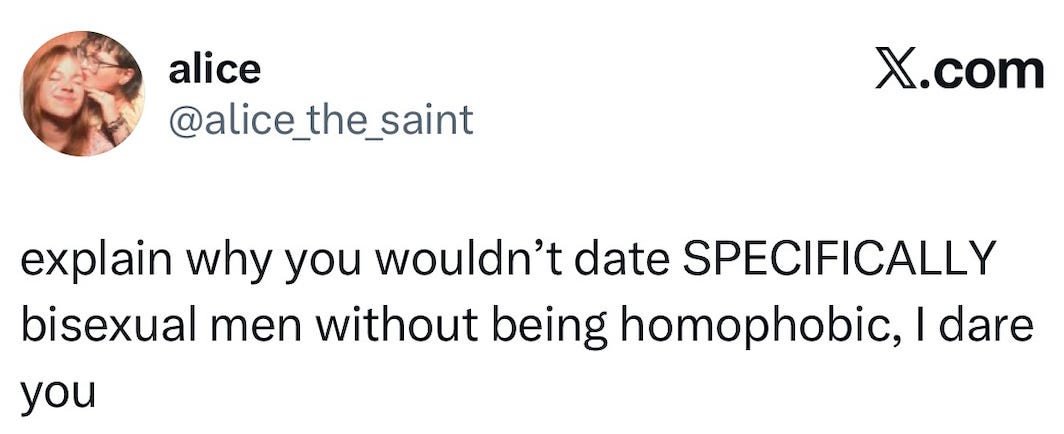
This week, X has been angered by a survey showing that very many women are not attracted to bisexual men, including a minority of bisexual women. Accusations of homophobia, biphobia and, in the case of bisexual women, hypocrisy, abound. This is because, yet again, people are confusing sexual desire with a reasoned, ethical stance and politicising their own and other people’s sexual responses. This is a category error.


The difficulties bisexual men often report finding female partners come up repeatedly in political debate, accompanied by claims of homophobia or prejudice against bisexual men specifically due to assumptions that they are highly promiscuous and less likely to practice safe sex. Such attitudes undoubtedly exist.
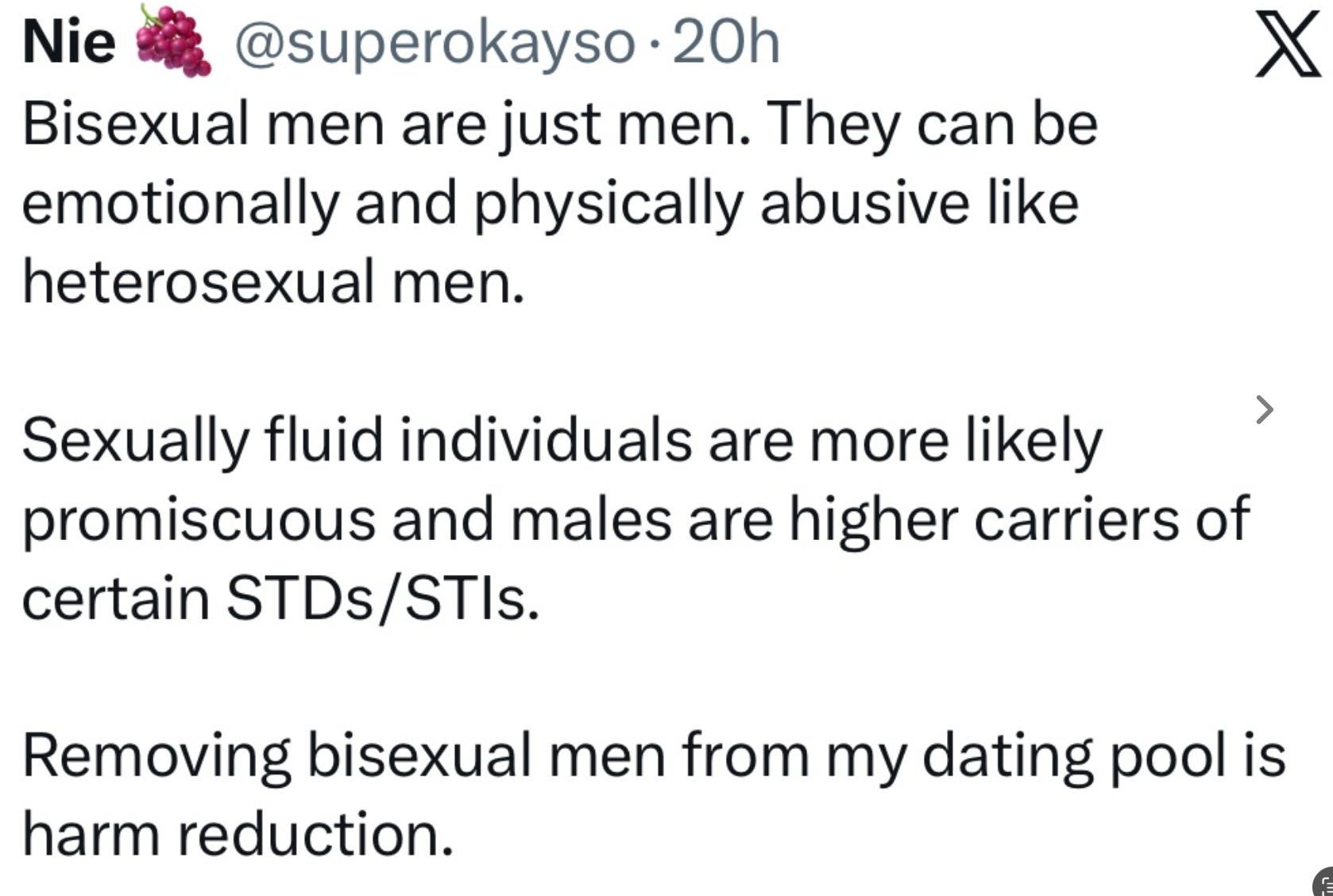
However, the claim that a non-attraction to bisexual men cannot be explained by anything other than such intense personal antipathy based on negative stereotypes strains the bounds of credulity. Do we really live in a society where a majority of heterosexual women and a minority of bisexual women hold homophobic (and misandrist) views? Some clearly believe we do. To them, the idea is that, if we counter homophobic and biphobic attitudes and stereotypes in society and dismantle them in our own conscious or unconscious biases, more women will start finding bisexual men attractive. Most commonly, those making such accusations make them of other people, but we do also sometimes see women who oppose homophobia and biphobia attempting to justify their non-attraction to bisexual men on rational, ethical grounds.
The problem with this is that sexual attraction is not generally based on moral or rational decision-making. It is based on what attributes and behaviours people find arousing. Men who are attracted to women very commonly find two women having sex arousing. Women who are attracted to men do not commonly find two men having sex arousing. This complicates a straightforward explanation of homophobia somewhat. Bisexual men are men who are attracted to women and bisexual women are women who are attracted to men. I do not see why the fact that they are also attracted to the same sex should make them vary significantly from heterosexual trends in what they find attractive in the opposite one.
The terms ‘homophobia’ and ‘biphobia’ are generally used to describe a political, ethical or religious stance that same sex attraction is morally wrong or objectively disgusting and that same-sex attracted people and relationships are therefore immoral, wrong or lesser. Some people quibble with the terms themselves, arguing that the suffix of ‘-phobia’ is not warranted because it indicates an irrational fear or aversion while they have neither but instead a religious or ethical objection to homosexual sex. I am not going to quibble with the semantics. For the purposes of this piece, I am talking about a considered belief that homosexuality and bisexuality are morally wrong or objectively inferior and that prejudice and discrimination against same-sex attracted people is therefore ethically justified in some or all social circumstances.
This is where I believe the category error comes in. We do not typically consider sexual attraction to be a social circumstance, but instead an individual one. Being discriminating in one’s choice of sexual partners is generally considered to be acceptable because sex and romance are individual choices based on individual inclination. Being exclusively attracted to men, for example, is not usually understood to be misogynistic. Instead, if the individual is female, the term for this is ‘heterosexual’ and if he is male, the designation for this is ‘gay.’ This is commonly accepted even by Critical Social Justice activists of the LGBT variety, although in recent years, there has been a drive to pressure people into being attracted to subjectively experienced gender identity rather than sexed bodies. Naturally, this has not worked very well because, again, sexual attraction is not a political or ethical stance.
The same rule applies more broadly than heterosexuality or homosexuality and continues to be subject to much individual variation. People find that they have a ‘type’ and also compatibilities and incompatibilities. Height, weight, build, colouring, presentation, personality, vocational status and finer details of sexuality are all highly relevant here and highly individual. I am a bisexual woman who has been attracted to women who present a ‘butch’ aesthetic and not to typically feminine-presenting women. This is not a prejudice against femininity more generally. Like most heterosexual women and gay men, I can admire feminine women’s beauty without finding it sexy. I am attracted to men who are taller than me, older than me and have a more leanly muscular physique than a robust bulky one. This is not a belief in the inferiority of shorter, younger or stockier men, many of whom I love and respect and also recognise as handsome. I have never been remotely attracted to sexually submissive men but those who are aggressively dominant are also unappealing. This is not a judgement on anybody else’s consensual sexual preferences and nor do they ever prevent me from liking and respecting an individual. Most individualistically, perhaps, I have been exclusively attracted to men who build and fix things. I have no idea why but a man in overalls is sexy while a man in a suit or a mortar board is not. This is not prejudice against professional or intellectual men who make up the vast majority of my male friends. Sexual attraction is just in its own category separate to other relationships.
Of course, attraction is not entirely individual because strong trends exist. Very many women share my preference for men who are taller than them and, at 5 ft 9, I was occasionally informed as a young woman that I was too tall for a man to find attractive despite being otherwise appealing. (Young men, this is probably something you should think in your head. Young women, gratuitously telling shorter men that they are unattractive to you is also something you should avoid doing unless one is pressing you for a reason). Women’s preference for men who are successful, confident, and somewhat dominant (without being domineering to her) is also well-documented as is men’s tendency to find youth and beauty and agreeability particularly attractive and professional status less so.
There are strong evolutionary psychological hypotheses for why these sex differences in attraction exist (see particularly, David Buss) related to what is most likely to result in the production and survival of healthy offspring. In women, fertility and fidelity are key. In men, the ability to defend and provide. It is important to understand that these attractions are not fundamentally conscious deliberations made by individuals but a result of evolution having favoured the offspring of males who are attracted to fertile females and females who are attracted to males who can provide for and protect their young. Gay men, for example, are still likely to value physical beauty in their partners particularly highly even though they are under no illusion that this is an indication of his ability to produce babies. As always, while strong enough trends exist for these sex differences in sexual attraction to be observable and measurable across many cultures and, in fact, the animal kingdom, much individual variation exists and consequently also many exceptions to the rule.
Is it the case that patterns of women being unattracted or less attracted to men who are (also) attracted to men also has an explanation in evolutionary psychology? I know of no research to this effect. (If you do, please post it in the comments.) It is plausible that evolution would favour organisms who are attracted to others who are exclusively attracted to the sex they are as a matter of not wasting one’s efforts on another who is homosexual and thus unlikely to wish to reproduce with them, but as previously mentioned, heterosexual men do not typically find women having sex with women unattractive, so, as a broad rule, this does not seem to stand up. I would, however, be surprised if there were nothing in our evolved psychologies that could offer a clue to this and it were entirely a social construct.
Perhaps it is simply that women are the much choosier sex when it comes to sexual partners. This is convincingly argued by evolutionary psychologists to be because we are the sex that gets pregnant and are thus limited in the number of offspring we can have in a way that men are not. This incentivises being selective as does the fact that our offspring’s survival has historically been greatly benefited by the father sticking around to protect and provide for it. This is argued to be why women are, on average, less open to casual sex than men. Again, this is not purely a conscious deliberation made by individual women to safeguard against pregnancy. Lesbians are also highly selective in their choice of partners even though no pregnancy can result from their lovemaking. It has been my experience and that of many bisexual women I have spoken to that lesbians are also less likely to be attracted to bisexual women than to women who are exclusively attracted to women. Is it possible that bisexuality triggers some kind of cognitive mechanism in women related to their need for signs of commitment in order to want to engage in a sexual relationship that is not a feature of male evolved psychology? I do not know. This is a genuinely interesting question and the answer is probably a complex mixture of hardwired and cultural factors rather than pervasive cultural biphobia.
Is there any moral imperative to try to redress this, though? I am not convinced that there is. I never felt any need to badger lesbians into being attracted to me. All my (three) female partners before I entered an exclusive relationship with my husband 25 years ago were bisexual and this worked. I am sure the majority of bisexual men would not wish to pressure women into having sex with them to demonstrate their inclusivity either. We can certainly address any negative stereotypes that exist about bisexuals without badgering anybody into feigning an attraction they do not feel on political or ethical grounds.
I think people engaging in this kind of argumentation are coming at it from the wrong angle. The question, “Well, why aren’t you attracted to this particular type of person’ assumes that the default status is attraction and the thing that needs explaining is the lack of it. I think it is the opposite. For most people, the default state when interacting with other humans is ‘not attracted’ and, only for a small percentage of them do a sufficient number of appealing features converge that this tips into ‘attracted.’ For women, as the choosier sex, that percentage is likely to be smaller than for men and the appealing qualities that need to align more numerous. It may be that one of the things likely to make that switch to attraction for many women is exclusive heterosexuality (or, in the case of lesbians, exclusive homosexuality).
I am one of the bisexual women who has never found the attraction switch to come on with men I know to be attracted to men, no matter how good-looking, charming or likeable they may be. In talking to other women who are attracted to men, it is my observation that this is quite common. A woman may think that a gay man, for example, is gorgeous with a handsome face and impressive physique and appreciate these attributes aesthetically. She may also admire his intellect or principles and respect him as a thinker. Or she may find his personality engaging and endearing and wish to establish an intimate and enduring friendship with him. She may, in short, admire him on many levels and be far from thinking of him as in any way inferior due to his sexuality. When it comes to thinking about him sexually, however, it is as though the brain returns an error message. This is just not what we are doing here. Of course, this response generally suits gay men just fine! Bisexual men who encounter it repeatedly, however, may well find it disheartening because it is what they’d like to be doing here.
If it is the case that many women do not find the attraction switch to go on with bisexual men because they are bisexual, is this not the definition of homophobia or biphobia, though? I’d suggest that this is only the case if you are defining these so loosely that the terms lose all usefulness. This is not the result of ethical reasoning which makes a claim that same-sex attraction is wrong or that same-sex attracted men are bad or inferior which can be argued with. It is the absence of sexual attraction which is not receptive to such arguments. I doubt that there has ever been a case in which somebody has successfully argued somebody else into wanting to have sex with them.
If it is not women’s rational brains capable of ethical reasoning which are discriminating against same-sex attracted men but their sexual attraction responses, can this be argued to be morally wrong? I do not think so. We generally consider discrimination morally wrong when it prevents people from accessing something we think everybody should have a right to access. We do not live in a society that holds that sexual access to women is a right that all men have the right to and I’d very much like to keep it that way. In their choice of sexual partner, both men and women must have every right to be discriminating and to be so on their own criteria. Nobody can reasonably insist that they have the right to have any aspect of their body, identity, personality, sexuality, presentation or behaviour automatically found attractive or not deemed unattractive by other people. Nor should anybody have to justify not being attracted to any particular physical feature, trait, quality or behaviour.
This demand that people justify whom they do not find attractive is not confined to arguments about bisexuality. I have most commonly had this argument in relation to Fat Activism where fat activists have argued that men not commonly being attracted to heavily overweight women is a form of romantic discrimination. In a parallel argument, some shorter men have argued that women’s general preference for taller men is a form of heightist discrimination. Online activists in this realm typically say that height should not be compared to weight as the latter is within the individual’s control while the former is not. This again relies on the false belief that sexual attraction is amenable to rational, ethical argument. I doubt that any woman has ever said, “Oh, I see. Your height is a result of genetics not any choice on your part. In that case, I find you hot now.” In each case, an ethical argument is being addressed to a sexual response as though the two were the same kind of thing.
While there is a certain unfairness inherent in sexual attraction, I do not believe it is one that can be addressed by social engineering or political campaigns. There are always going to be qualities and traits that are found more commonly attractive and others that are found less so and there is no way to ensure an equity of dating opportunity that does not intrude unconscionably upon the private lives of individuals. This is the primary liberal reason to resist attempts to treat patterns of attraction as a form of unethical discrimination: individual autonomy matters more than equal access to potential partners.
It has taken considerable time and effort to get us to a place in which there is a general consensus that sexual attraction and romantic love between consenting adults are a matter of individual choice and not an issue for the state, the church, familial elders or dominant factions in society to decide. It is vitally important that we maintain this ethos both legally and socially. If it becomes a norm to shame people for conducting their romantic and sexual lives according to their own desires rather than the beliefs of a dominant moral orthodoxy (again) we will see vulnerable people, particularly the young, pressured into engaging in sexual activity and relationships they do not want (again). This can be experienced as sexual violation.
A second, and equally important reason to resist this discourse is that it risks stripping the concepts of homophobia and biphobia of their useful meaning. We should not define them so loosely as to include whom somebody does or does not find sexually attractive. We should reserve them for political, cultural, social and ethical stances towards same-sex attracted people where they are most needed because they influence public policy. We have already seen the vitally important concept of racism weakened by stretching it to include any dissent from Critical Social Justice theories of anti-racism thus undermining a fragile consensus that racism is a grave moral failing. The rights and freedoms of same-sex attracted people to live and love and marry those to whom they are attracted, and to have their relationships recognised as legitimate and meaningful, are still relatively new and vulnerable. The Critical Social Justice movement has already alienated many people who were previously sympathetic, or at least not hostile, to this cause.
Can we Please Not Throw LGBT Rights Away?

One of the major faults of human psychology appears to be our tendency to react to the rise of an illiberal current in society with a counter-current that is illiberal in the opposite direction. This is what I have been referring to as “reactive overcompensation” and ‘negative reciprocity’ but which is most commonly…
If we genuinely wish to create a world in which gay men, lesbians and bisexual men and women can live and love freely and have their relationships widely recognised as legitimate and meaningful, we would do better not to attempt to pressure people into having sex they do not want.
In short, leave other people’s consensual sex lives alone.
I have a suspicion that the same is true of those who self-identify as pansexual. They claim to be attracted to anyone, regardless of their sex or their gender. Which may be a worthy aspiration, but, as you say, not the way attraction actually works. You find somebody sexy, because ... well, you find them sexy. Your politics doesn't come into it.
I am a bisexual man. I am also much to the joy of superkayso present as the masculine muscled thirsty promiscuous stereotype, admittedly pure top so have a slightly lower STI risk than she might suggest, but yes a wider range of partners, and many parts of the gay and trans scene have very different sexual morals and partner turn over than straight basic lady preference dating.
But, honestly, never had an issue. 1) the male and trans gaze is much sterner, bi men on average dress, smell and look better because we will get judged for it. Abs not popping, not jacked and hung? You will be asked for body and dick pics up front on Grindr. Straight lads barely have to shave and throw on a shirt. Advantage bi 2) Dating apps are wide ranging and powerful these days. I found a lot of female partners that were turned on not off. The ones that had always wondered about two fellas for example. This is much easier to organise successfully for the inquisitive madam with a bi male partner. Apps like Feeld allow the adventurous ladies to seek us out. Play to your strengths and find your niche. 3) Some selectivity gentlemen goes a long way. Being based in central London, with the universities and largely liberal and younger population makes a huge difference. When I did try to swing a date up in Newcastle on a work trip was the only time I got homophobic comments. I would suggest there might be some political and class skew to these results.