


(Audio version here)
The Overflowings of a Liberal Brain has nearly 6500 readers! We are creating a space for liberals who care about what is true on the left, right and centre to come together and talk about how to understand and navigate our current cultural moment with effectiveness and principled consistency.
I think it is important that I keep my writing free. It is paying subscribers who allow me to spend my time writing and keep that writing available to everyone. Currently 3.8% of my readers are paying subscribers. My goal for 2026 is to increase that to 7%. This would enable me to write full-time for my own substack! If you can afford to become a paying subscriber and want to help me do that, thank you! Otherwise, please share!
Today, I came upon this post by Konstantin Kisin introducing a video clip in which he says that it is a parent’s job to teach children how to live their lives and considers the concept of fairness. This has inspired me to have a rather lengthy meditation on the subject of teaching children about fairness myself. It is not intended as a rebuttal of Konstantin with whom, as shall be seen, I largely agree, but an expansion on this theme.
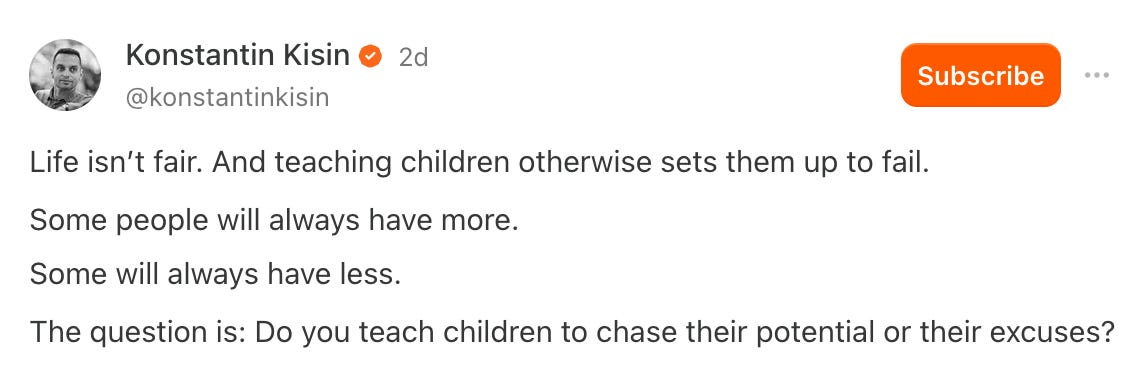
This is a question certainly about how to teach children about fairness and an important one. There are other questions too, including “Is fairness a good thing that we should strive for? Should we try to be fair? Should we object to unfairness?” It would not, for example, be good parenting to give one child many books, tutors and time to study while giving another none and then telling them that some people will always have more and some less and it is up to them to chase their potential rather than make excuses about why they are not getting the same grades as their brother. This would not be a useful learning experience.
This is, of course, a ludicrous example and no parent would consider doing this (assuming they did not hate one of their children). Nevertheless, across society such disparities do exist and they are unfair and I think it is defensible to say that it is undesirable that such unfairness exists and that we can teach children to have an expectation of fairness and object to unfairness. How we think about this in relation to our own lives and in relation to public policy, however, varies significantly and legitimate differences of opinion exist. I think most of my readers would find the argument of the UK professor who claimed that parents reading to their children unfairly disadvantaged other children utterly ridiculous self-flagellation while also agreeing that ensuring that all children have access to a good education is a social responsibility.
Although Konstantin says “It’s not an ideological question. It’s empirical. Is it more useful for a child be to fulfil their potential or to navel-gaze and analyse the precise way in which they didn’t have as much as Johnny the neighbour?” the framing of this specific question could certainly be considered to be based on conservative premises. It is a focus on individual responsibility. A progressive thinking about what to teach their child about fairness would also be unlikely to think they should teach them that life is fair but their empirical question might be “Is it more useful for society for a child to be taught to accept unfairness as a fact of life and focus on their own advancement within that system or that this is something they should oppose and endeavour not to perpetuate themselves?” This is a focus on social responsibility.
It is not that progressives focus only on the responsibility of society to make systems fair for all people and not at all on personal responsibility or that conservatives focus solely on the individual’s responsibilities and not at all on society’s although they do typically perceive each other to err in the wrong direction. Most people who are not radical ideologues believe both that it is important for children to be taught to take responsibility for their own lives and to develop resilience and avoid self-victimising and that society should be set up in such a way that it does not unfairly disadvantage any subset of people and hinder them from reaching their potential.
Ultimately, I think we should teach children to pursue agency rather than grievance, while also teaching society to pursue fairness rather than indifference. Given that children ultimately become society, it is ideal to do these in tandem.
It is the case that when I was 14, my parents were focused on getting me a maths tutor and many books to help me prepare for GCSE, my private school had also arranged extra classes and had a well-stocked quiet and comfortable library of such books and I was excused other responsibilities so that I could focus on my maths in my private study which adjoined my bedroom at home. It was this intensive support which enabled me to pass GCSE maths with which I had always struggled and consequently gain access to a university where I studied English Literature and History and discovered postmodernism and wrote about my dislike of it in a book which became a bestseller. It enabled me to fulfil my potential.
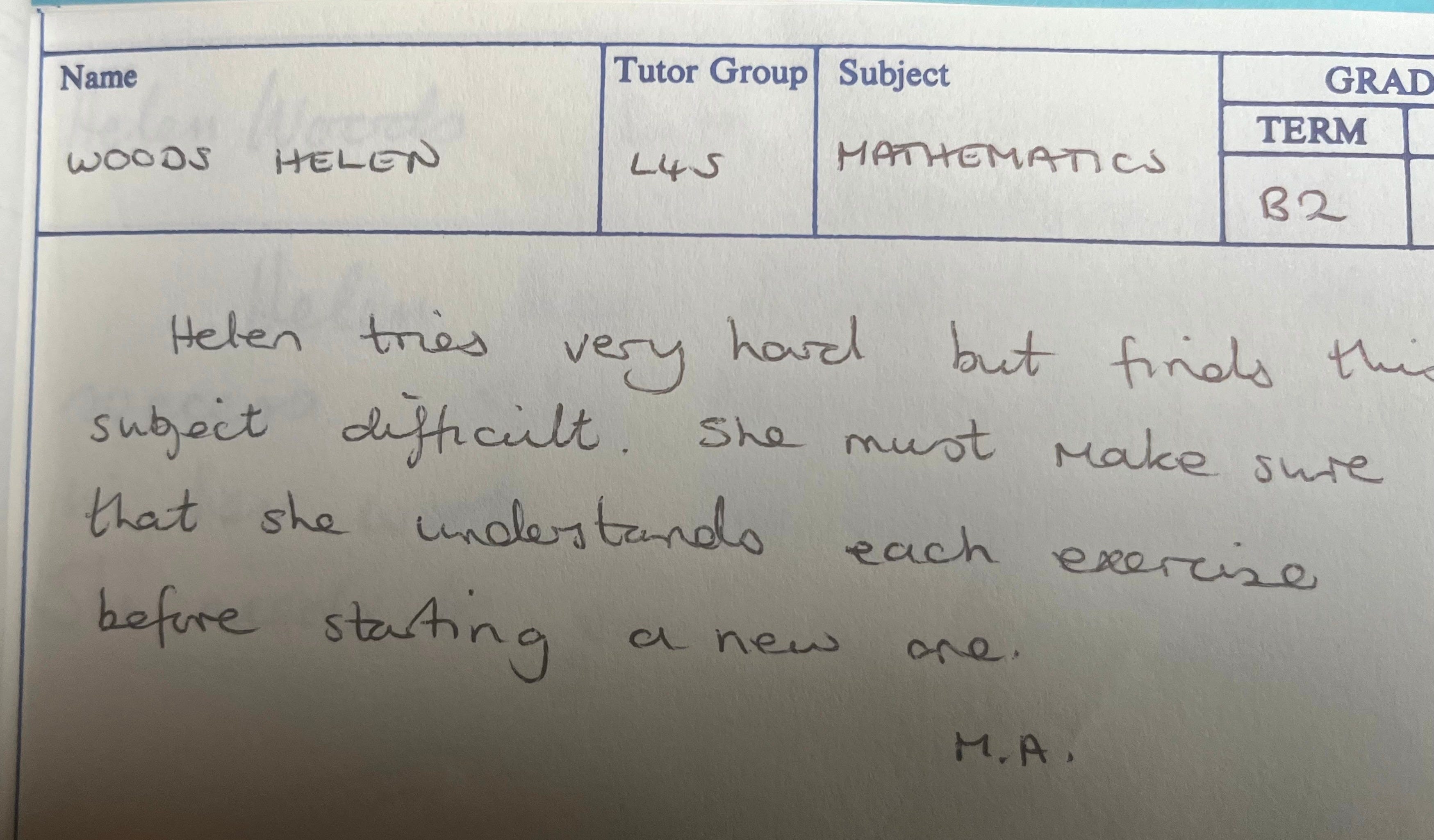
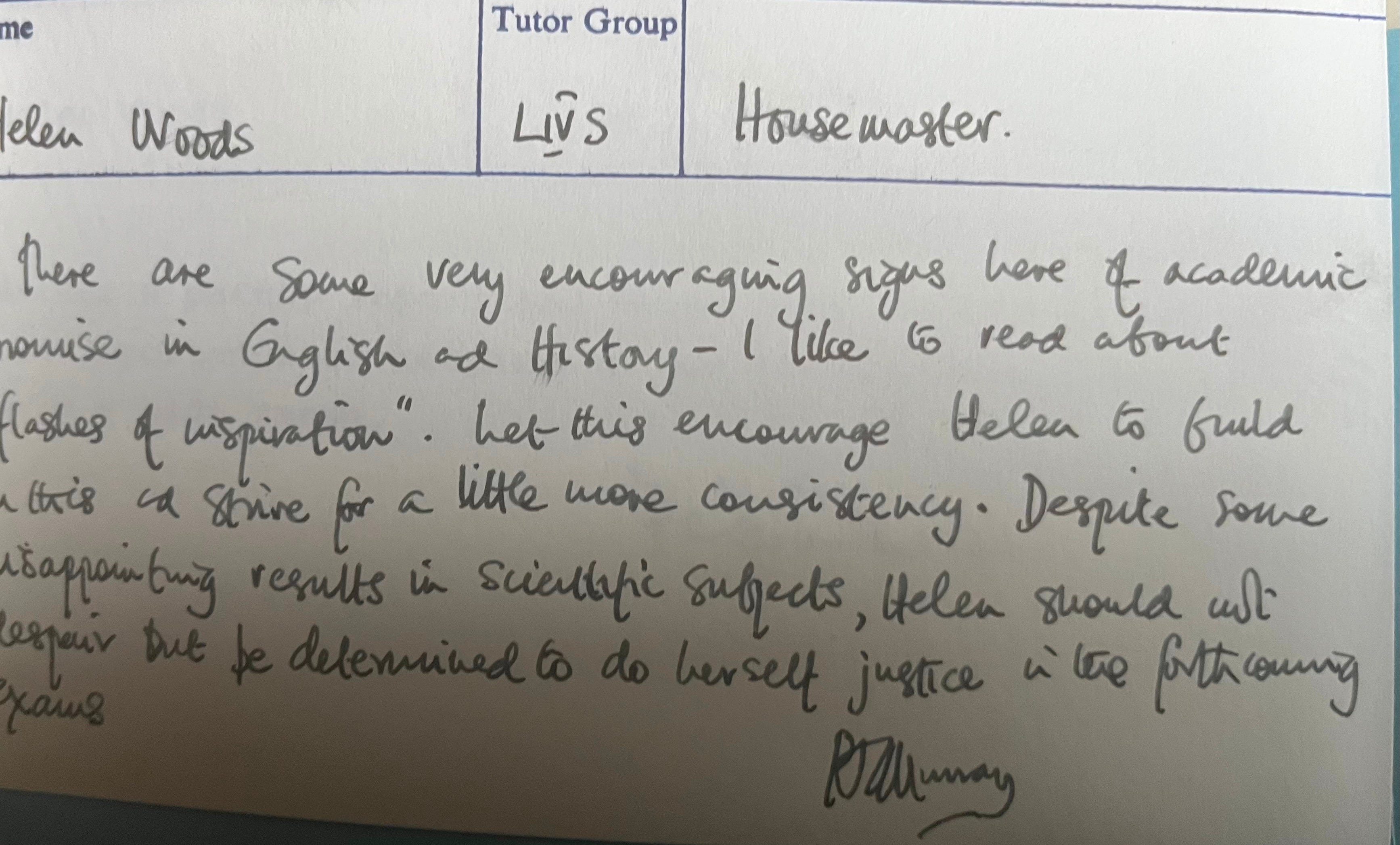
It is also the case that when my husband, David, was 14, he had left school and was working full-time in order to support his family. There was not much point in him remaining at school as it was so awful that it had not, by this time, taught him to read. It was eventually closed down and dubbed “the worst school in England” for failing in this most basic of educational responsibilities. Nor could he learn under his own steam because his parents had neither the education to help him nor the income to provide books and, because there were five boys in a three-bedroomed house, quiet and space in which to study were hard to come by. He acquired literacy in evening classes as an adult, but it is fair to say that this did hinder him from reaching his potential.
Dave would certainly not consider himself a victim of anything, however, and he is not one inclined to navel-gazing. He got a job in which he had the opportunity to take exams in the operation of so many kinds of moving machinery that his skills were sought after and he was able to take a job at the top of his payscale and, when he married and started a family, provide for them so I could stay home with the baby. I have just asked him whether he considers himself successful and he said, “Yes.” (He is a man of few words). When pressed to expand on this, he said, “Well, I’ve done well for myself. I’ve got a nice house, wife and family. We’ve always done alright.” Indeed, we have. On explaining the purpose of this piece, he pronounced himself in agreement with Konstantin, saying, “You’ve just got to get on with it. I can point at other people who had more opportunities than me, but you’ve got to make your own opportunities.”
However, the reason we have a house is because my first flat in London cost £26,000 in 1993 and the mortgage was within my means as a care assistant earning £10,000 a year. When I married him in 2002, a forklift driver earning £16,000 a year, we were able to pay that off quite quickly between us, start a family on his salary alone and then move up the property ladder. That flat is currently valued at £180,000 and forklift drivers now earn about £26,000 a year. It is unlikely that one could now afford to buy it and start a family there. I am sympathetic to the feelings of many of Gen Z that they are not getting the chance of a fair start in life that previous generations had. The attitudes of some boomers and Gen X that they just need to work harder and skip the Netflix and avocado toast simply do not map onto reality. Even someone with my struggles in maths can see that this does not work.
Sometimes, people perceive themselves to be at a disadvantage because they are and the hardwired moral intuition that is likely to arise here is that of unfairness. Rather than telling people that they just need to pull themselves up by the bootstraps, we might want to consider prioritising workable policies to enable affordable housing, especially if we would like the birthrate to increase. There are both economically left-wing policies for increasing social housing and libertarian proposals to enable building that could potentially address this problem.
I deeply admire my husband’s ‘You’ve just got to get on with it’ attitude. It has certainly served him well and our family well. When I wanted to stop work for a couple of years to be with our baby, he took on more work to enable that to happen. When I returned to work, he dropped back to his allotted hours so I could work evenings and weekends. When I had a neurological accident and became disabled, he switched to working nights so that he could take our daughter to school and pick her up if needed and also because it paid more so I could finally do my undergraduate and postgraduate study. When this led to me being invited to travel and speak in the US frequently, he maximised his annual leave so I could do that and he could be at home overnight for our now teen daughter. He did not get a holiday which was actually a holiday for five years. My ability to reach my potential and our daughter’s to reach hers has been enabled by a thoroughly good man ‘just getting on with it.” I was glad to be able to enable him to retire early and, now that our daughter is an adult, dedicate his time to his own interests.
This, however, is not a possibility for most people. When my husband hit 50, his work, which includes much manual lifting of heavy objects, began to get too heavy for him. He could still do it, but his immune system began to suffer. After 14 years without a sick day, he began to get every bug and virus going, be hit hard by them and struggle to throw them off. His work was unsympathetic. If he made it into work but informed them that he needed lighter tasks, they would give him the heaviest. If he said he could not do overtime, they gave him a big job five minutes before end of shift. They believed that, because he’d be unlikely to get another job of this kind at 50, they could exploit him now. In fact, they could not, because my mother just died and I had inherited two houses and convinced him, with difficulty, that it would make more financial sense for him to work on repairing and redecorating them to be sold than for us to hire someone else to do it. He enjoyed giving in his notice and said that, when asked, ‘What will you do for money?” he only just restrained himself from citing the Harry Enfield character, “I am considerably richer than you.” This is, of course, not the situation the vast majority of men or women in manual jobs find themselves when they hit their 50s. This is another reason I think we should raise children to expect fairness from the systems and institutions around them and, if they themselves attain positions of power or management, to treat others fairly in turn.
When I founded Counterweight to help people experiencing a Critical Social Justice authoritarianism problem at their place of work, university or children’s school, I heard from many individuals who objected to narratives of grievance and victimhood which they felt infantalised them or undermined their children’s confidence. Following the death of George Floyd and the Black Lives Matter protests in 2020, many companies and schools across the Western world developed new policies to address racism based on the work of Robin DiAngelo. They implemented anti-racist unconscious bias training which held that society was set up in ways that disadvantaged black people at every turn and that much of this was rooted in unconscious racist bias held by all white people. The white people who came to us for help to address this mostly objected to assumptions that they were racist and being forced to affirm this. However, a disproportionate number of the people who objected to this were black, particularly in the UK, and their objection was that such a narrative was an assault on their dignity, individuality and professionalism. They particularly objected to their children being taught that society was against them and that they would be hobbled at every turn. So many parents felt this way that we produced a template letter for them to adapt for their own situation,
Dear <school official/head teacher/school board>,
Thank you for your communications that you have been teaching about racism and the importance of opposing it. I heartily support this endeavor. It is very important that children have an understanding of history and the ways in which black people and other people of color have been oppressed. They need to know not only the importance of ensuring that this never happens again but also the importance of continuing to oppose evaluating people’s moral worth and social status by their race. We will support any ethical approach to conveying this important message in age-appropriate ways to our child. However, I am somewhat concerned about the ways in which this is being done.
…
I am particularly concerned that my child is being taught that society is stacked against <her/him> and that <she/he> is unlikely to be able to succeed no matter how hard <she/he> works. While racist attitudes do still exist, and we do have to prepare our child to face them, this fatalistic and defeatist attitude undermines the values and confidence we have worked to instill in our child. Children are very impressionable at this age, and I must object to your encouraging them to believe they will fail in life simply because of their skin color. We must request that you stop undermining the strength, ambition, and hope we have instilled in our child and attempting to replace it with resentment and despair.
This maps very closely onto the argument that Konstantin was making and it is one I heartily agree with. It is very difficult to see how any child could develop the confidence to reach their full potential if they believe that every white person they meet has been socialised into believing them to be unintelligent and criminally-inclined and consequently to underestimate their ability to fulfil roles of responsibility and expertise and also regard them as a liability.
However, many of these individuals, particularly in the US, felt it important to stress that black children did continue to face disadvantage statistically and that it was important to address this. The problem with the CSJ approach, they said, was that it rooted this problem in the unconscious minds of white people rather than the material disadvantages that continue to affect black communities who had been relegated to second-class citizens for so many generations. This, then, is partly a class issue, not fundamentally dissimilar to that which affected my (white) husband, although the origins of this class structure are bound up in America’s racial history. It would be a mistake, however, to try to reduce disadvantage entirely to class issues as some Marxists are inclined to do. Racial prejudice also plays a role as indicated by social science experiments which have sent out job applications with identical qualifications but with names associated with Black (ADOS) Americans and white Americans and found the former to receive a less favourable response.
The fact that prejudice and structural disadvantage continues to exist does not mean that descending into self-victimisation and resentment of others is a good solution to it. Surely it is ideal to teach children to be strong and resilient in the face of adversity and also to advocate for social policies and norms that reduce class or demographic-based adversity? We will never be able to make life entirely ‘fair’ for every individual because much individual variation in aptitude exists. I will never be a mathematician or a ballerina. Is it ‘fair’ that my generally serviceable brain becomes paralysed in the face of maths or that I regularly trip over my own feet? Maybe not, but it is unclear how this could redressed. I just have to accept reality and do something else with my life. But if someone had the aptitude and was prevented from being a mathematician because of their sex or a ballet dancer because of their class or race, this is something we, as a society, should surely seek to redress.
When arguing about this in the past in the context of race-based disadvantage, I have semi-facetiously suggested that we might do best to apply the thinking of Shelby Steele to our individual advancement and that of Cornel West to our stances on society. Both of these black intellectuals agree that racism continues to exist and is morally wrong, but while Steele sees the solution to this as black individuals prioritising individual agency, responsibility, education and hard work, West sees it as a universal responsibility to create systems that do not discriminate by class or race and prioritise the needs of the disadvantaged. Both men place a significant focus on the importance of dignity and moral development, but their ethos would seem to be fundamentally opposed. Nevertheless, Steele’s emphasis on agency and dignity is psychologically strengthening when directed inward, while West’s emphasis on justice and social obligation is morally strengthening when directed outward. Even if one disagrees with one or both of these specific thinkers strongly, I’d suggest that when teaching our children about fairness, this should include an understanding of what is owed to oneself and what is owed to society.
Ultimately, as parents, don’t we all want our children to grow up to be confident and resilient, to take responsibility for themselves and to have the capacity to ‘just get on with it’ when life throws something difficult at them, rather than dissolving into a puddle of resentment and self-pity? But don’t we also want them to be adults who can advocate for themselves and object to being treated unfairly rather than accepting that others have the right to treat them badly and they must resign themselves to this because that’s just how it is? Don’t we want them to be socially responsible adults who have an expectation that their political leaders and the systems of society will operate fairly and make this expectation clear to those who hope to be elected by them to positions of power, whether they are on the left or the right? Do we not want our children themselves, if they attain positions of power, to hold themselves to high expectations of the fair treatment of others? I think that most of us, whether more conservative or progressive in our outlook do want this because human beings value fairness, and this goal need not be naive, idealistic or self-victimising.
I think we should teach children to pursue agency rather than grievance, while also teaching them to expect fairness from society and from themselves.
Excellent as usual
We should delineate between unfair treatment, which is a real problem, and unfair circumstances, which is much less so. Too often there’s an application of the unfair treatment to “address” the unfair circumstances.
Very clear and excellent advice. Thankyou for the personal story.