


(Audio version here)
The Overflowings of a Liberal Brain has over 6500 subscribers! We are creating a space for liberals who care about what is true on the left, right and centre to come together and talk about how to understand and navigate our current cultural moment with effectiveness and principled consistency.
I think it is important that I keep my writing free. It is paying subscribers who allow me to spend my time writing and keep that writing available to everyone. Currently 3.8% of my readers are paying subscribers. My goal for 2026 is to increase that to 7%. This would enable me to write full-time for my own substack! If you can afford to become a paying subscriber and want to help me do that, thank you! Otherwise, please share!
I have always been argumentative. I discovered that I was quite good at it when I was 8. This was, according to family lore, when I made a case that my teacher could either say “Two wrongs don’t make a right” when I pushed my best friend down a short flight of steps for hitting me with her satchell or she could keep me in at breaktime for said assault, but not both. I don’t remember this and I think it unlikely that I made a sophisticated philosophical argument about concepts of justice vs revenge, but it interested my teacher enough for her to inform my parents of it and suggest that I was generally good at verbal argumentation.
I remained good at arguing throughout my school days and this was a feature of my reports accompanied by words like ‘difficult’, ‘argumentative’, ‘contrary’ and ‘tiresome.’ My father’s favourite word for it was “bolshie” and he expressed a combination of pride and concern about this. One of the few Serious Conversations we had in my teens was about his concern that being a contrarian was going to hamper me in any career and life generally. He died the year before I was nominated for the Contrarian of the Year Award in 2019, which ultimately went to the great Katharine Birbalsingh.
Nevertheless, he was, in important ways, correct. I was, at this stage, a contrarian. I was somebody who enjoyed verbal contest with authority figures for its own sake. It did not much matter what the rule or claim I was objecting to was and I did not give the rightness or wrongness of it any serious thought. I just wanted to find a way to argue and disconcert whoever I was talking to. I attended a very strict and academically demanding private school which I did not like and this was a source of power. As long as I was polite in my objections and presented them as reasoned arguments or questions that sought clarification, rather than disobedience or rudeness, I could be a consummate pain-in-the-arse without getting into any trouble. My housemaster did get into the habit of ending any address to the class about rules and expectations with an anticipatory, “Shut up, Helen,” but my school disciplinary record was entirely clean.
This tendency of mine to use verbal reasoning as a weapon against those in a position of power or authority over me featured in other areas of my life too. My poor cousin, at four years older than both myself and his sister and considering it his responsibility to prevent us from doing stupid and reckless teenage girl things that we were, in fact, doing, said, “My sister was just mouthy and wouldn’t do what she was told, but you looked like butter wouldn’t melt in your mouth and would try to convince me that black was white.”
This was ultimately the problem. What I was doing, in my immature and rebellious years, was engaging in sophistry, being intellectually dishonest and not caring about what was true. I just wanted to win arguments against people who had power over me, get my own way and make the other person - typically a good-faith actor trying to do what was best for me - feel discomfited, confused and not quite sure what had just happened. I had discovered that my main strength was in verbal argumentation, persuasiveness and plausibility and, at that time, I was very much rebelling against authority of any kind and saw this as the best weapon I had in my arsenal. I also thoroughly enjoyed the fight.
I had an epiphany about this when I was 22. I had got a job and left home at 18 and had a mortgage on my own home. I was living alone and had obtained a job in home care where I worked fairly autonomously. I was very much my own boss and rarely found myself in any situations where anybody else had authority over me. My clients were elderly people whose need for personal care put them in a position of vulnerability, so I never argued with any of them even when they were unreasonable and demanding. I wanted them to feel that they were the ones in power for the sake of their own dignity and autonomy. I was their assistant. I also felt no need to do this with partners or friends. Whenever I did encounter anybody in any position of power, however, my hackles still rose and I still tended to argue with any instructions or advice, on principle.
It was a psychologist I was seeing for OCD who pointed this out to me. My arguing was not being terribly helpful to my recovery. She said that my argumentativeness revealed a problem with authority and an attempt to gain some degree of power when I felt myself in a position of powerlessness. I immediately asked her what evidence she had for this as I was not aware of having told her of any relationships I had with anybody in a position of authority. She was surely not referring to herself because she was an employee of the NHS to which I contributed as a taxpayer and consequently, she worked for me. If she did consider herself to be an authority figure in relation to me, could she justify that? What was it about her being a psychologist providing a service to clients that made her feel like she was an authority figure in a way that, say, a hairdresser would not be?
I went home feeling satisfied that I had won that battle because the psychologist had, as I had intended, become discomfited at being asked to justify a stance I had attributed to her which had twisted her position into one she almost certainly did not hold and would not want to ethically defend. She had assured me that we were working together and changed the subject. I was, at first, jubilant, but then began to feel distinctly uncomfortable. An honest part of me suspected that she was right and that I had shut down someone who was trying to help me. I also suspected that I had not only been unjust to her, but had potentially intimidated her. I had shown her that I could, if I so wished, twist her words into expression of classist assumptions of her own superiority and also her power over vulnerable people which, if made in written complaint, could have been taken seriously and been investigated. I had heard her observation as a threat, “I have power over you” and responded to it with one of my own, “No, you don’t. I have power of my own.” I had, in fact, bullied her.
I felt ashamed that I had used a genuine strength in a way I would have condemned had it taken another form and began to journal about this in a honestly introspective way.
If my particular strength had been physical - if I had been six foot four and built like a rugby player - would it have been justifiable to respond to her observation by looming over her, using my strength to intimidate her or physically overpower her in order to get my own way? Clearly not. Most of us recognise immediately that physical power creates responsibilities. The stronger person bears a greater obligation to exercise restraint. The strength need not be physical for this responsibility to apply. It can be social, institutional, financial or intellectual. It can be the ability to dominate a conversation, tie somebody in knots, or persuade an audience that black is white. The form differs. The ethical question remains the same.
What I had done was use a particular verbal acuity and argumentative skill to twist a narrative to make a psychologist trying to help me feel wrong-footed and defensive. I had not been interested in whether her observation was true. I had been interested in shutting her down and winning. Worse, I had wanted to win in a way that demonstrated that I could not be challenged without consequences.
Once I identified this as the source of my moral unease, I could no longer regard verbal reasoning and rhetorical skill as a morally neutral attribute. The ability to construct persuasive cases verbally in real time is a form of power and consequently it can be abused.
It had not occurred to me at that time that I could ever be a bully. I was very young, living alone, working long hours to get by while feeling very vulnerable in ways which were affecting my mental health. I saw myself as the powerless one defending myself against power being used against me (precisely as the psychologist had suggested). My youth, low social status or mental health struggles could absolutely have been used against me to disregard any complaint, including valid ones, but that wasn’t happening. I had been the aggressor in that exchange. My motivations were antagonistic, my epistemology was pragmatic and my principles were non-existant. The problem was not that I was reasoning badly. The reasoning itself was often strong as a piece of verbal argumentation. The problem was that it was twisty rhetorical trickery in service of a self-defensive goal and I would have used any argument that worked, regardless of what was true or principled.
Years later, with a good clinical psychologist, I came to understand where this reflexive opposition to authority came from. Childhood experiences had left me inclined to see authority itself as the threat rather than assessing whether any particular authority was factually correct and acting justly. Schema therapy provided a useful framework for understanding the distorted perceptions at play here. What mattered was not the details, however, but the realisation that I was treating all authority as abusive and responding accordingly.
I had learnt to react against any form of authority indiscriminately and attack it with the only strength I had. But because I was indiscriminate, I was unjust and attacked people who were not attacking me. And because I was using language as a weapon and not a way to determine truth or consider ethics, I was reaching for anything that could make the other person back off rather than addressing what they actually said honestly. This was immature defensive behaviour which needed to be unpicked.
It helped when I spent time considering what this must feel like from the other side. If I twist somebody else’s meaning and attack them in a way that makes them back off and leave me alone, how do they then feel about me? They are likely confused and even hurt because they weren’t looking for an argument or to win anything. It is unlikely, even if they decide not to argue with me again, that they respect me. My arguments were dishonest and manipulative. This could lead someone else to decide against challenging me again, but it could not make them credit anything I say.
Over the course of this journaling process about truth, fairness, authority, intellectual honesty and consistent principles, which took about 18 months in its first intensive burst but has been continuing ever since (and more recently, in public), I gradually came to the conclusion that a distrust of authority and an ability to make strong verbal arguments were a good combination provided they were used thoughtfully. I must not be a reflexive, indiscriminate contrarian but pick my battles wisely and in defence of things that actually matter, not my own ego. The rightful target cannot be any presentation of authority, but abuse of authority, illegitimate authority and authoritarianism. Then when something does need fighting, this must be done honestly and with principle, not in defensive or self-serving ways. The ability to admit when one has been wrong and change one’s mind is also key.
It was this post of Gurwinder’s referencing C.S. Lewis which made me think of this period in my life.
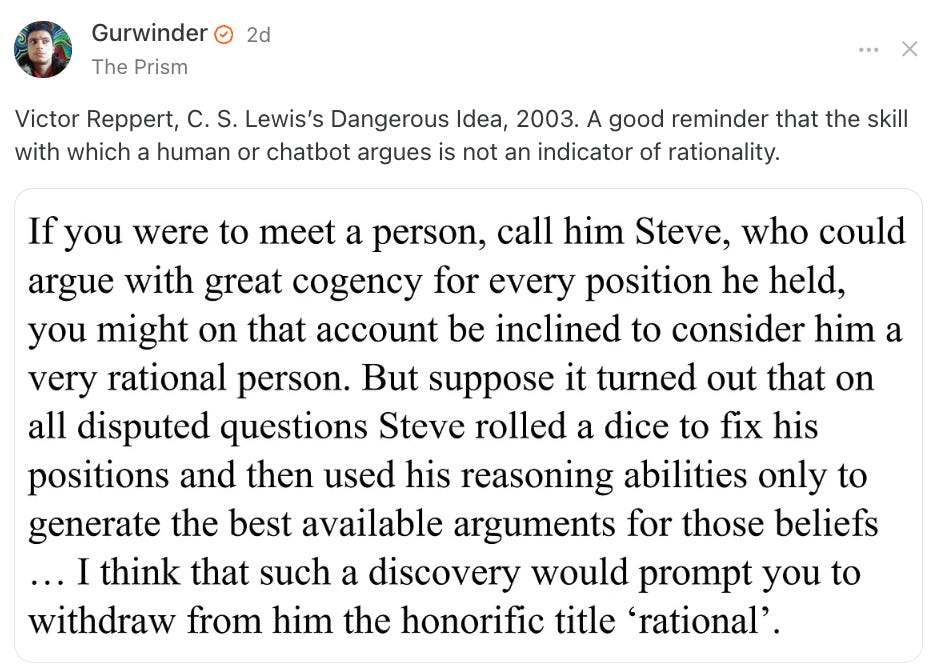
Indeed! Rationality is not best understood as the ability to make internally coherent, logical arguments well. The person using reason well is not the one who can defend any conclusion or justify any principles. It is the one who cares which conclusion is actually true and can uphold principles consistently across tribes. This is what makes the difference between the effective use of reason and a rationalisation.
A person who is willing to argue brilliantly for any position is like a mercenary. We can admire the skill but not the purpose to which it is put. The mercenary fights for whoever pays him. The indiscriminate sophist argues for whichever conclusion benefits him. These are the opportunistic hoppers upon bandwagons that seem likely to be profitable either financially or in social status. They will switch allegiance as soon as it seems prudent to do so.
A person who is willing to argue brilliantly but without any concern for truth, principle or self-correction in defence of a cause is generally an ideologue. Again, their skills may be impressive but their intellectual dishonesty and ethical inconsistency make productive discussion and conflict resolution extremely difficult and are likely to ultimately discredit their own cause. We need the best arguers for every position to do so in good faith and with an acceptance that some of their ideas might be wrong.
I get very angry when I see mature adults with fully-developed frontal lobes using impressive abilities of verbal reasoning and rhetorical skill to make plausible and persuasive arguments which are nevertheless dishonest and self-serving, whether this is for reasons of self-advancement or ideological commitment. If they have the ability to formulate such sophisticated arguments, they must also be aware of the ways in which they have bent them to be deceptive and inconsistently principled. If not, they have a heightened responsibility to scrutinise their own reasoning and remain alert to the possibility that they are rationalising rather than reasoning. They are using an ability they have to confuse and mislead people of good faith and good will whose strengths lie elsewhere than the argumentative realm. Perhaps, in the case of ideologues, they justify this as being for the greater good of their cause. Nevertheless, it is an abuse of intellectual power and it is unconscionable in the same way an abuse of physical, economic or institutional power is. It puts ego or ideology above the interests of individuals watching such arguments with the intention of evaluating them to form their own conclusions. It contributes to a culture in which a functioning marketplace of ideas is derailed and truth and principle are subordinated to narrative and ideological convenience and in which confusion, misunderstanding and polarisation flourish.
I still enjoy arguing. I still enjoy the process of dismantling bad arguments and challenging authoritarianism. I still think it is absolutely acceptable to be someone who thrives on collaborative conflict and takes pleasure in making strongly critical arguments and in making them persuasive. The issue is not whether we should do that and do it forcefully and take satisfaction in a point hitting home. It is whether we are using that skill in service of what is true and what is consistently principled and whether we are applying the same standards of honesty, consistency and self-scrutiny to our own arguments as we do to those of others.
The difference between good reasoning and self-serving rationalisation is not ability, but integrity.
I experienced a similar epiphany, though I sometimes forget it in the heat of verbal combat. Maybe a good shorthand for what not to do would be something like: neither a mercenary nor a true believer be.
So, argue in good faith in service of truth - not in service of personal power?