


(Audio version here)
Since writing my piece on Britishness and Englishness, I have tried to talk with ethnonationalists about what makes someone belong to a nation. This has been largely futile. The problem is not simply disagreement but a refusal to recognise that the disagreement exists at the level of premises. Ethnonationalists typically speak as though their understanding of national belonging as rooted in ethnicity were self-evidently true, and that anyone who disagrees is simply factually wrong.
There are, in fact, two contradictory premises underlying the debate about what makes someone British or English.
Britishness or Englishness is defined by an individual’s ethnicity or genetic lineage — where one’s ancestors lived.
Britishness or Englishness is defined by where the individual themselves lives, was born and the culture they are embedded in.
Ethnonationalists work on the first premise. Most other people work on the second.
The disagreement is therefore not about whether genetic ancestry exists. Nearly everyone accepts that it does. The disagreement is about whether ancestry should determine national belonging.
It is not self-evident that people should be defined by the geographical location of their ancestors rather than their own. In most situations we evaluate people within their own context rather than that of their forebears, though this is not always the case. I once dated a man from a fishing family that had dominated a small village for centuries and generated much local lore. Although he himself was a mechanic, local people still referred to him as a fisherman because of that lineage. Humans often do feel a strong connection to their ancestry. Yet in most cases we assess people according to their own lives rather than those of their ancestors. This includes nationality. The Irish often joke, with irritation or resignation, about Americans eager to inform them that they are Irish. The joke is that, to the Irish, they are quite clearly not. They are American.
Nevertheless, it is clear that humans commonly feel invested in their ancestry and history, and this tendency may be partly innate. Ancestor worship has appeared across cultures, along with many less formal expressions of ancestral attachment. As both a patriotic person and someone with a background in late medieval English history, I feel this pull and a sense of connectedness and continuity when thinking about who my ancestors were, where they lived and what they were likely doing. This is necessarily tied to place. People also commonly feel pride or shame about things their country did long before they were born. Given this intuition, it will not do simply to dismiss attachment to ancestry as irrational or racist. Ancestry is culturally meaningful to many people, so Premise One cannot simply be rejected.
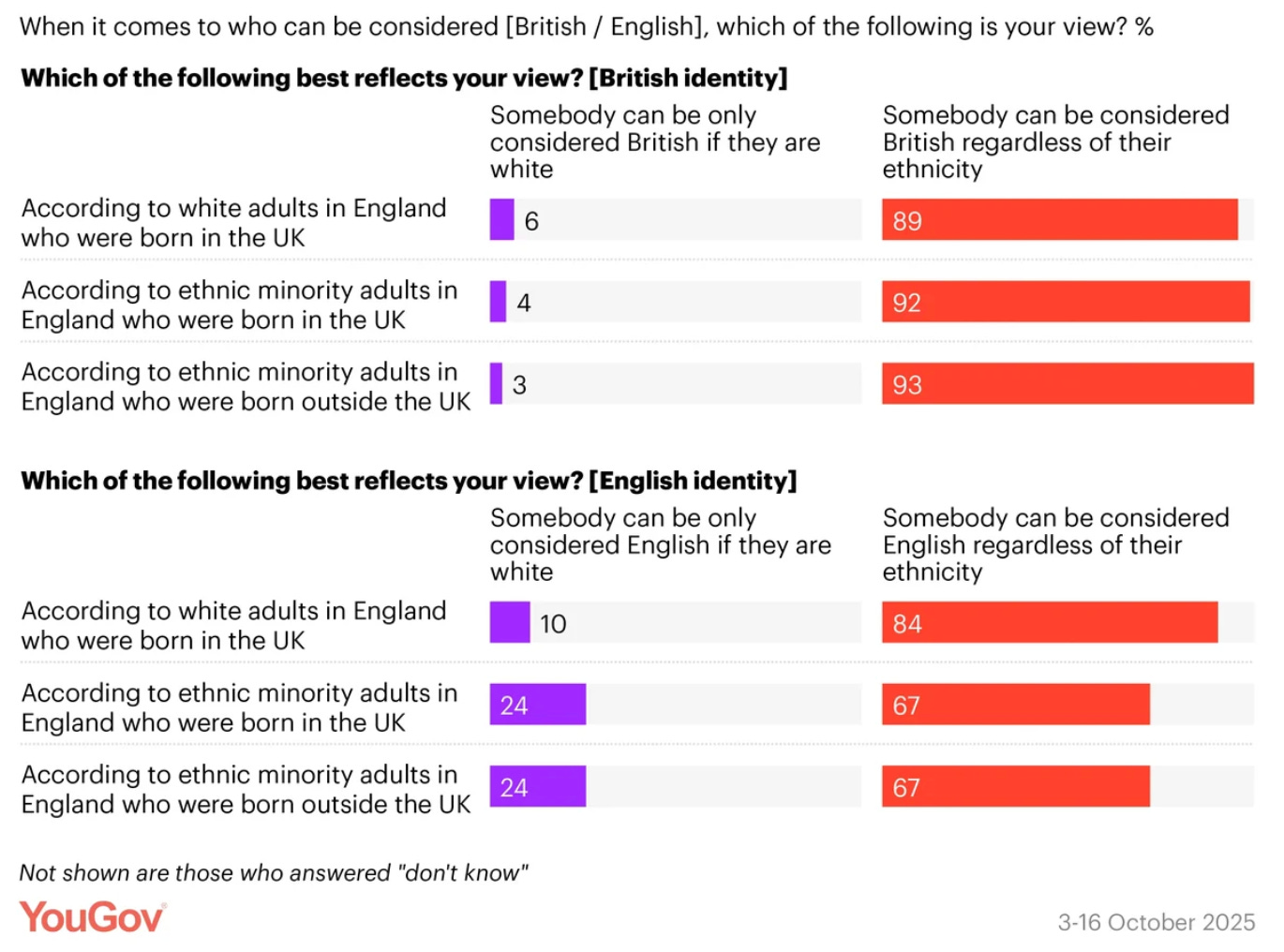
Both premises ultimately stem from our tendency to create, value and preserve culture. Humans are a culture-creating species. The 89% of white Brits who think one does not have to be white to be British and the 84% who think one does not have to be white to be English clearly understand these identities primarily in cultural terms: where someone was born and lives, the language they speak, the national identity they hold and the customs and norms they embody. Those who instead define these identities through ancestry typically justify this in terms of protecting cultural heritage and history. In both cases, concern about culture and about people failing to respect or integrate into it lies at the heart of concerns about immigration.
If neither premise is inherently irrational or factually false, then the question becomes which one should guide how we define belonging. This requires argument. Yet this is precisely what ethnonationalists often refuse to do. Instead they assert their premise — that Britishness or Englishness is defined by ethnicity or genetic lineage — as though it were simply an objective fact. Some have begun accusing those who reject this premise of using the same reasoning as people who deny that “woman” is a biological category and claim it can be identified into. But people who use “British” or “English” to describe someone born and raised in the country do not typically deny the biological reality of ethnicity. They simply disagree that ethnicity must define national belonging.
Both groups accept that genetic lineage is biologically determined and can be identified through genetic testing. The disagreement concerns whether this should determine who belongs to Britain or England. When we are arguing about how we should understand and define things, we have moved away from indisputable biological facts and into the realms of culture and ethics. We have moved from the realm of what is objectively true to the realm of what is socially constructed. Facts about humans’ genetic ancestry are objective. The division of the world into nations and devising of rules for who belongs where are social constructs.
Many people become deeply suspicious when anyone speaks of anything being ‘a social construct.’ This is understandable. In recent years, we have most commonly heard this used by Critical Social Justice activists telling us that certain things are social constructs when, in fact, they are not and/or that we have a moral responsibility to deconstruct certain social norms that exist or are claimed to exist and reconstruct them according to their own theories. However, social constructs do actually exist because humans form societies and within them, they construct systems. Money is a social construct and so are marriage, political parties and systems of government. Whenever someone argues that some feature of society should be changed, they implicitly acknowledge that social arrangements are constructed and can be constructed differently.
We can often identify social constructs by asking a simple question: would this still be true if no humans had thought of it? Take biological sex. Humans are a bimodal, sexually reproducing species. That fact would remain true whether humans recognised it or not. But the social rules and expectations surrounding how men and women should behave have varied widely across societies and time periods. Those rules are socially constructed. This does not mean that all arrangements are equally good including sexual slavery and child marriage, but that such rules arise from human societies rather than nature itself.
Questions about who is British or English similarly involve both biological facts and social constructs. Genetic populations existed long before humans understood genetics but categories such as “British” and “English” are products of human history. The island to which the labels refer existed long before any humans knew about it (although it was not always an island). The naming of it and the formation of countries within it resulted from different groups of humans engaging in invasions, battles, tribal warfare, monarchical dynasties, feuds, alliances and unifications that decided who it belonged to and who had a right to be there. This was constructed by societies of humans. (The other animals living here presumably have no concept of being British or English).
The mixture of biological facts and social constructions appears particularly clearly in the arguments of those who say that black and brown people can be British but not English.
For example, Rupert Lowe, the leader of Restore Britain, recently said,
English ethnicity exists - it’s the only sodding data point that the Government collects on anything. Of course someone who is not of that ethnicity can be British, obviously. But it equally does not mean that the English ethnicity is imaginary. Those two things can be true at the same time.
It is not self-evident why descent from Anglo-Saxon populations should define “English,” while descent from the many populations who inhabited the larger landmass of Britain does not similarly define “British.” An arbitrary decision has been made that Englishness should be ethnic while Britishness can be granted legally. It is indeed true that an English ethnicity exists but it is not inherently true that a British identity can be granted by law or that this is how either should be defined. That part is a social construct. And, of course, very many people disagree with it. Many ethnonationalists will insist that “British” is also defined by ethnicity while the vast majority of white Brits will consider their black and brown compatriots born and raised in England to be English. Interestingly, a smaller proportion of black and brown Brits in England see themselves as English while nearly all consider themselves to be British.
Therefore, it should be clear that there is no consensus on who should and should not be considered British or English and that different, coherent and logical premises exist for considering this to be a matter of ancestral lineage or to indicate the country one was born in and continues to live in and considers home. It is no good for ethnonationalists to assert that both designations simply are a matter of genetic lineage and thus the vast majority of people who disagree with this are straightforwardly, factually wrong. It certainly doesn’t help when some of them insist that this is ‘not up for debate’ and that to disagree with them is to ‘deny their right to exist.’ This approach has never convinced anybody.
My own position, as a patriotic, liberal, economically left but culturally conservative Brit, is clear. To be proudly British and patriotic is to value the history and culture of the nations on this island and to preserve those elements that are worth preserving. Ethnonationalism is often presented as a defence of tradition, but it has little grounding in the intellectual or cultural traditions of Britain. It is not to be found in liberal philosophy, in Christianity or even in the tribal cultures that existed on these islands before the modern nation emerged.
The British values I most want to conserve are those developed in the modern era. They include Britain’s significant contributions to Enlightenment thought and liberal philosophy: individual liberty, freedom of belief and speech, parliamentary democracy, equality under the law and respect for our common humanity. Defending these values also means recognising the many black and brown Brits who share these commitments as my compatriots and my people. To defend such British values is to oppose threats wherever they arise whether from external cultures that reject science, reason, liberty, democratic processes and human dignity, or from internal ones.
The Overflowings of a Liberal Brain has over 6000 readers! We are creating a space for liberals who care about what is true on the left, right and centre to come together and talk about how to understand and navigate our current cultural moment with effectiveness and principled consistency.
I think it is important that I keep my writing free. It is paying subscribers who allow me to spend my time writing and keep that writing available to everyone. Currently 3.8% of my readers are paying subscribers. My goal for 2026 is to increase that to 7%. This would enable me to write full-time for my own substack! If you can afford to become a paying subscriber and want to help me do that, thank you! Otherwise, please share!
US person here, colloquially known as "American," sharing that similar debates (or more accurately, similar lack of actual debates!) about what distinctions are relevant for "Us vs Them" exist here as well, and on so many fronts of the "Culture Wars."
A favorite thinker of mine, Greg Thomas, once shared an anecdote on the Jim Rutt Show of how a Black British colleague of his had made a pilgrimage to some part of Africa to explore his familial ancestry. Upon arriving, he was taken aback by the fact that his ancestral community treated him as an outsider, clearly someone who was "British first, with Black skin," while much of the progressive British population "back home" was being encouraged to see him as "Black first, raised British."
So fascinating how different contexts can variably allocate different identity components as more or less primary than others!
And moderation. Moderation has been one British value I have been most appreciative of in recent years.