


(Audio version here)
The Overflowings of a Liberal Brain has over 6000 readers! We are creating a space for liberals who care about what is true on the left, right and centre to come together and talk about how to understand and navigate our current cultural moment with effectiveness and principled consistency.
I think it is important that I keep my writing free. It is paying subscribers who allow me to spend my time writing and keep that writing available to everyone. Currently 3.8% of my readers are paying subscribers. My goal for 2026 is to increase that to 7%. This would enable me to write full-time for my own substack! If you can afford to become a paying subscriber and want to help me do that, thank you! Otherwise, please share!
People so often speak of “gender ideology” as if there is only one. Typically, they are referring to a belief in an innate gender identity which is more authoritative in determining whether one is a man or a woman than one’s biological sex. This is, of course, an ideology of gender. However, it is far from the only one and I think we do well to consider carefully the arguments against it by people who clearly have a very distinct gender ideology of their own.
First, we should examine what a gender ideology is. The term ‘ideology’ simply means ‘a set or system of ideas and beliefs’ but it is often said with negative connotations to imply that claims made from ideology are biased rather than objective. When engaging in political and cultural debate, and addressing social issues, however, there is nothing inherently suspect about doing so from any political, religious or philosophical position as long as one is clear and consistent about it. I argue from a liberal framework which is a set of ideas and beliefs about individual liberty, viewpoint diversity and democratic governance. Having a consistent set of principles, ideas and beliefs only becomes a problem when people become authoritarian or blinkered and engage in dishonest argument, motivated reasoning and tribalism to protect their beliefs.
The concept of “gender” is more complex, because it has multiple definitions. Some people use ‘gender’ synonymously with ‘sex,’ either as a more ‘polite’ term or to distinguish it from the act of sex. In political and cultural discussions, however, ‘gender’ is more commonly used to refer to characteristics of being a man or a woman that are not anatomical—primarily behaviours and presentation. Even within this definition, there is considerable variation. Some use ‘gender’ to include distributions of traits that constitute evolved psychological sex differences, while others restrict it to socially constructed, culturally specific roles and expectations. This is further complicated by disagreement over which traits are rooted in our biology as a dimorphic, sexually reproducing species, and which are socially constructed. These disagreements can be productive, however. Rigorous research in evolutionary psychology, cognitive psychology, and sociology can help to clarify them.
The simplest way to capture what most people mean by ‘gender’ is to think of it as standing in relation to sex as ‘masculine’ does to ‘male’ and ‘feminine’ to ‘female’. From there, we can recognise that people differ considerably in how they define masculinity and femininity, how they believe they came to be associated with men and women, and whether they regard this as a good thing or a problem.
We appear always to have had a concept that distinguishes gender from sex. This is reflected in longstanding language: ‘manly’ and ‘womanly’ (generally approving and aligned with sex), ‘mannish’ and ‘womanish’ (often disapproving and applied to those seen as manifesting traits more proper to the other sex), and terms like ‘effeminate’ or ‘butch’ to describe more feminine men and masculine women. If the sentences “She is a very feminine woman” or “He is not a particularly masculine man” make intuitive sense to you—even if you disapprove of evaluating people in this way—you already have a concept of gender as distinct from sex.
Therefore, a gender ideology can most simply be defined as “a set of ideas and beliefs about what masculinity and femininity are, how they relate to being male or female, and what their ethical and social implications are.” On this definition, it becomes clear that more than one gender ideology is being expressed and contested in contemporary political and cultural discourse.
There are many sets of ideas and beliefs about gender and its relationship to sex, but they can be broadly divided into three main streams: gender conservative, gender critical, and genderqueer. Each contains a kernel of truth and can be articulated in ways that respect individual liberty. But when hardened into ideological commitments, each can lead us away from what is true and become hostile to that liberty.
Gender conservatism holds that gender roles and stereotypes of masculinity and femininity are good and natural (or God-ordained), that they should align with biological sex, and that this alignment ought to be enforced legally and/or socially for the wellbeing of individuals and the moral good of society. This typically includes, or strongly privileges, heterosexuality as a moral ideal.
There are significant ethical differences within this broad stance. The ‘manosphere,’ which includes figures such as Andrew Tate and Myron Gaines, portrays masculinity as aggressive, boorish, and misogynistic, with an emphasis on sexual conquest. This is sharply at odds with the ‘tradlife’ Christian conservative ideal, which emphasises celibacy before marriage, monogamy, male leadership, and female submission. Nevertheless, both are rooted in beliefs about the natural dominance of men, seen as suited to leadership and governance, and the corresponding subordination of women, seen as primarily suited to sexual and domestic roles.
Most social conservatives reject both of these extremes, but typically believe that men and women are fundamentally different—though often of equal value—and suited to different roles in life. They tend to see men as oriented towards protecting and providing, and women towards nurturing and homemaking, and to believe that both sexes are happier in these roles, that families function best within this arrangement, and that society is healthier as a result.
The kernel of truth here is that psychological sex differences do exist, and that gender roles and stereotypes are therefore grounded in something real. More men than women are drawn to protecting and providing roles, while more women than men are drawn to nurturing and homemaking ones. Attempting to socially engineer these differences away entirely would likely make many people unhappy.
Gender conservatism departs from reality when it attempts to turn statistically different distributions of traits between the sexes into rigid categories of masculine and feminine roles, ignoring the biological fact that men and women are overlapping populations with significant individual variation. Some of the most ambitious, career-oriented people with strong leadership skills are women, while some of the most nurturing and domestically oriented are men. More commonly, men and women both possess a mix of these qualities and are happiest when they combine professional, intellectual, or vocational work with hands-on parenting and family life. They may differ, on average, in the work–life balance they prefer.
Gender conservatism becomes illiberal when it not only denies the overlap in trait distributions between the sexes, but insists that such variation should not exist. In its more rigid forms, it treats deviations from stereotypical masculinity and femininity—whether in personality, behaviour, or sexuality—as morally wrong. Some seek to impose these values on others through legal or social pressure.
Gender-critical views require more unpacking because this concept is not only held to different degrees, some of which are compatible with truth and individual liberty and some of which are not. Its meaning has also recently been significantly expanded to encompass directly contradictory views.
Gender-critical feminism is continuous with the radical feminism that arose to challenge longstanding and historically dominant forms of gender conservatism. It holds that ‘gender’ is an oppressive social construct created to subordinate women to men within patriarchal systems. Gender—and with it, gender roles and stereotypes—is understood as a set of fictions created to justify the subordination of one sex class to another. Notions of masculinity and femininity should therefore be abolished in order to liberate women (and, to a lesser extent, men) from the constraints they impose.
The term ‘gender critical,’ however, has broadened considerably, particularly over the last decade. Many people have adopted the label specifically to signal opposition to the trans activist/queer movement, often from positions other than radical feminism or any form of feminism. As a result, while those who describe themselves as ‘gender critical’ can nearly all be understood to object to the concept of gender identity, they are not all critical of gender itself, including roles and stereotypes. Some hold gender-conservative views, and there has been a noticeable influx of people from the populist right hostile to the aims of gender critical feminism. This adds further to the conceptual confusion. Some of the original left-wing, gender-critical feminists from the radical, materialist and socialist traditions now feel utterly alienated from the movement they began.
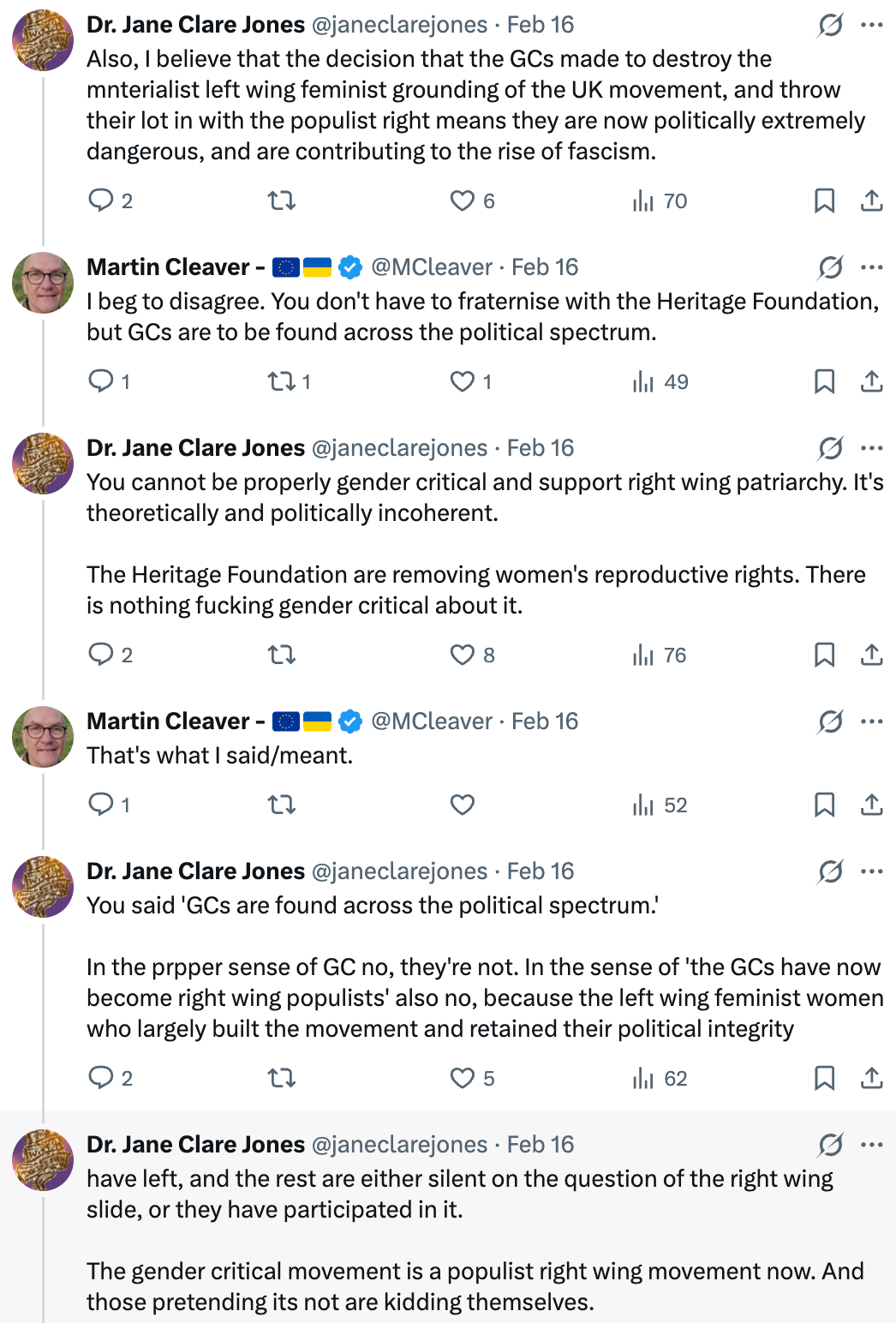
Among those original gender-critical feminists who are both genuinely critical of gender and grounded in feminist theory, there is still considerable variation. In their most absolutist manifestation, some gender-critical feminists within the radical feminist tradition adopt a blank-slatist position. They are “defined by holding that all behavioural and psychological average differences are developmentally acquired, and that none are structured into sexed brains in the womb or at puberty.” (Kathleen Stock, Material Girls). This is also often described as holding a belief that ‘evolution stops at the neck.’ It assumes that, if patriarchal social conditioning did not exist which assigns different roles to men and women, the sexes would be psychologically and behaviourally identical. This stance can be expressed explicitly or revealed implicitly in assumptions that any disparities between men and women must be socially constructed rather than influenced by biologically-driven psychological differences. These include overall differences in earnings (but not in spending), representation in prestigious professions (but not dirty or dangerous ones), work/life balance, concern for domestic orderliness, violent crime etc.
Because this is a political movement with the specific aim of liberating the sex class of women from the sex class of men, feminist theorising is prone to reading behavioural and psychological differences between men and women as well as the different experiences and challenges faced by men and women in a highly politicised way. “Patriarchy” - an oppressive system which legally or socially gives men disproportionate power and leadership, including over women - is typically theorised to persist and provide a primary explanatory framework for a wide range of social issues. Due to class-based thinking that sees men and women as distinct classes with their own sex-based interests rather than as individuals who can individually subscribe to a range of political positions on the roles and rights of women, ‘patriarchy’ can often be used synonymously with ‘men,’ thereby lending justification to misandrist views.

This blank-slatist stance on the existence, origins, and causes of psychological and behavioural sex differences is sometimes upheld consistently, and sometimes not. Because this strand of feminist theory operates explicitly through a lens of what it understands to be in the interests of women, it does not always apply its principles consistently across groups. In this respect, it differs from a liberal framework, which treats people as individuals with equal moral rights, and can be described as feminist when it objects to women being denied those rights. This can lead some proponents to accept psychological sex differences when they appear to favour women, but to downplay or reject them when they appear to favour men, and to recognise areas in which women are disadvantaged while overlooking those in which men are.
Steve Stewart-Williams gives a good overview of how these biases can manifest in the social sciences and more widely.

However, it would be a mistake and unjust to assume that all who take a gender critical stance with particular concern for the rights and roles of women are blank slatists with a misandrist bias. The majority of people who take this position (and many of them are men) accept that psychological and behavioural sex differences exist and manifest in disparities between the sexes. They are concerned about the enforcement of gender roles and stereotypes or social pressure to conform with them and particularly with the way this manifests in trans activism and the risks of this to women (and children). They typically reject the idea that the conflict is between ‘men’s interests’ and ‘women’s interests,’ and instead see it as a disagreement between political groups comprising individuals of both sexes. They may or may not believe that we still live in a society in which patriarchal norms have a significant presence and disadvantage women in particular.
The kernel of truth in the gender critical stance is that culturally constructed and oppressive gender roles and stereotypes and patriarchal values have demonstrably existed throughout history and continue to be held and expressed within factions of society today. There is also an inherent risk in assuming that psychological sex differences manifesting in autonomous choices made by women explain their underrepresentation in any prestigious field. It may well be better to err in the direction of making a false positive error (assuming disadvantage to exist when it does not) than a false negative error (assuming that disadvantage does not exist when it does) and then falsify this if warranted.
The gender-critical standpoint departs from reality when it adopts a blank-slatist position and defines ‘gender’ in ways that encompass cognitive, psychological, and behavioural sex differences for which there is considerable evidence. Evidence for these differences can be found across multiple disciplines, including anthropology, sociology, neuroscience, cognitive and evolutionary psychology, primatology, and endocrinology. They are also observed in very young children, prior to extensive socialisation, and show parallels in other great apes, suggesting evolutionary roots that predate human culture. There is also a well-documented paradox in which differences in male and female preferences tend to increase, rather than decrease, in more sex-egalitarian societies where individuals have greater freedom to choose.
The gender critical feminist stance becomes illiberal when it demonises men and pathologises perfectly normal and healthy male traits which most commonly manifest in positive and neutral ways. It can also hinder effective detection of, and intervention with, violent and predatory offenders when ‘men’ or ‘masculinity’ are treated as the primary explanatory categories, rather than undertaking rigorous analysis of why a minority of men behave in harmful and antisocial ways despite widespread social condemnation. It also represents a devaluation of more female-typical traits and a denial of individual autonomy when it is assumed that when women do not make the same life and career choices as men in the same numbers, this means they are being prevented from doing so. This seems to regard men as the default and optimal humans, diminishing the value of areas in which women are more strongly represented, such as communication and social domains.
The gender critical movement more broadly is illiberal when it attempts to cancel and penalise people for their language and clothing choices and engages in homophobic and racist rhetoric. Principled gender critical feminists who object to authoritarianism consistently and actively support gender nonconformity and same sex attraction have been in the forefront of opposing this development. It remains essential to distinguish between gender conservatives who adopt the ‘gender critical’ label alongside (often radical) culturally conservative views, and left-wing gender-critical feminists working within a progressive, materialist framework. The people most likely to blur this distinction are the ‘genderqueer’ activists.
Genderqueer activism holds that categories of sex, gender and sexuality have all been socially constructed in the service of upholding cis/heteronormative power structures. ‘Cis/heteronormative’ refers to the assumption that people are, and ought to be, heterosexual and conform to gender roles, stereotypes, and presentations aligned with their biological sex. Liberation, on this view, requires dissolving, blurring, and fragmenting these categories. The verb ‘to queer’ refers to this process of dismantling boundaries and destabilising classifications.
The development of ‘queer theory’ upon which this ideology depends followed the evolutionary pattern we set out in Cynical Theories. Originally, it was merely deconstructive and sought to subvert established concepts of sex and sexuality particularly by complicating them. This then moved into an activist phase which took aim at both gender conservatism and the radical feminism with which gender critical feminism is continuous. Consequently, it shares gender conservative views that align gender roles and gender stereotypes with biological sex but inverts them. Rather than ‘Women should be feminine” it enables ‘People with feminine traits are women.” It also shares some tenets with feminists in that it believed gender to be a social construct but explicitly contradicted their materialist stance by claiming sex to also be socially constructed and so open to subjective reconstruction. Later (and current) development of queer theory hardened into accepting the subjective element of ‘gender identity’ as authoritative and unquestionable while allowing sex to be redefined in accordance with that identity and sexuality to be reframed as attraction to gender identity rather than biological sex.
Consequently, there is a range of views that exists under this heading too. However, what is most evident to most people is authoritarian trans activism and institutional capture. This takes an absolutist stance which holds that gender identity must be affirmed and that a failure to do represents a denial of the trans-identified individual’s right to exist. The advocated right of the trans person to be accepted straightforwardly and uncritically as a man or woman on the basis of their gender identity and in all situations is held as though it takes precedent over the rights and freedoms of every other group. This gender ideology has rightly been the cause of greatest concern because it has gained most institutional power and been implemented in ways which directly jeopardise the safety of women and children.
Trans activists have been particularly aggressive and even violent and their primary targets have been gender critical feminists. The website “TerfIsASlur” has been documenting this.
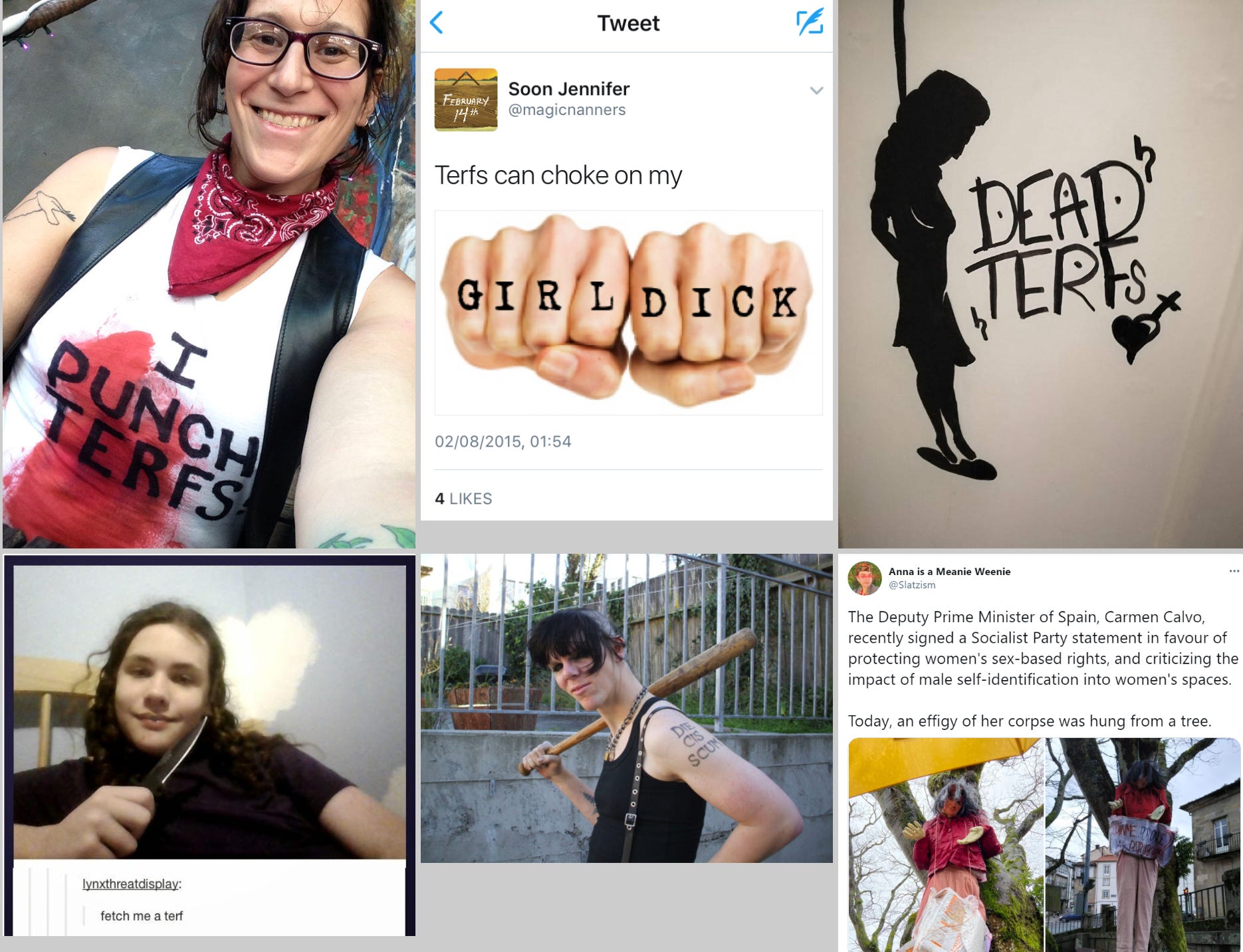
Meanwhile, institutions, organisations and workplaces have been enforcing affirmation of belief in gender identity on employees under threat of disciplinary action. This necessitated court cases to produce rulings that people cannot be discriminated against for simply believing that ‘man’ and ‘woman’ are biological categories and declining to affirm otherwise. The battle to protect women’s single sex spaces and categories including bathrooms, changing rooms, refuges, prisons and sports for reasons of safety and fair competition are ongoing. So too are attempts to address “gender-affirming care” for children experiencing gender distress, oppose medical interventions on those typically considered too young to give consent to life-changing decisions and make available therapeutic support that helps young people explore a range of reasons for feeling alienated from their sexed bodies including autism and same-sex attraction.
These varied and serious problems are all underlain by the belief that the consequences of not affirming the gender identity of a trans-identified person are so devastating that a moral imperative to do so takes precedence over other considerations. These include freedom of belief and speech, the risks to women of enabling sexual predators to ‘self-identify’ into spaces where they are undressed or vulnerable, and the rights of women to compete safely and fairly in sport. They also include the rights of children who will not always perceive themselves as having a gender identity different from their biological sex, to grow up without medical intervention and make their own decisions as adults capable of informed consent.
Because these manifestations of genderqueer/gender identity views are so authoritarian and unreasonable and the consequences so serious, they have understandably dominated the discussion and eclipsed earlier iterations which were more playful, individualistic and freedom-respecting, demanding no affirmations, sacrifice of women’s sex-based rights or medical intervention on children. These included the ‘gender-bending’ playfulness commonly seen in the 70s, 80s and 90s and portrayed by artists like David Bowie, Prince and Annie Lennox and in the “Rocky Horror” fandom.
It also included the rare phenomenon of people (mostly men) who experienced persistent distress about their sexed bodies and underwent psychiatric evaluation as adults followed by hormonal treatment and surgery to alleviate their distress. They were typically known as ‘transsexuals’ and understood to be dealing with a persistent psychological issue, not to have actually changed sex. Many transsexuals are particularly critical of the concept of gender identity.
Support of both categories of individual and an acceptance of ‘queerness’ as a liberatory and/or joyful phenomenon involving anybody who is not straightforwardly masculine or feminine, heterosexual, monogamous and sexually conventional continue to exist. This stance is commonly found among those who have a worldview geared towards sexual liberation and a culturally libertarian ethos. That same ethos causes them to strongly object to authoritarian queer or trans activism.
The kernel of truth to be found within ‘queer’ activism is that many people do not have, or do not wish to express, typically masculine or feminine traits aligned with their biological sex, and have historically been pressured to conform to them. This sometimes coincides with same-sex attraction, which has also been subject to stigma. Enabling people to live more openly as gender-nonconforming and/or homosexual has made life easier for those individuals.
Genderqueer activism departs from reality when it asserts that a sense of gender identity is universal, and that it is more authoritative than biological sex in determining whether someone is a man or a woman. It does so when it claims that trans women simply are women, and that recognising them as such carries no risks for women’s safety or fair competition. It also does so when it treats gender identity as uniquely stable and reliable in adolescence, unlikely to be mistaken or exploratory, and therefore something that can be safely affirmed without question.
Genderqueer activism becomes illiberal when it coerces others into affirming beliefs about gender identity that they do not hold, and to which they may have ethical objections that should be protected in a liberal society. It is illiberal when activists engage in abuse, intimidation, no-platforming, censorship, or attempts to silence gender-critical feminists in particular, but also others who object either to the concept of gender identity or to the methods used to promote it. It is illiberal when it treats the rights it seeks for trans-identified people as overriding the individual liberties and group-based rights of others.
There are clearly at least three gender ideologies with a significant presence in our culture wars. The question is how those who care about truth and individual liberty should navigate them. A common response is what I have called “reactive overcompensation”: surging in the opposite direction of a dominant totalising narrative and embracing its apparent opposite. This is seldom helpful, either for remaining grounded in reality or for protecting freedom. Understanding truth as that which corresponds with reality and caring about it is essential for forming principled stances and achieving anything effectively.
We cannot be entirely certain of knowing everything that is true about sex and gender. Research into cognitive, psychological, and behavioural sex differences, sexuality, and individual variation is ongoing, and competing hypotheses remain. This is all fascinating (to me, at least), but a detailed grasp of the literature is not required in order to take a stance in defence of truth.
Some things are so well established that they are extremely unlikely ever to be overturned and can, at least, be accepted as provisionally true and worked with.
We are a sexually reproducing, dimorphic species, consisting of two sexes defined by the production of one of two types of gametes. This is not a social construct, and it has practical significance—for example, in relation to single-sex spaces and categories.
It is also extremely unlikely that evolution ‘stops at the neck.’ A substantial body of evidence from multiple, mutually reinforcing fields indicates that cognitive, psychological, and behavioural sex differences exist. This has relevance for patterns in career choice, work–life balance, crime, and attitudes towards risk and sexuality, among other things.
At the same time, men and women are overlapping populations with respect to these traits, and there is considerable individual variation within each. For this reason, claims that men and women are psychologically distinct in ways that justify rigid gender roles are scientifically unsound.
A minority of people are exclusively attracted to members of the same sex. This is highly unlikely to be socially constructed, and attempts to pressure such individuals into heterosexuality whether by social conservatives or trans activists are unlikely to be effective.
Liberals can vary enormously on ethical stances towards gender. They can be socially conservative, gender critical or gender queer. What they are united on is the responsibility to apply this to their own lives and not impose it on other people.
Those who value traditional gender roles can build relationships and communities around them, advocate for their value, and still respect the right of others to live differently. Those who are gender critical can organise their lives around rejecting gender roles and stereotypes, while respecting others’ freedom to adopt them and limiting their objections to criticism. Those who understand themselves as genderqueer can live and present themselves however they wish, while recognising that others are not obliged to affirm gender identity, are free to criticise it, and that biological sex continues to exist and have significance.
It is also entirely possible for liberals to have no strong opinion on theoretical concepts of gender whether conservative, critical or queer. I suspect this to be the majority position. As recently as 2022, a Yougov survey found that the majority of Britons paid little to no attention to debates around gender identity. I admit that this would be my preferred stance. Those of us who simply do not care very much if others embrace, reject or play with gender norms cannot meaningfully be said to have a gender ideology.
Nevertheless, liberals are defined by a commitment to individual liberty and freedom of belief and speech. That has required engagement in this debate, because these freedoms have come under significant threat. Those who are not interested in arguing about what gender is, how it works and whether it should be respected, accepted or abolished should still be committed to ensuring that those who are can argue amongst themselves without being penalised or censored.
Because recent threats to freedom of belief and speech have come largely from the genderqueer faction, and because gender-critical feminists have often been the primary targets, many liberals rallied to their defence under the banner of #LetWomenSpeak. That was the right thing to do. It was also right to defend the freedom of those with socially or religiously conservative views to hold, express, and live by them without penalty. It would be a mistake, however, to assume that having worked together to protect the freedom of belief and speech of those who wanted to criticise the concept of gender identity, makes us natural allies. That should entirely depend on whether the individuals making those critiques are doing so in a way that corresponds with reality and upholds individual liberty.
It is important that liberals who care about truth do not attempt to fit empirical, rational, and liberal principles into any particular gender ideology and then put their weight behind it. Instead, both those already committed to a particular view and those without strong opinions should remain focused on understanding truth as that which corresponds with reality, and on allowing others the freedom to believe, speak, and live as they see fit provided they do not materially harm others or deny them the same freedom. This is not a compromise between competing ideologies, but an overarching framework within which they can coexist, argue with other productively and be tested against reality.
It is always so good to read your clear, detailed, rational and considerate arguments. Your writings are so useful and enlightening, for anybody I believe who struggles with this mess of competing irrationality.
And what amazes me, and I truly admire, is your ability to maintain a cool mind, and a generous, understanding and liberal attitude, towards positions that make me so furious as to wish them and their holders erased from the face of the Earth. I hope I will always baulk at enacting such wishes or endorsing who does, but it is hard. Your words help with that.
Great unpacking of the issue! In my undergrad (2001-2005) and grad school (2005-2012) years I was consistently surrounded by people with a liberal attitude to gender. There were still areas of disagreement, but a lot of area of agreement that could be broadly taken for granted. It's a bit disorienting to observe that the past 15 years have featured a simultaneous surge in both conservative manosphere-type ideas on the one hand and authoritarian queer gender ideology on the other. It feels like us liberals haven't had the upper hand lately. Do you think this is likely to improve, though? Perhaps the appeal of the various illiberal ideologies will flame out?