


(Audio version here)
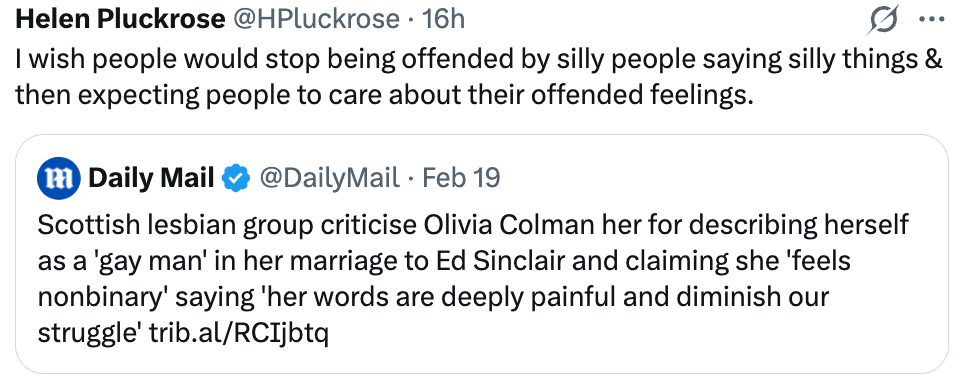
I recently made this post in response to a Daily Mail headline:
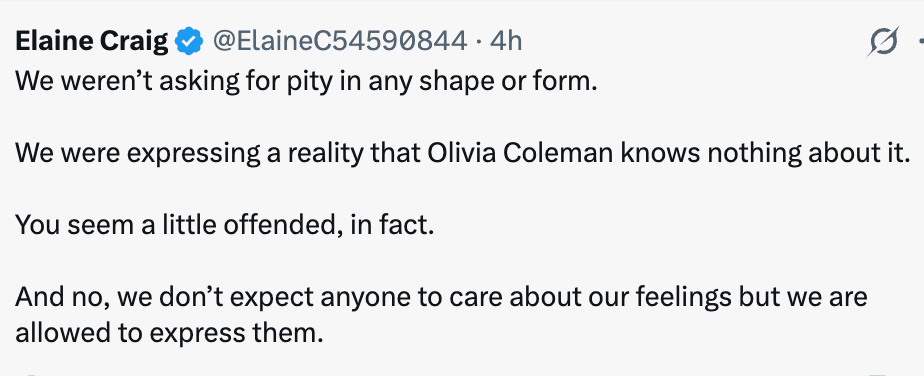
Elaine Craig, who was a member of The Fantastic Lesbians group, responded to me with this:
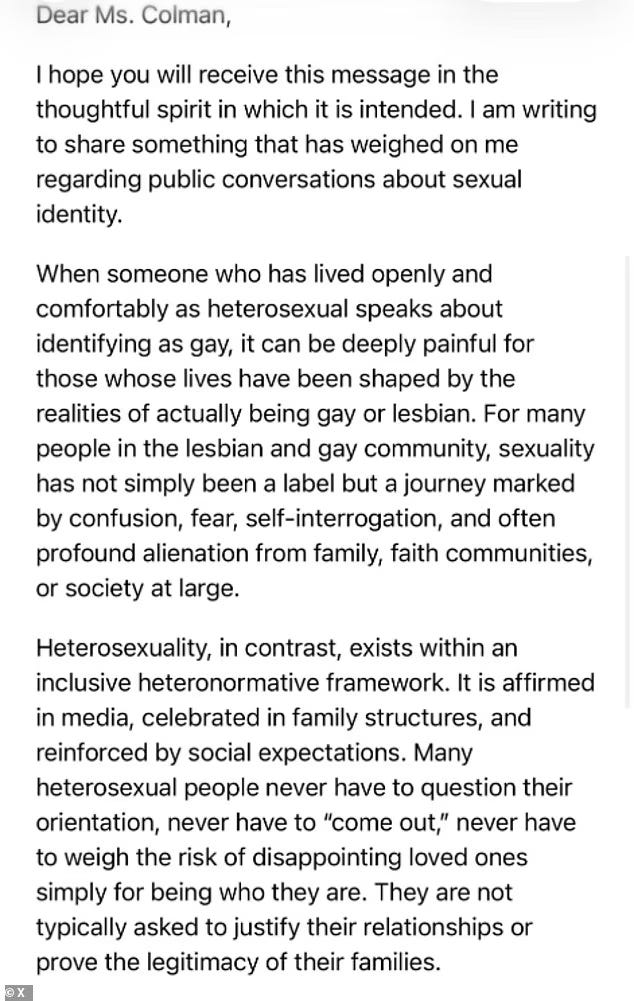
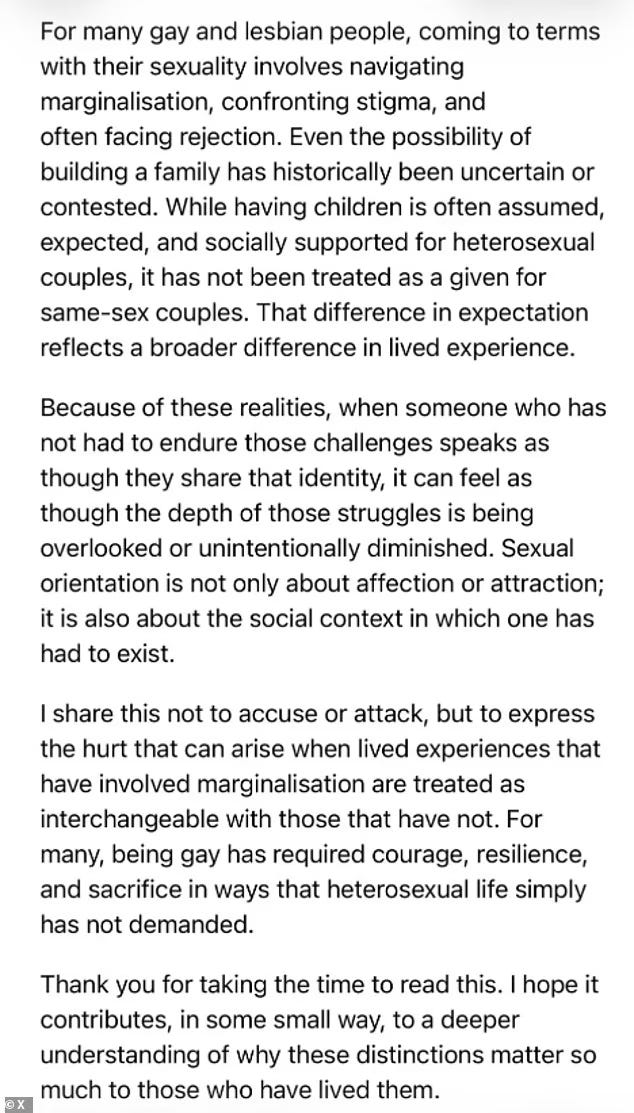
The letter, as reproduced in the Daily Mail read like this.
On reflection, I think my post was too glib and flippant. It failed to explain itself. I don’t think that there is anything wrong with feeling offended per se and I would certainly never argue that people should not be allowed to express anything. I also agree that Colman’s comment was not at all helpful to increasing public acceptance of homosexuality. I’m just not sure the lesbian group’s response was either.
A few days ago, I published a piece asking people to stop taking on bisexual and autistic identities as a form of political identity that may or may not be supported by actually having same-sex relationships or a diagnosis of autism. I argued that this ascribes political values to innate sexual attractions and neurological wiring in a way that is presumptuous and unwarranted and that it enables political activists to foreground themselves as spokespeople for groups whose experiences and needs are likely quite different. I said that I worry about what effect this can have on young bisexual and autistic people having to navigate a world in which their attractions or wiring has been politicised. In short, I agree with much of the Scottish lesbian group’s objection.
My “I wish people wouldn’t” sentiment was in relation to the framing of this. By using the rhetoric of “the hurt that can arise” when “lived experiences that have involved marginalisation” are taken on by someone who does not “share that identity” and operates within the ‘social context’ of sexual attraction that has a ‘heteronormative framework,” I fear that a line which really needs to exist between same-sex attracted people wanting to live lives of dignity and acceptance and Critical Social Justice activists operating in the realm of Queer Theory gets blurred. I think better responses to a heterosexual woman seeing herself as a gay man in her relationship would be, “Well, you’re not.” or “How could you possibly know what that feels like?”
This does not, however, mean that this was the wrong stance for the group to take given that the person they are appealing to is Ms. Colman. Is she most likely to be receptive to arguments for people finding her words deeply painful in the social context of heteronormative assumptions that cite the importance of the lived experience of having a marginalised identity? Yes, quite possibly she is. It is quite likely that she also operates within this feelings-centred, identity-based, standpoint epistemology framework. An argument that she is doing harm that is based on shared premises could therefore reach her more effectively than simply pointing out that she is neither a man nor gay and that this was a silly thing to say.
I said “I wish people would not” take this feelings-based, identity-based stance because I think it is unlikely to be effective with anyone who does not already accept the underlying premises. Those who do share this epistemological framework — identity-based knowledge, lived experience as authoritative, the idea that words and discourses inflict psychological harm, and a worldview organised around privileged and marginalised identities — but who prioritise the interests of people who identify as a gender different from their biological sex are not going to be persuaded by it. They will simply use the same framework to argue that they are the marginalised group, and that trans and non-binary people suffer harm when their lived experience is invalidated by discourses such as the lesbian group’s, which they would frame as operating within a “cisnormative” context.
And because this whole system rests on politically defined categories of privilege and marginalisation, and on subjective accounts of psychological harm, the disagreement quickly collapses into yet another battle over whose identity-based lived experience is authentic, and whose claimed harm should take precedence.
Meanwhile, those who are skeptical or tired of rhetoric involving marginalised identities, lived experience and cis/heteronormativity will tune out. Those who are hostile to the rights and freedoms of same-sex attracted people and the gender non-conforming will use this to claim that it is all bound up in queer theory and ‘woke’ activism or, alternatively, laugh at the LGBT ‘eating each other.’ Those who are actively trying to distinguish the LGB from the T or the apolitical reality of being same-sex attracted or gender non-conforming from political concepts of ‘queerness’ and Critical Social Justice activism and may have a variety of political or philosophical views are likely to resent being placed in this framework and find their goals made harder by it.
The only people who will think this statement makes an unambiguously clear point are those who already accept the epistemological and ethical framework indicated by it and believe it a priority to protect same-sex attracted people from beliefs they find false and hurtful rather than trans-identified or non-binary people.
I am also very concerned about the regressive attitude coming from the illiberal right which is becoming more hostile to gay men, lesbians, bisexual people and those who simply don’t conform to traditional gender presentations. I believe this anti-gay, pro-gender conformity stance is enabled to grow and to seem reasonable and ethical to increasing numbers of people who would not normally be illiberal but inclined to ‘live and let live’ because the existence of same-sex attracted people and the gender nonconforming has been so intensely politicised and forced upon people by the Critical Social Justice movement. The backlash against authoritarianism so often hits, not the authoritarian activists, but the people they claim to speak for, even if they had no part in the activism or opposed its political tenets and epistemological grounding. I think that, to address this most productively, not politicising same-sex attraction in language liable to recognised as sharing many features with that of an authoritarian movement so many feel antagonistic towards would be better.
Consequently, I said that I “wish people would stop” grounding their objections in claims of deep psychological pain caused by silly or unserious statements. This does not mean those feelings are unreal or that people shouldn’t be sympathised with. It means that I think they are poor grounds on which to appeal to others. People can and have felt genuinely hurt or offended by all sorts of things — women entering the workforce, criticism of religion, or simply seeing gay and lesbian people live openly. Feelings of hurt are not authoritative in themselves. The same principle applies to those who treat their own disgust as moral authority. These reactions are subjective, and the power to decide which feelings count as morally binding will always sit with the dominant moral orthodoxy. It is far better to argue that something is materially harmful, factually false, or ethically wrong. This is why I think the most constructive response to Colman saying she feels like a gay man is simply to focus on the truth claim: “Well, you’re not a gay man and and it’s a silly thing to say.”
Of course, the Fantastic Lesbians were not suggesting that anybody should be banned from saying anything, but simply expressing their own feelings on the matter. It is perfectly acceptable to feel offended or hurt by things and say so, provided one does not expect everybody else to take responsibility for those feelings and penalise them for hurting them. The lesbian group did not. I am not sure what Ms. Craig meant by not expecting anybody to care about those feelings given that the open letter did specifically appeal to Ms. Coleman to consider the hurt and pain she was causing. However, the group was not being authoritarian and so I was not raising any ethical objection and absolutely support their right to express their own feelings, in their own way.
I will always support people’s right to express any feelings, views or opinions and other people’s right to then express contrary ones. Ms. Colman is ‘allowed’ to feel that she is a gay man and say so. The Fantastic Lesbians are ‘allowed’ to feel that this is deeply painful to their lived experience as people with a marginalised identity in a heteronormative framework. I am ‘allowed’ to feel this is counterproductive and wish people would stop doing it and instead make arguments about what is true and what is consistently principled. It’s “turtles all the way down” with protection of freedom of belief and speech! What people are allowed to say and what is true, principled and helpful to say are different things.
However, my X post was too glib and dismissive. A better version would have read:
I wish people would do less appealing to identity and feelings in highly politicised language and frame their support of the rights and freedoms of same-sex attracted people and their concerns about certain forms of gender identity activism in more material terms or through principles that apply consistently across contexts.
I just think this works better. It avoids endless subjective disputes, it resists drifting into censoriousness, it defuses backlash and it is more persuasive to a wider range of people of goodwill.
The Overflowings of a Liberal Brain has over 6000 readers! We are creating a space for liberals who care about what is true on the left, right and centre to come together and talk about how to understand and navigate our current cultural moment with effectiveness and principled consistency.
I think it is important that I keep my writing free. It is paying subscribers who allow me to spend my time writing and keep that writing available to everyone. Currently 3.8% of my readers are paying subscribers. My goal for 2026 is to increase that to 7%. This would enable me to write full-time for my own substack! If you can afford to become a paying subscriber and want to help me do that, thank you! Otherwise, please share!
I am a member of Fantastic Lesbians and I wholeheartedly agree with literally everything you've just said. I went to a Sue Perkins gig last night, saw someone who looked like you, and nearly went over to say hello... then I realised she was not you and laughed about it to my girlfriend, saying "I have such weird fangirl moments these days!"
Helen, this is wonderful! I'm literally exploring this exact topic right now, as part of my overall mission to restore our universal moral TABOOS, which I shorthand as 'overt, hateful bigotry'.
As part of this project, I've developed a framework for how to distinguish between different types and degrees of speech that can be considered bigoted, and I even developed a survey to try to demonstrate that a consensus already exists for how we should treat these actual and potential expressions of bigotry, considering how the potential taboo violator responds to the initial response (which better signals intent or indifference to cause harm).
You describe beautifully in words what I tried to narrow down into a succinct and ~universal framing (which of course needs more context like you provide to bring it to life).
See/take the anonymous 3-minute survey (Shades of Hate & Harm) here: https://forms.gle/7UPACqmcVH3oU6fB8
Read "Lawful but Awful": A Guide to Moral Taboos (Part I) here https://elevin11.substack.com/p/lawful-but-awful-a-guide-to-moral
I'll share the framework and survey results with/after Part 3. If you're curious to learn more, provide feedback, or partner, please reach out!