


(Audio version here)
The Overflowings of a Liberal Brain has over 7000 subscribers! We are creating a space for liberals who care about what is true on the left, right and centre to come together and talk about how to understand and navigate our current cultural moment with effectiveness and principled consistency.
I think it is important that I keep my writing free. It is paying subscribers who allow me to spend my time writing and keep that writing available to everyone. Currently 3.8% of my readers are paying subscribers. My goal for 2026 is to increase that to 7%. This would enable me to write full-time for my own substack! If you can afford to become a paying subscriber and want to help me do that, thank you! Otherwise, please share!
Today, I spotted this note written last month by Michael JN Williams, PhD, a writer I frequently see being reasonable and making sense on Substack.
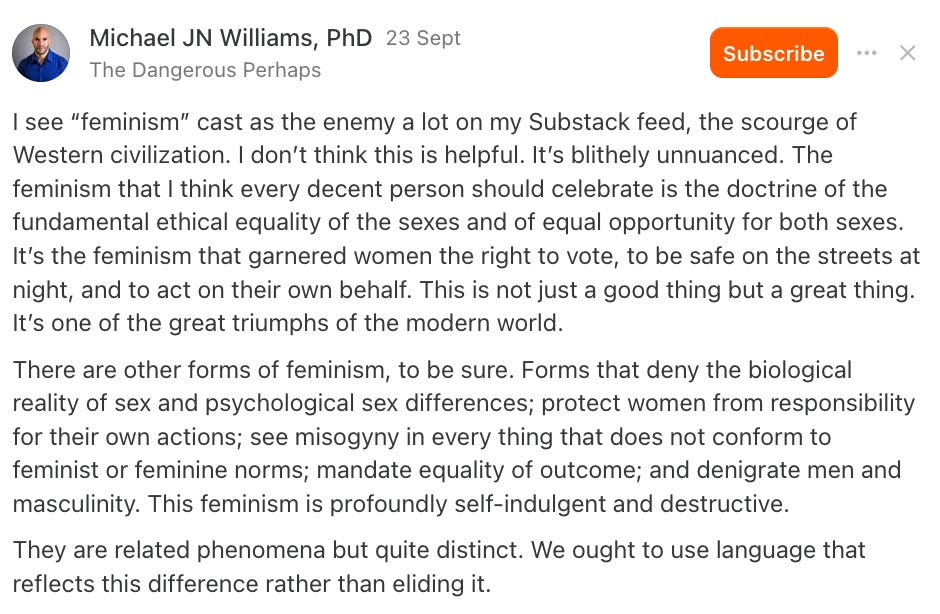
Yes! But, perhaps counterintuitively, the reason this is the conception of feminism that is so positive and worthy of celebration is because, in principle, it’s not fundamentally about women at all. At at the core of it is a principle that applies much more broadly and across contexts and groups. It is one that I would argue makes intuitive sense to the best and most positive aspects of human nature. It is a recognition that women are individuals and people, and as such should have equal social and moral status and the same opportunities and freedoms as men. It is liberalism.
The benefits of political activism that is based on principle rather than identity is that these principles can then be applied consistently in different contexts and across groups. This creates a solid, ethical foundation that people of all identities can support and, furthermore, want to support because they can clearly appreciate the benefits of being the beneficiary of such principles when they are upheld in their defence. Such consistent, principled stances also facilitate a common bond, empathy across groups and trust.
When we uphold the ‘fundamental ethical equality of the sexes and of equal opportunity for both sexes’ we are very explicitly and intentionally not doing identity politics. We are saying that a principle which should apply to all people must not be denied to some people because of their sex. In this case, the sex this has been denied to historically have been women and thus the activism in opposition to it is called ‘feminism’ and focuses on women. Nevertheless, in principle, this stance also protects men and should the need to defend them against such discrimination arise, explicitly advocates that. Men, therefore, can appreciate this principle and the framing of it to apply to both sexes facilitates empathy and a sense of justice. It inspired men to think “Well, I certainly want to be treated as a fundamentally equal member of society with all opportunities open to me, so why wouldn’t women? Denying them that is unjust.”
The principles of individuality and universality extend much more broadly to other contexts like race, sexuality and religion. So too does the tendency for it to trigger our most positive psychological traits of fairness and empathy. The reason the words of Martin Luther King which have survived most strongly are “I have a dream that my four little children will one day live in a nation where they will not be judged by the color of their skin but by the content of their character” is because they speak precisely to this. It inspired white people to think, “I also have dreams for my children. I want them to be evaluated on their merits and have all the freedoms and opportunities society provides. Why wouldn’t black people also want this? Denying them it is unjust.”
The same principle applies to the most successful activism on behalf of same-sex attracted people. When they argued that they should be able to choose their partners freely based on love and attraction and live openly with them without shame or discrimination, heterosexual people, who also feel love and attraction and enjoy being able to pursue it, could empathise with this and see the justice in facilitating it. Equally, when members of minority religions appealed to be able to practice their faith openly and in peace, members of majority religions could conceive of what it must be like not to be able to do that, and support their right to do so.
In short, my argument is that the liberal position on both individual liberty and recognition of our shared humanity appeals very strongly to positive human intuitions that enable us to think abstractly about justice and empathise across groups. It is the growing realisation of liberal principles within society that has produced the remarkable progress we have seen for the rights of women and racial, religious and sexual minorities over the last century. This progress was not achieved primarily by thinking in terms of specific groups and what would be in their interests specifically but by holding up a consistent principle of fairness, equality and (genuine) inclusion and demanding that it be applied to those who were denied them. This distinction matters.
Compare this stance to the slogan frequently used by radical feminists. “Feminism is a movement by women, for women and about women.” Men already inclined towards radical feminist positions can appreciate the context of this and even men not so inclined can concede that it is something that has the right to exist and could possibly have some beneficial effects. Nevertheless, it does tend to send a message to men that this is a movement which is, at best, irrelevant to them and, at worst, hostile to them. Feminists wishing to counteract this last impression then have to do a lot of work contextualising and justifying the stance and this generally requires making claims which are not universally accepted - e.g., patriarchy is pervasive and ongoing.
Think too of the slogan “Black Lives Matter.” The intuitive response to this from people who value individuality and universality (which I would argue is most of us when not triggered into defensive tribal stances) has been “All lives matter.” This actually agrees with the original statement but produces immense frustration in activists who then also have to justify and contextualise the specificity of their statement according to premises which, again, are not universally accepted - e.g., white supremacy is pervasive and ongoing.
Both of these forms of activism are convincing mostly to people who already accept the political premises of them and can have very little persuasive power to those who do not.
The same problems emerge when those wanting to uphold the validity and worth of homosexual relationships do so in ways which seem to dismiss or denigrate heterosexual ones or when defenders of a minority religion do so in ways which disregard or disparage majority ones. They emerge whenever people foreground the interests of a specific group and detach this from the consistent principles of individuality that generate our senses of justice, empathy and investment.
This is when the worst of our human nature is liable to be triggered - the tribal, territorial elements of our ape brains which doubtless served us well for millions of years of violent struggle for resources and survival. Having been presented by identity-based activists with an in-group and an out-group and been informed they are in direct competition and that we cannot possibly empathise across group divides, we are prone to believing this. We are then in danger of ceasing to think about other groups as individuals with whom we share a common humanity and instead register them as a threat. In its most extreme form, this leads to dehumanisation.
We are then likely to see rising factions of women who think all men are violent, callous, destructive monsters and the source of all evil, and men who think women are soulless, irrational incompetents who, if allowed equal rights and autonomy will destroy civilisation and mankind. We see black supremacists declaring that white people are evil and the cause of all the world’s problems and white supremacists claiming that black people are inherently intellectually inferior, violent and destructive. We see claims that ‘cisheteronormativity’ is an evil force causing sexual minorities and particularly the trans-identified to kill themselves thus justifying violent retaliation and responding claims that this was enabled by allowing ‘sexual deviants’ (gay men, lesbians and the gender non-conforming) to declare themselves publicly, get married and choose their own clothing. We see illiberal and extremist factions of minority religions emboldened to impose authoritarian censorship on their critics and engage in violence and a resurge of illiberal and extremist majority religions in an attempt to counteract this.
Naturally, it is the minority groups and the physically weaker sex who are likely to lose these battles if they are allowed to continue to escalate and then we really are in danger of living in a patriarchal, white supremacist, homophobic and religiously intolerant world. The left-wing identitarian activists will then take this as evidence that these were always prevalent features of society as they had claimed and blame the liberals for not having supported their activism. The right-wing identitarian activists will claim that they had to counter an excess of ‘liberalism’ in order to save western civilisation and that this becoming a necessity proves that ‘liberalism’ has failed. Meanwhile, genuine liberalism and principles that value individuality and universality, when upheld consistently and robustly, are our best hope of preventing our societies from backsliding into this kind of tribal and ideological warfare.
So, yes. Those feminists—those liberal feminists along with liberal opponents of racism, anti-gay sentiment, religious intolerance and more—are the ones that all decent people should celebrate as producing the progress that can justifiably be considered “a triumph of the modern world.”
But more importantly, and as Michael indicates, the consistent principles of the philosophy that underlay their goals need to be recognised as the source of that triumph. These are the principles of individual liberty and universal human rights. They insist that no individual should be relegated to a subclass and denied freedoms and opportunities because of their identity. Alongside these principles is a genuine, felt appreciation of our shared humanity and our ability to empathise and demand fairness for people who are not us. All of these are essential if we want to hold onto that progress and continue living in a modern, liberal world.
Spot on. The principle of equal protection before the law applies to everyone, and avoids singling out any identity group for elevated treatment.
In system theory there is a principle of progress where the course corrections early on eventually help achieve the purpose of the system, but then there is the inevitable corruption that occurs from human nature to constantly want more.
The design of Western democracy and the freedom to agitate for cause was always supposed to work this way:
People take time from their normal productive endeavors, including the crushing demands for managing a family and providing safety, security and sustenance, to agitate for a cause. Then after the war or the vote, people go back to their normal productive endeavors.
In this way, the "movement" if you will is always a temporary project that seeks to achieve some outcome and then ends.
Feminism has become an industry, and it has been corrupted as per the Shirky Principle. It in fact achieved all and more based on its initial outcome targets. It then should have gone away. But the feminists had attached themselves to the movement as a perpetual power, status and money-making enterprise. And feminized men attached themselves to the feminists for the same.
The movement went over the apogee of positive returns and has been on the downward slope for the last several decades. The 3rd and 4th wave feminists agenda is no longer about female choice and female equality. It is about pushing ideas that are the death of Western democratic capitalist liberal society to be replaced with a collectivist design that these feminists think will acquire them more power, status and money.
Feminism is frankly the current primary enemy of Western civilization. It is the new fascist movement and WWIII is upon us. Feminist females have become the conduit of destruction... the Pandora's Box fable come to life.