


(Audio version here)
The joining of Substack by self-proclaimed misogynist, Andrew Tate, has caused something of a furore on the platform. My own readers, who tend to be staunch defenders of free speech, are divided on the ethics of this. The majority take the view that, while Tate is a deeply unpleasant character with abhorrent views, Substack must stand by its commitment to free speech and only ban people from the platform if they incite violence on it. They advocate blocking, criticising or mocking him.
There have been a few people who appear to believe that Tate does actually have worthwhile things to say.
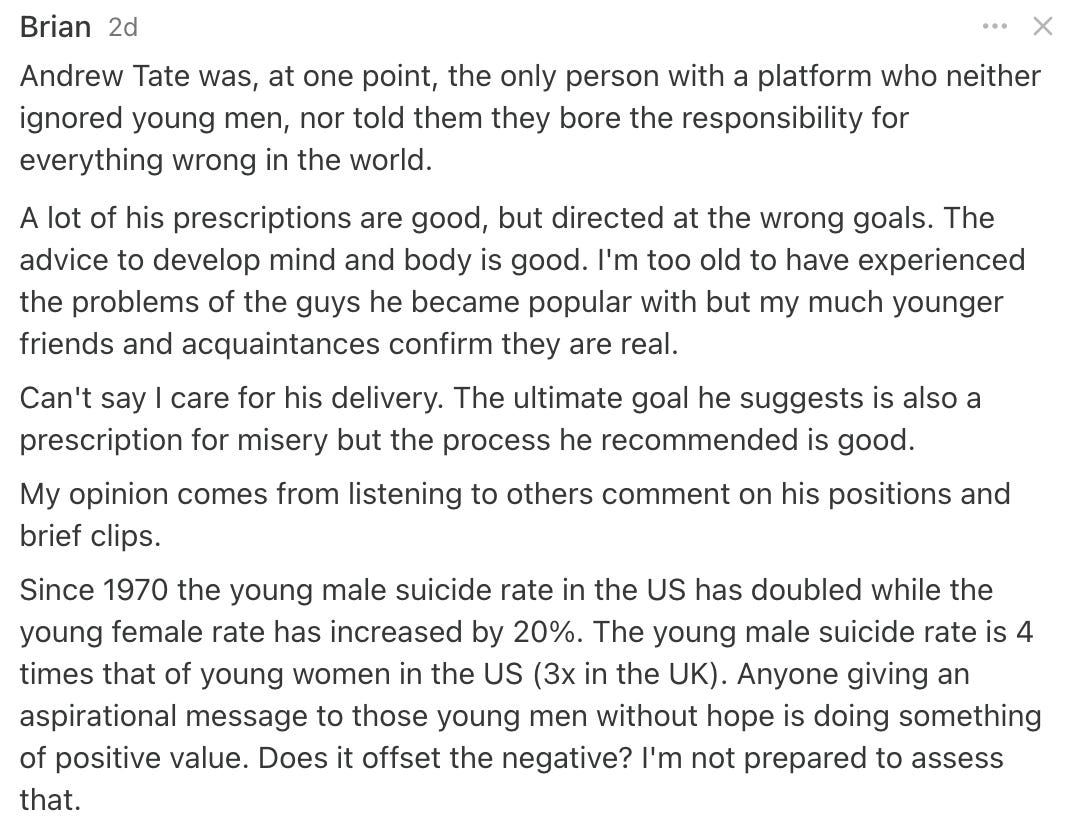
However, I would suggest that we can acknowledge the problem with discourses that demonise men and pathologise masculinity without endorsing Andrew Tate whose relation to such rhetoric appears to mostly be to confirm and support it. There are, in fact, many influencers who promote fitness, discipline, and psychological resilience in ways that offer a positive and aspirational model of masculinity without the misogyny or criminality. There are certainly grounds to advocate for these kinds of models having a more mainstream presence for boys and young men than they currently do and for rhetoric which problematises masculinity to be challenged in the mainstream. Nevertheless, as Brian himself concedes, Tate’s ultimate vision is not a solution but a path to misery even if some of the steps along the way appear superficially constructive.
Others have resorted to ‘whataboutism’ to offer some defence to Tate via deflection. These are people who, while unwilling to defend Tate himself, are keen to argue that the values associated with the left pose a greater threat to women than anything he represents.
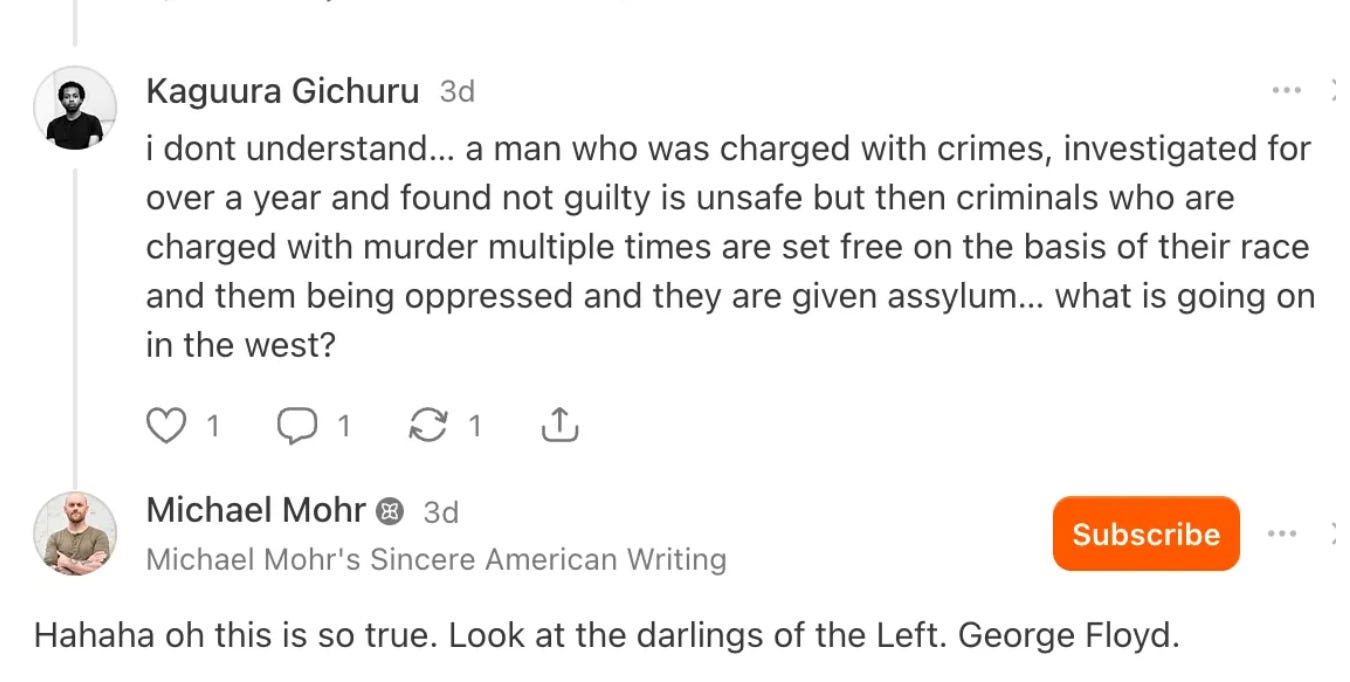
This does not contribute anything worthwhile to discussions of whether Andrew Tate should be banned from Substack. It does, however, indicate the kind of challenges Substack would face if it did, particularly the ease with which any attempt at content moderation can become entangled in broader ideological disputes about fairness, political bias, and double standards.
Much of the loudest opposition to Tate on Substack has involved invoking the concept of a ‘safe space.’ This is a move unlikely to garner much sympathy from defenders of free speech because it is closely associated with the identitarian left and has commonly been used to exclude dissenters from their own ideas including mainstream conservatives and gender critical feminists.
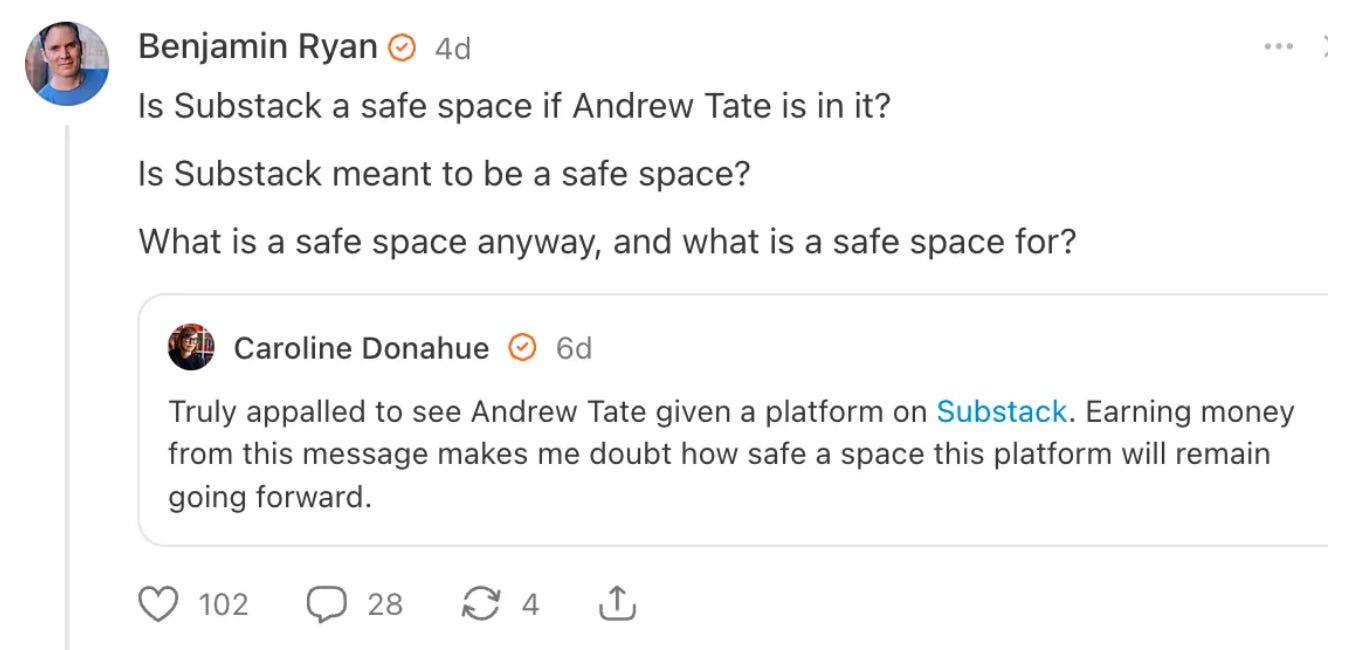
Some of the people in my network, however, without embracing ‘safe space’ rhetoric, are inclined to think that tolerating the presence of Andrew Tate on Substack really goes beyond what can expected of a commitment to free speech. His views on women, they argue, are straightforwardly hateful and have no merit at all. He is not known for making arguments that could be addressed but provocative statements intended to shock so there is little hope of a productive exchange of ideas with him. They also point to the seriousness of the allegations surrounding him: charges of sex trafficking, accusations of rape, violence, and exploitation, and a public record of statements that appear to endorse or trivialise violence against women, including suggesting that women bear some responsibility for sexual assault. While he may not be known to have directly incited specific acts of violence, they argue that his broader persona and messaging function as a form of implicit incitement.
What has received far less attention is what banning Andrew Tate from Substack would entail in practice and what it would actually achieve.
Substack’s current policy is to remove users only for direct incitement to violence. In practice, this amounts to a largely “hands-off” approach, leaving users to curate their own feed through subscriptions and blocking. If Substack were to change its policy in order to ban Tate for his aggressively misogynistic views, it would face a choice between two broad approaches. It could adopt a principle that bans sex-based hatred consistently across the board, or it could attempt to apply such a rule selectively and target misogyny in particular.
Substack could, for example, introduce a policy prohibiting the expression of hatred or contempt toward any demographic group including aggressive rhetoric, claims of inferiority, or arguments that such groups should be excluded from positions of influence. A consistent rule like this would not only remove figures like Tate, but also a significant amount of rhetoric that is currently tolerated and even popular on the platform. It would, for example, make misogyny a bannable offence but also misandry, and would likely result in the removal of many well-subscribed feminist accounts.
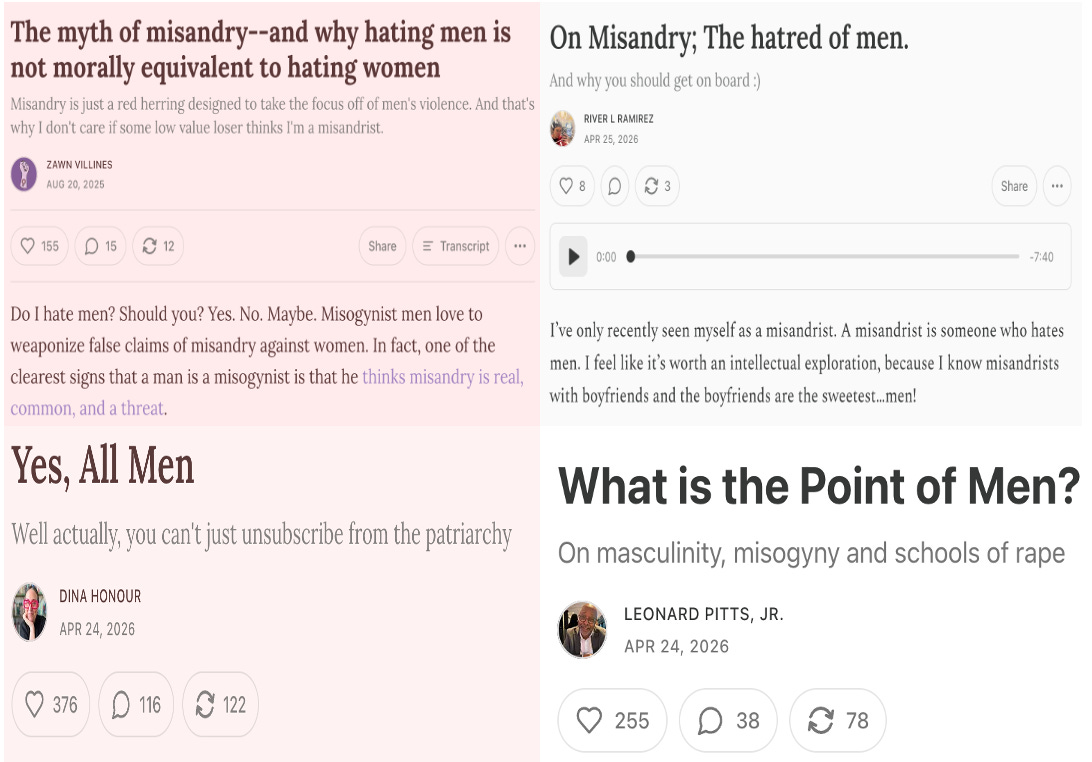
Misandry is an issue feminists have addressed at length and their defence of it parallels that made by Critical Social Justice ‘anti-racist’ activists. It holds that power is concentrated in the hands of men or white people and for any prejudice to be real and meaningful on a systemic level, it has to be supported by systems of power. Therefore, only white people can be racist and misandry is either not real or not an ethical problem. Expressing hatred and contempt for the oppressor class is a valid and justifiable form of political expression within this political worldview.
Some feminists would object here and point out that it is not simply about systems of cultural power but real, material violence. Men have a greater capacity for it, a greater likelihood of engaging in it and when they do, women are particularly vulnerable to it. Misogyny is therefore much more likely to result in real physical damage to female humans than misandry is to do any physical harm to male ones. This is true. However, Substack is a platform for expressing ideas, not blows, and when it comes to verbal acuity, women have a statistical advantage. We can hold our own.
The strongest objection to this is that ideas do not exist in a vacuum. They influence behaviours in the real, material world. Certainly. If we accept that censoring hostile and radical ideas is an effective way to make them go away - I do not - and that substack has a social responsibility to play its part in this, it would need to call upon empirical research into which ideas are radicalising people into hateful, contemptuous stances on great swathes of the population. It is not at all clear that this is all coming from far-right sources, nor that young men are taking on more radically hostile views than young women or that the rise of a misogynistic manosphere can be understood to be inspired entirely by right-wing influences and not at all by the rise and social prestige of misandrist strains of feminism.
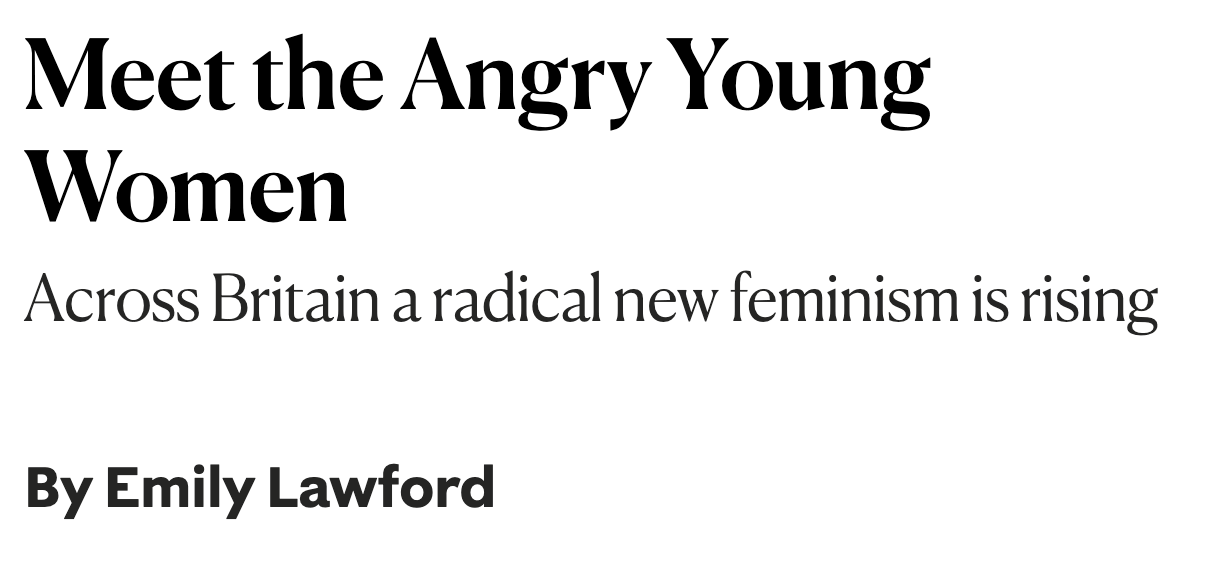
In short, if Substack were to enact a general policy against hate speech applied consistently across groups, it would not simply remove figures like Andrew Tate, who add little of value to political discourse, but also a great deal of substantive and provocative political expression. It would amount to a form of “tone policing” that excludes many common and widely accepted forms of political argument on both the left and the right—but particularly, I would argue, on the left, where the ethos of “speaking truth to power” often involves ‘taking the gloves off ‘ and engaging in sharp, generalised, and deliberately provocative claims.
Some would welcome this. I share the concern that the temperature of public discourse is often far too high, and that a return to more measured, thoughtful, and civil exchange would be desirable. In practice, however, such a policy would likely rebrand Substack as a platform for polite but largely ineffective centrism and diminish its appeal both to progressives and to those who value free speech, viewpoint diversity, and the exchange of robust, unfiltered arguments.
If, instead, Substack were to prohibit hateful speech only when directed at minority groups and women, it would be taking a clear political position on how power and language operate in society. It would be implicitly endorsing the view that we live in a society structured by white supremacist and patriarchal power, and that it has a responsibility to intervene in discourse accordingly. Any claim to be non-partisan or committed to free expression would quickly become untenable, as critics asked why some ideologies were excluded while others were not—why Nazis but not communists, misogynists but not misandrists. It would, as many users have suggested, come to resemble a long-form version of BlueSky which is hardly a model for an open pluralistic platform.
Once a platform begins moderating speech on the basis of content rather than direct incitement to violence, it enters an inherently subjective moral terrain. It must then justify which ideas are “acceptably” horrible and which are unacceptably so. This requires increasingly complex rules of moderation, heightening the risk of political and cultural bias. It also becomes difficult to prevent the boundaries of allowable speech from steadily contracting.
If Substack justified banning ideas on the basis that they are simply too objectionable, it would then have to contend with the implication that it implicitly endorses those that remain. It would voluntarily abandon the principled defence of free speech as a system in which ideas compete and bad ones can be challenged and defeated as the basis for which it declines to moderate content. This gives activists, fuelled by moral outrage, ammunition to make endless demands using the precedent of already banned ideas, and defences against that will necessarily be subjective and give the appearance of ad hoc rationalisations.
A far stronger and more ethically consistent position is to prohibit only direct incitement to violence, and to trust users to decide for themselves whether they wish to block those expressing objectionable ideas or to engage with them. This also, I would argue, respects the judgement and agency of users of the platform, many of whom (like me) have accounts dedicated to addressing bad and illiberal ideas and would resent the paternalistic attitude inherent in being kept ‘safe’ from them.
This would be a bad move for Substack, and therefore a bad move for its users. For us.
On a broader societal level, those of us who claim to hold liberal principles and to believe in the marketplace of ideas should resist attempts to turn Substack into a “safe space” whether in general or from any particular political standpoint. The platform’s founders have expressed a commitment to freedom of speech. We should both support them in that commitment and hold them to it.
The belief that bad ideas can be made to disappear by censoring them seems to make intuitive sense to our species, but history shows it to be profoundly mistaken. We are a deeply disagreeable species and will always be generating conflicting ideas, buying into them and trying to sell each other on them. As I have argued before, “The Marketplace of Ideas will always exist. The only choice we have is how to work with it.” Ideas do not disappear when they are excluded from mainstream spaces. Instead alternative marketplaces of ideas form to accommodate them but they risk then being characterised by limited ‘anti-establishment’ stances and consequently lack sufficient productive conflict with counterviews. Some of these then form “black markets” of ideas where the most extreme views become more concentrated and twisted, feeding and building upon themselves due to absence of challenge and internal competition to stand out by becoming more radical than everybody else.
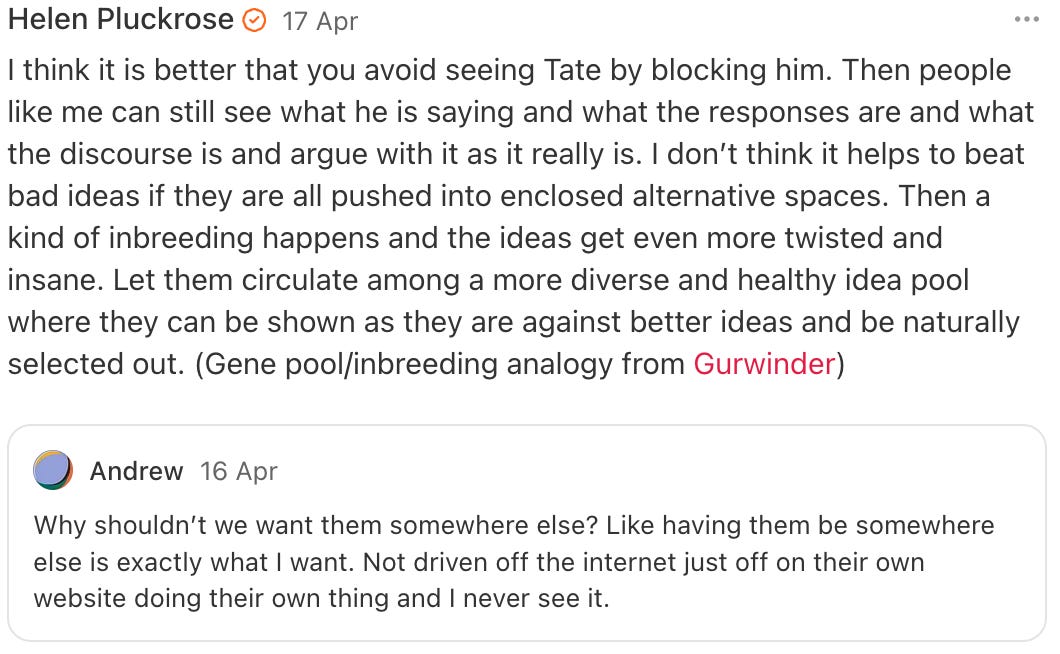
The manosphere is a clear example of this dynamic. Its appeal to adolescent boys is not unrelated to the fact that many of its ideas have been pushed out of more mainstream discourse, acquiring a kind of transgressive allure in the process. Those of us who wish to draw boys away from it would be wise not to assist it in presenting itself as a space for outcasts and rebels against the norm. Instead, we’d do best by showing it to be rather ridiculous and pathetic in comparison to other platforms that celebrate healthy, unashamed masculinity of the kind that is genuinely affirming to ambitious and energetic young men and is also attractive to psychologically healthy young women!
Substack is an excellent place to do some of this. It is not the marketplace of ideas but it is a marketplace of ideas and its expansion is pushing it well and truly into the mainstream. It is in all our interests to keep it that way. That requires maintaining it as a space which is genuinely open to all ideas being able to test themselves here. Unlike more reactive forms of social media, where engagement is brief and often aimed more at sloganeering and signalling one’s allegiance to tribe, Substack is populated by people who like to read widely, think carefully and engage substantively. This can take the form of rigorous analysis of ideas, grounded cultural commentary, or clever and vicious satire that punctures the pretensions of illiberal ideologies. All of these are effective ways of addressing rhetoric of the kind associated with Andrew Tate. The last thing we should do is get in the way of that happening. He’s on our turf now. We can choose to block and ignore him and his ilk or we can meet them there.
The Overflowings of a Liberal Brain has over 6000 readers! We are creating a space for liberals who care about what is true on the left, right and centre to come together and talk about how to understand and navigate our current cultural moment with effectiveness and principled consistency.
I think it is important that I keep my writing free. It is paying subscribers who allow me to spend my time writing and keep that writing available to everyone. Currently 3.8% of my readers are paying subscribers. My goal for 2026 is to increase that to 7%. This would enable me to write full-time for my own substack! If you can afford to become a paying subscriber and want to help me do that, thank you! Otherwise, please share!
Thanks! I appreciate your clear thinking and writing very much, Helen!
I posit the best way to handle Tate is to relentlessly dunk on him. It's not a high bar to clear.